Virginia SOL 3.2.b
The Standard
- 3.2
- The student will investigate and understand that the direction and size of force affects the motion of an object. Key ideas include
the net force on an object determines how an object moves
Virginia Standards of Learning for Science
Teacher's field guide
What This Standard Means
What Students Need to Do
- Students compare pushes and pulls acting on one object. They predict whether the object will start moving, stop, speed up, slow down, or change direction.
What Mastery Looks Like
- Students identify which direction has the stronger combined force. They explain that equal opposite forces do not change an object's motion, while unequal forces do.
Common Misconceptions
- Students may think any force always causes motion or that equal opposite pushes make a moving object stop. They may also add opposite forces instead of comparing them.
How to Assess It
- Ask: “A toy car rolls right. A weak push acts left and a stronger push acts right. How will its motion change? Explain.”
Lesson moves
Ways to Teach It
In pairs, push a toy car from opposite sides, first equally and then unequally, and record how its motion changes.
Write: “A wagon has equal pulls in opposite directions. Will its motion change? Explain using force arrows.”
Give teams arrow cards showing forces, then have them sort each set into no change, speed up, slow down, or turn.
Observe a shopping cart being pushed and discuss how harder, softer, and sideways pushes change its motion.
Free download
Printable 3.2.b Worksheet
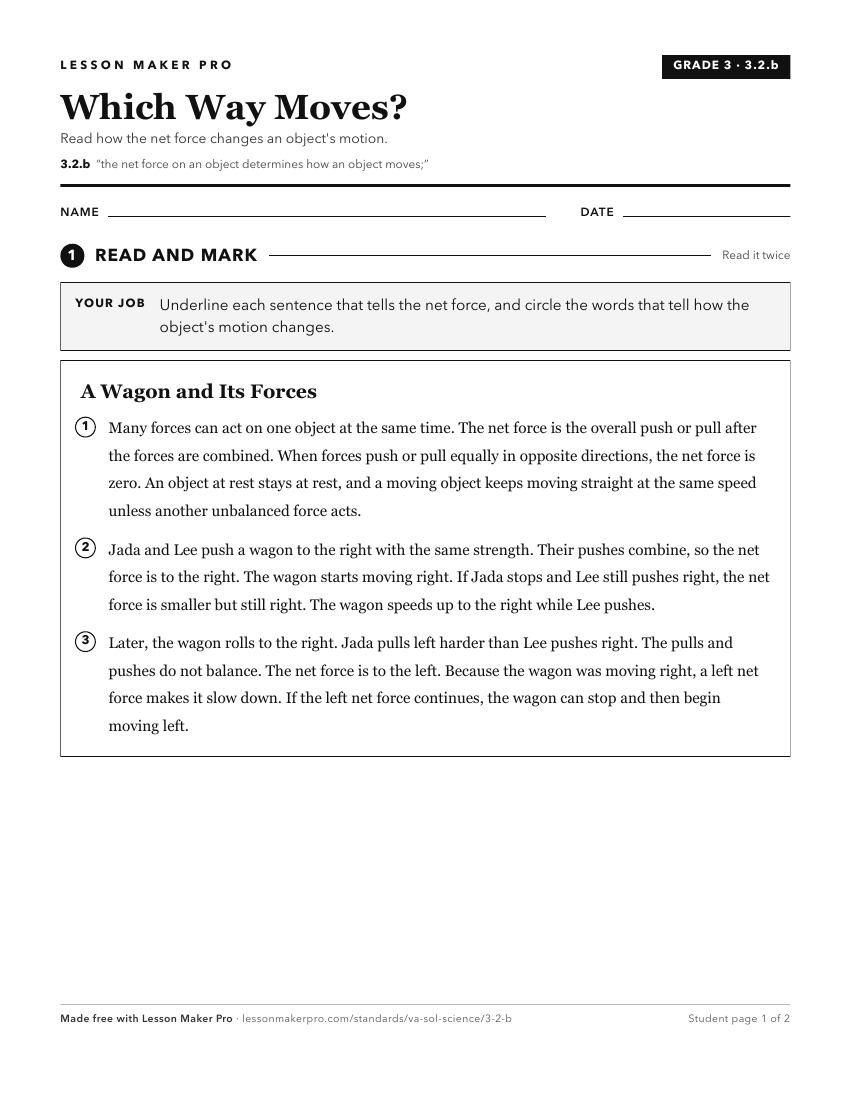
A ready-to-print activity worksheet aligned to 3.2.b, with an answer key for the teacher on its own page. No account needed.
PDF, US Letter, prints cleanly in black and white.
Download the worksheetKeep exploring
Related Standards
Turn this exact standard into a lesson
Grade, subject, topic, and the complete standard are prefilled. Create one free, no account needed.
Also for this standard:Make a WorksheetMake a QuizMake a Sub Lesson