Virginia SOL 1.5.a
The Standard
- 1.5
- The student will investigate and understand that animals, including humans, have basic life needs that allow them to survive. Key ideas include
animals need air, food, water, shelter, and space (habitat)
Virginia Standards of Learning for Science
Teacher's field guide
What This Standard Means
What Students Need to Do
- Students identify the resources an animal gets from its surroundings. They explain how a suitable habitat helps an animal breathe, eat, drink, stay protected, and move.
What Mastery Looks Like
- Given an animal and a habitat picture, students can point out how each need is met. They can explain what would happen if one resource were missing.
Common Misconceptions
- Students may think a habitat is only a nest, den, or other hiding place. They may overlook air or room to move. They may also assume every animal needs the same food and shelter.
How to Assess It
- Exit ticket: Draw a rabbit habitat and label five features that let the rabbit breathe, eat, drink, hide, and move. Circle the feature you think is hardest to find.
Lesson moves
Ways to Teach It
Give pairs a toy animal, a tray, paper, blocks, and cups to build and label a habitat that meets all its needs.
Show a zoo enclosure photo and ask, “How does this place help the animal live, and what might still be missing?”
Play a card match game where students pair animal cards with pictures of food, water sources, shelter, air, and open space.
Walk around the schoolyard and record where birds or insects find water, food, protection, air, and room to move.
Free download
Printable 1.5.a Worksheet
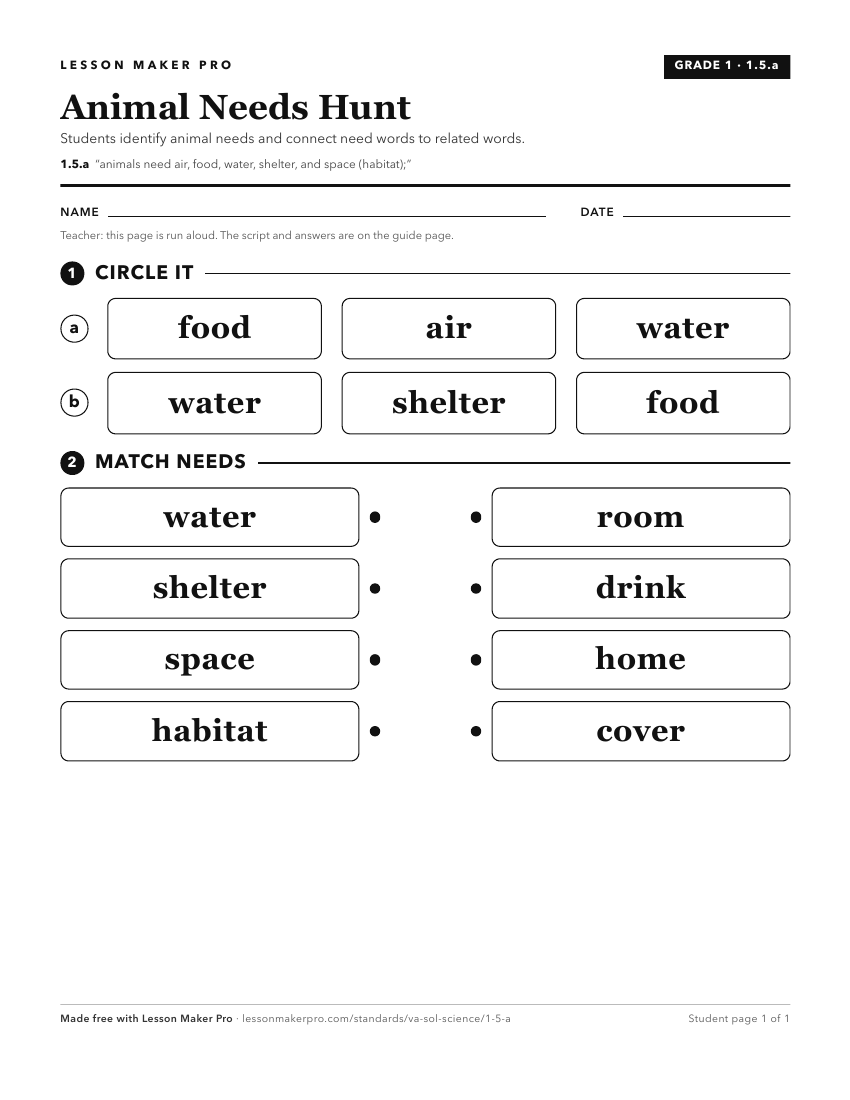
A ready-to-print activity worksheet aligned to 1.5.a, with an answer key for the teacher on its own page. No account needed.
PDF, US Letter, prints cleanly in black and white.
Download the worksheetKeep exploring
Related Standards
- 2.8.b
plants provide oxygen, homes, and food for many animals
- 2.5.b
an animal's habitat provides all of its basic needs
- K.7.a
living things need adequate food, water, shelter, air, and space to survive
- 1.5
The student will investigate and understand that animals, including humans, have basic life needs that allow them to survive. Key ideas include
Turn this exact standard into a lesson
Grade, subject, topic, and the complete standard are prefilled. Create one free, no account needed.
Also for this standard:Make a WorksheetMake a QuizMake a Sub Lesson