Virginia SOL 6.MG.1.c
The Standard
Develop an approximation for pi (3.14) by gathering data and comparing the circumference to the diameter of various circles, using concrete manipulatives or technological models.
Virginia Standards of Learning for Mathematics · The student will identify the characteristics of circles and solve problems, including those in context, involving circumference and area.
Teacher's field guide
What This Standard Means
What Students Need to Do
- Students measure the circumference and diameter of several circular objects. They divide each circumference by its diameter and use the repeated results to approximate pi as 3.14.
What Mastery Looks Like
- Students measure circumference and diameter accurately, then calculate the ratio for several circles. They recognize that the ratios cluster near 3.14 and explain why small measurement errors cause variation.
Common Misconceptions
- Students may divide diameter by circumference instead of circumference by diameter. They may confuse radius with diameter or expect every measured ratio to equal exactly 3.14.
How to Assess It
- Give students measurements for three circles and ask them to calculate circumference divided by diameter. Have them state what the results suggest about pi.
Lesson moves
Ways to Teach It
Wrap string around cans, lids, and cups, measure each string and diameter, then calculate circumference divided by diameter.
Ask students to write why different-sized circles produce nearly the same circumference-to-diameter ratio.
Play a matching game where students pair circumference and diameter cards whose ratios are close to 3.14.
Measure bicycle wheels, pizza pans, or circular tables, then use the data to estimate pi and compare results.
Free download
Printable 6.MG.1.c Worksheet
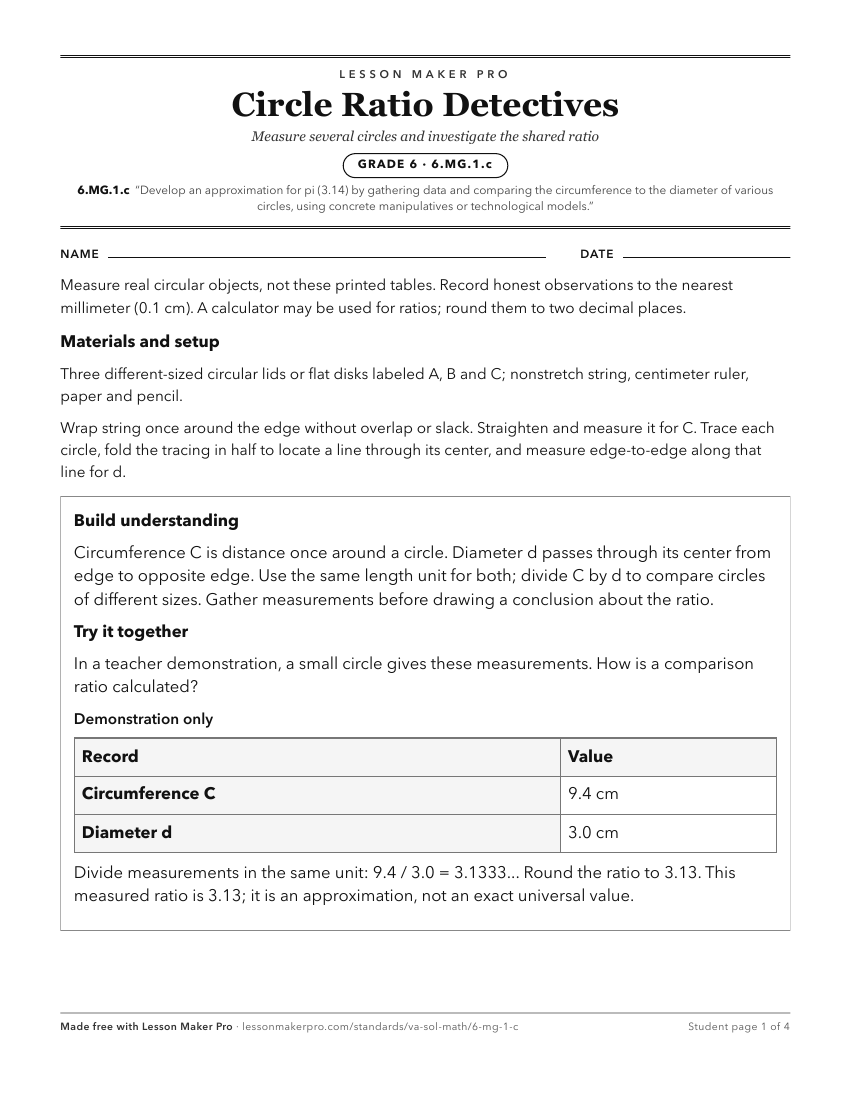
A ready-to-print activity worksheet aligned to 6.MG.1.c, with an answer key for the teacher on its own page. No account needed.
PDF, US Letter, prints cleanly in black and white.
Download the worksheetKeep exploring
Related Standards
- 6.MG.1.e
Solve problems, including those in context, involving circumference and area of a circle when given the length of the diameter or radius.
- 6.MG.1.d
Develop the formula for circumference using the relationship between diameter, radius, and pi.
- 6.MG.1
The student will identify the characteristics of circles and solve problems, including those in context, involving circumference and area.
- 6.MG.1.b.iii
Investigate and describe the relationship between diameter and circumference
Turn this exact standard into a lesson
Grade, subject, topic, and the complete standard are prefilled. Create one free, no account needed.
Also for this standard:Make a WorksheetMake a QuizMake a Sub Lesson