Virginia SOL 6.MG.1.b.iii
The Standard
Investigate and describe the relationship between diameter and circumference
Virginia Standards of Learning for Mathematics · The student will identify the characteristics of circles and solve problems, including those in context, involving circumference and area.
Teacher's field guide
What This Standard Means
What Students Need to Do
- Students measure diameters and circumferences, then compare the measurements. They recognize that circumference divided by diameter is always about 3.14 and use that relationship to solve problems.
What Mastery Looks Like
- Students explain that circumference is about 3.14 times the diameter. They use C = πd to find either measure and label the answer with correct units.
Common Misconceptions
- Students may confuse radius with diameter or use the radius in place of the diameter. Some think circumference increases by adding a fixed amount, rather than multiplying in direct proportion. Measurement error may also hide the ratio of about 3.14.
How to Assess It
- Give students a circle with a diameter of 8 cm. Ask them to estimate the circumference, calculate it, and explain why the answer is reasonable.
Lesson moves
Ways to Teach It
Wrap string around three circular objects, measure each diameter, then divide each circumference by its diameter and compare the results.
Ask students to explain why doubling a circle’s diameter also doubles its circumference, using numbers or a labeled sketch.
Play a matching game with cards showing diameters, circumference expressions, and approximate circumference values.
Calculate how far a bicycle travels in one wheel rotation using the wheel’s diameter.
Free download
Printable 6.MG.1.b.iii Worksheet
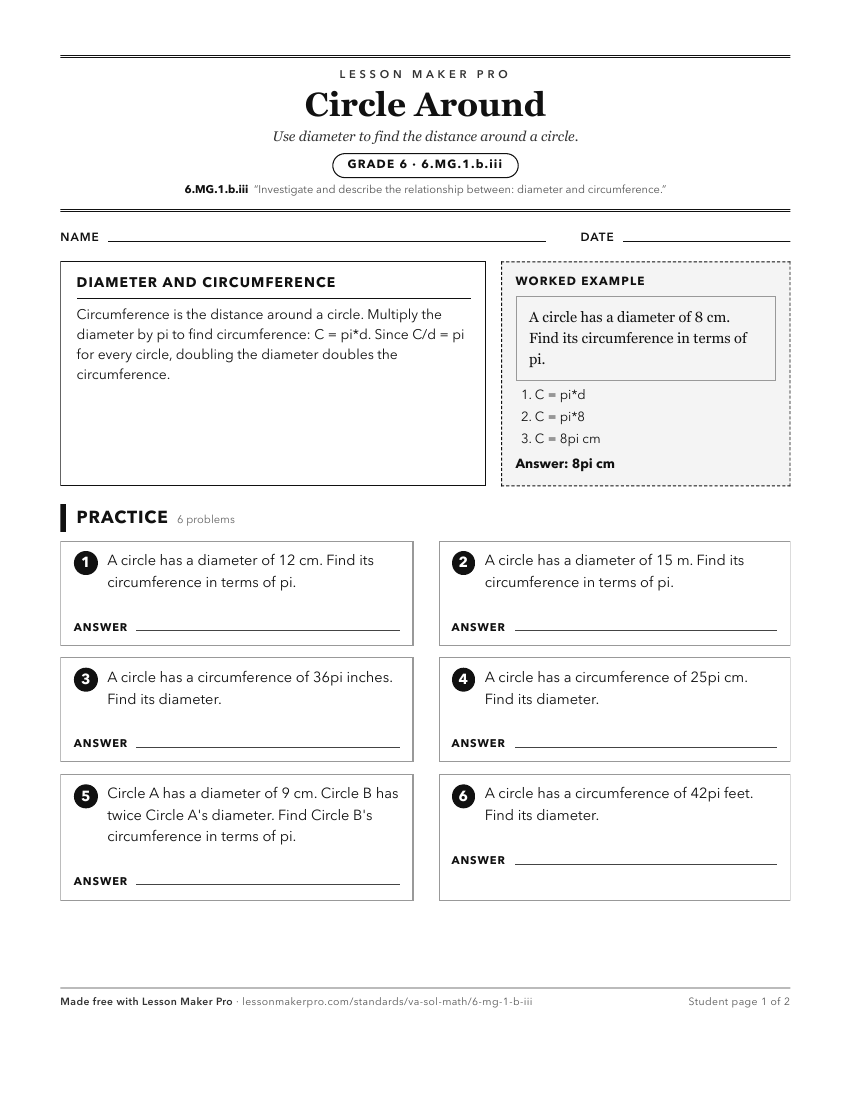
A ready-to-print activity worksheet aligned to 6.MG.1.b.iii, with an answer key for the teacher on its own page. No account needed.
PDF, US Letter, prints cleanly in black and white.
Download the worksheetKeep exploring
Related Standards
- 6.MG.1.e
Solve problems, including those in context, involving circumference and area of a circle when given the length of the diameter or radius.
- 6.MG.1.d
Develop the formula for circumference using the relationship between diameter, radius, and pi.
- 6.MG.1.b.i
Investigate and describe the relationship between diameter and radius
- 6.MG.1.b.ii
Investigate and describe the relationship between radius and circumference
Turn this exact standard into a lesson
Grade, subject, topic, and the complete standard are prefilled. Create one free, no account needed.
Also for this standard:Make a WorksheetMake a QuizMake a Sub Lesson