Virginia SOL 6.MG.1
SOL Standard (Knowledge and Skills Cluster)
The student will identify the characteristics of circles and solve problems, including those in context, involving circumference and area.
Virginia Standards of Learning for Mathematics
Cluster contents
Knowledge and Skills in This Standard
6.MG.1 is a Standards of Learning standard. These are the knowledge and skills expectations under it.
- 6.MG.1.a
Identify and describe chord, diameter, radius, circumference, and area of a circle.
- 6.MG.1.b.i
Investigate and describe the relationship between diameter and radius
- 6.MG.1.b.ii
Investigate and describe the relationship between radius and circumference
- 6.MG.1.b.iii
Investigate and describe the relationship between diameter and circumference
- 6.MG.1.c
Develop an approximation for pi (3.14) by gathering data and comparing the circumference to the diameter of various circles, using concrete manipulatives or tec...
- 6.MG.1.d
Develop the formula for circumference using the relationship between diameter, radius, and pi.
- 6.MG.1.e
Solve problems, including those in context, involving circumference and area of a circle when given the length of the diameter or radius.
Teacher's field guide
What This Cluster Means
What Students Need to Do
- Students identify and describe radii, diameters, chords, circumference, and area. They compare circle measurements to estimate pi, build circumference formulas, and solve circumference and area problems.
What Mastery Looks Like
- Students correctly label each circle part and explain that the diameter is twice the radius. They choose the correct formula, substitute accurately, and include suitable units or square units.
Common Misconceptions
- Students often mix up radius, diameter, and chord. They may use the area formula for circumference, forget to square the radius for area, or think pi equals the radius.
How to Assess It
- Give students a circle with radius 6 cm. Ask them to label a radius, diameter, and chord, then find circumference and area using 3.14.
Lesson moves
Ways to Teach It
Measure round lids with string and rulers, record circumference and diameter, then divide to estimate pi.
Write an explanation for why doubling a circle's radius also doubles its circumference but does not double its area.
Play a card-matching game with circle diagrams, radius or diameter values, formulas, circumferences, and areas.
Calculate the edging and planting space needed for a circular garden with a given radius.
Free download
Printable 6.MG.1 Worksheet
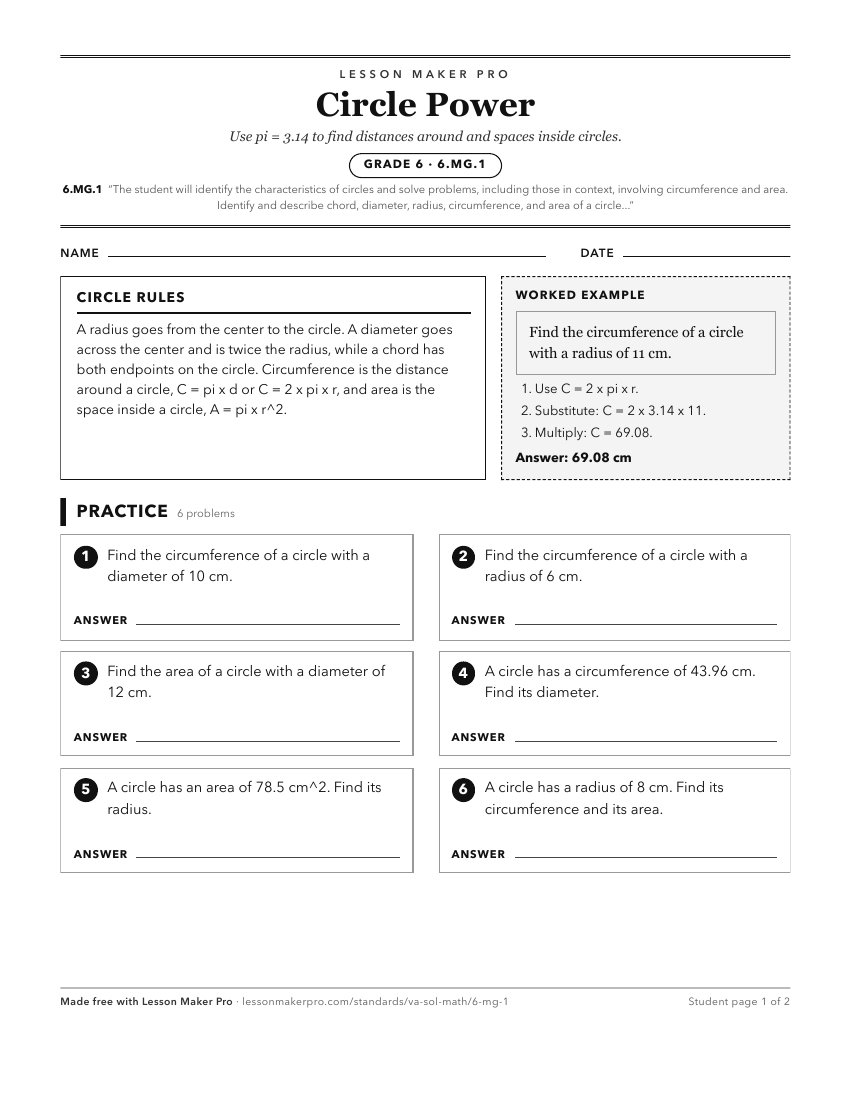
A ready-to-print activity worksheet aligned to 6.MG.1, with an answer key for the teacher on its own page. No account needed.
PDF, US Letter, prints cleanly in black and white.
Download the worksheetKeep exploring
Related Standards
- 5.MG.2
The student will use multiple representations to solve problems, including those in context, involving perimeter, area, and volume.
- 6.MG.2
The student will reason mathematically to solve problems, including those in context, that involve the area and perimeter of triangles and parallelograms.
- K.MG.2
The student will identify, describe, name, compare, and construct plane figures (circles, triangles, squares, and rectangles).
Turn this cluster into a lesson
Grade, subject, topic, and the complete cluster are prefilled. Create one free, no account needed.
Also for this cluster:Make a WorksheetMake a QuizMake a Sub Lesson