Virginia SOL 5.MG.2
SOL Standard (Knowledge and Skills Cluster)
The student will use multiple representations to solve problems, including those in context, involving perimeter, area, and volume. Investigate and develop a formula for determining the area of a right triangle. Estimate and determine the area of a right triangle, with diagrams, when the base and the height are given in whole number units, in metric or U.S. Customary units, and record the solution with the appropriate unit of measure (e.g., 16 square inches). Describe volume as a measure of capacity and give examples of volume as a measurement in contextual situations. Investigate and develop a formula for determining the volume of rectangular prisms using concrete objects. Solve problems, including those in context, to estimate and determine the volume of a rectangular prism using concrete objects, diagrams, and formulas when the length, width, and height are given in whole number units. Record the solution with the appropriate unit of measure (e.g., 12 cubic inches). Identify whether the application of the concept of perimeter, area, or volume is appropriate for a given situation. Solve contextual problems that involve perimeter, area, and volume in standard units of measure.
Virginia Standards of Learning for Mathematics
Cluster contents
Knowledge and Skills in This Standard
5.MG.2 is a Standards of Learning standard. These are the knowledge and skills expectations under it.
- 5.MG.2.a
Investigate and develop a formula for determining the area of a right triangle.
- 5.MG.2.b
Estimate and determine the area of a right triangle, with diagrams, when the base and the height are given in whole number units, in metric or U.S. Customary un...
- 5.MG.2.c
Describe volume as a measure of capacity and give examples of volume as a measurement in contextual situations.
- 5.MG.2.d
Investigate and develop a formula for determining the volume of rectangular prisms using concrete objects.
- 5.MG.2.e
Solve problems, including those in context, to estimate and determine the volume of a rectangular prism using concrete objects, diagrams, and formulas when the ...
- 5.MG.2.f
Identify whether the application of the concept of perimeter, area, or volume is appropriate for a given situation.
- 5.MG.2.g
Solve contextual problems that involve perimeter, area, and volume in standard units of measure.
Teacher's field guide
What This Cluster Means
What Students Need to Do
- Students decide whether a problem calls for perimeter, area, or volume. They use objects, drawings, and formulas to find triangle areas and rectangular prism volumes. They estimate first and report answers with linear, square, or cubic units.
What Mastery Looks Like
- Students choose perimeter, area, or volume to match a situation and explain their choice. They estimate, calculate accurately, label units, and show their thinking with a model, diagram, or formula.
Common Misconceptions
- Students often confuse perimeter, area, and volume or use the wrong type of unit. They may forget to halve a right triangle’s base times height. They may count only visible cubes in a prism.
How to Assess It
- Give an exit ticket with a 6-by-4 garden, a right triangle with base 8 and height 5, and a 4-by-3-by-2 box. Students choose the needed measure, calculate it, and label each answer with correct units.
Lesson moves
Ways to Teach It
Build a 3-by-4-by-5 rectangular prism with cubes, count layers, and connect the count to length times width times height.
Ask students which measure fits a room’s border, floor, and storage space, then have them justify each choice in writing.
Play a card sort matching context cards, diagrams, formulas, estimates, answers, and linear, square, or cubic units.
Measure a cereal box, calculate its volume, and discuss how package dimensions affect how much it can hold.
Free download
Printable 5.MG.2 Worksheet
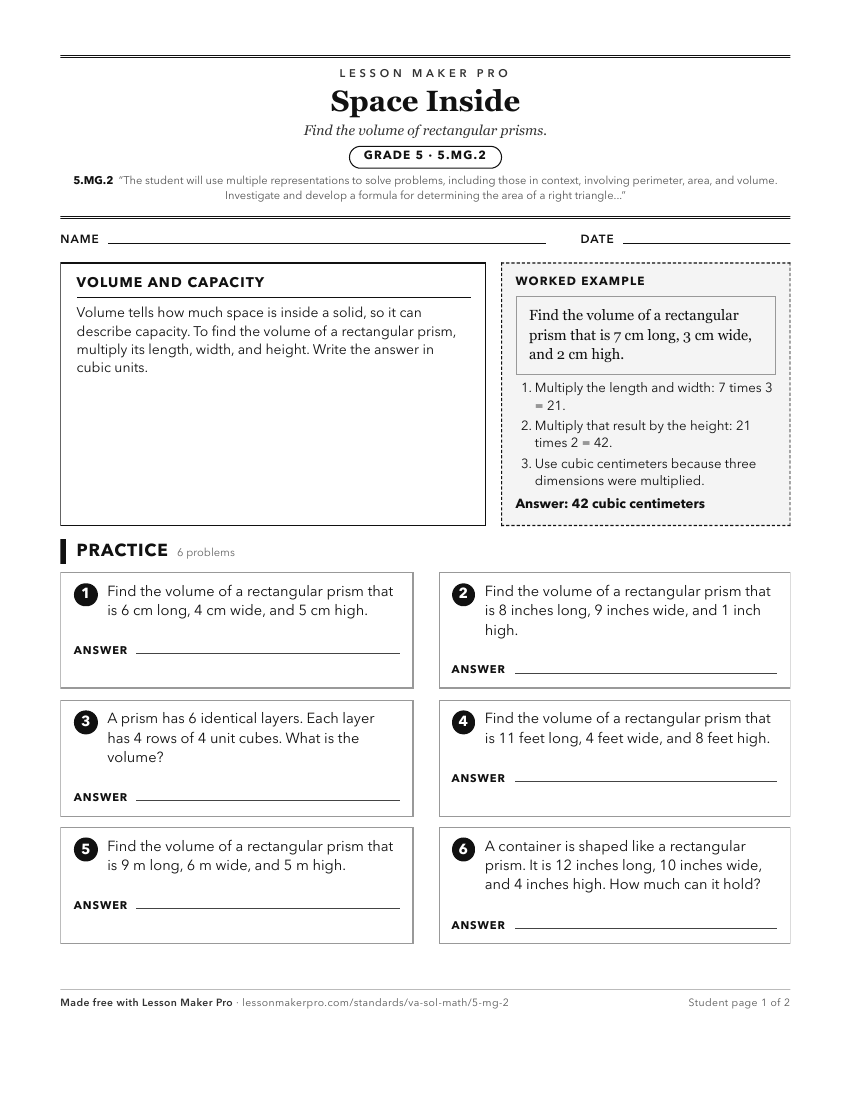
A ready-to-print activity worksheet aligned to 5.MG.2, with an answer key for the teacher on its own page. No account needed.
PDF, US Letter, prints cleanly in black and white.
Download the worksheetKeep exploring
Related Standards
- 3.MG.2
The student will use multiple representations to estimate and solve problems, including those in context, involving area and perimeter (in both U.S. Customary a...
- 4.MG.3
The student will use multiple representations to develop and use formulas to solve problems, including those in context, involving area and perimeter limited to...
- 6.MG.2
The student will reason mathematically to solve problems, including those in context, that involve the area and perimeter of triangles and parallelograms.
- 8.MG.5
The student will solve area and perimeter problems involving composite plane figures, including those in context.
Turn this cluster into a lesson
Grade, subject, topic, and the complete cluster are prefilled. Create one free, no account needed.
Also for this cluster:Make a WorksheetMake a QuizMake a Sub Lesson