Virginia SOL 3.MG.4
SOL Standard (Knowledge and Skills Cluster)
The student will identify, describe, classify, compare, combine, and subdivide polygons.
Virginia Standards of Learning for Mathematics
Cluster contents
Knowledge and Skills in This Standard
3.MG.4 is a Standards of Learning standard. These are the knowledge and skills expectations under it.
- 3.MG.4.a
Describe a polygon as a closed plane figure composed of at least three line segments that do not cross.
- 3.MG.4.b
Classify figures as polygons or not polygons and justify reasoning.
- 3.MG.4.c
Identify and describe triangles, quadrilaterals, pentagons, hexagons, and octagons in various orientations, with and without contexts.
- 3.MG.4.d
Identify and name examples of polygons (triangles, quadrilaterals, pentagons, hexagons, octagons) in the environment.
- 3.MG.4.e
Classify and compare polygons (triangles, quadrilaterals, pentagons, hexagons, octagons).
- 3.MG.4.f
Combine no more than three polygons, where each has three or four sides, and name the resulting polygon (triangles, quadrilaterals, pentagons, hexagons, octagon...
- 3.MG.4.g
Subdivide a three-sided or four-sided polygon into no more than three parts and name the resulting polygons.
Teacher's field guide
What This Cluster Means
What Students Need to Do
- Students decide whether a figure is a polygon and support the decision with its features. They name and compare polygons by side count, then join or divide shapes and identify the results.
What Mastery Looks Like
- Students correctly sort polygons and non-polygons and explain their choices. They name polygons in any orientation by counting sides, compare them, and name shapes made by combining or subdividing polygons.
Common Misconceptions
- Students may count figures with gaps, curved sides, or crossing segments as polygons. They may think a rotated shape changes its name or name shapes by appearance instead of side count. When combining shapes, they may count shared interior edges as sides of the new polygon.
How to Assess It
- Give students an exit ticket with one open figure, one rotated hexagon, and a quadrilateral divided into two triangles. Ask them to classify each figure and explain using sides, corners, and closure.
Lesson moves
Ways to Teach It
Give students triangle and quadrilateral cutouts to join along full sides, then trace and name each new polygon.
Show a rotated pentagon and ask, “How can you prove its name without turning the paper?”
Play Polygon Sort Relay with cards showing closed, open, curved, crossed, and rotated figures; teams sort and justify each placement.
Take a school hallway shape hunt, then sketch and label polygons found in tiles, signs, windows, and floor patterns.
Free download
Printable 3.MG.4 Worksheet
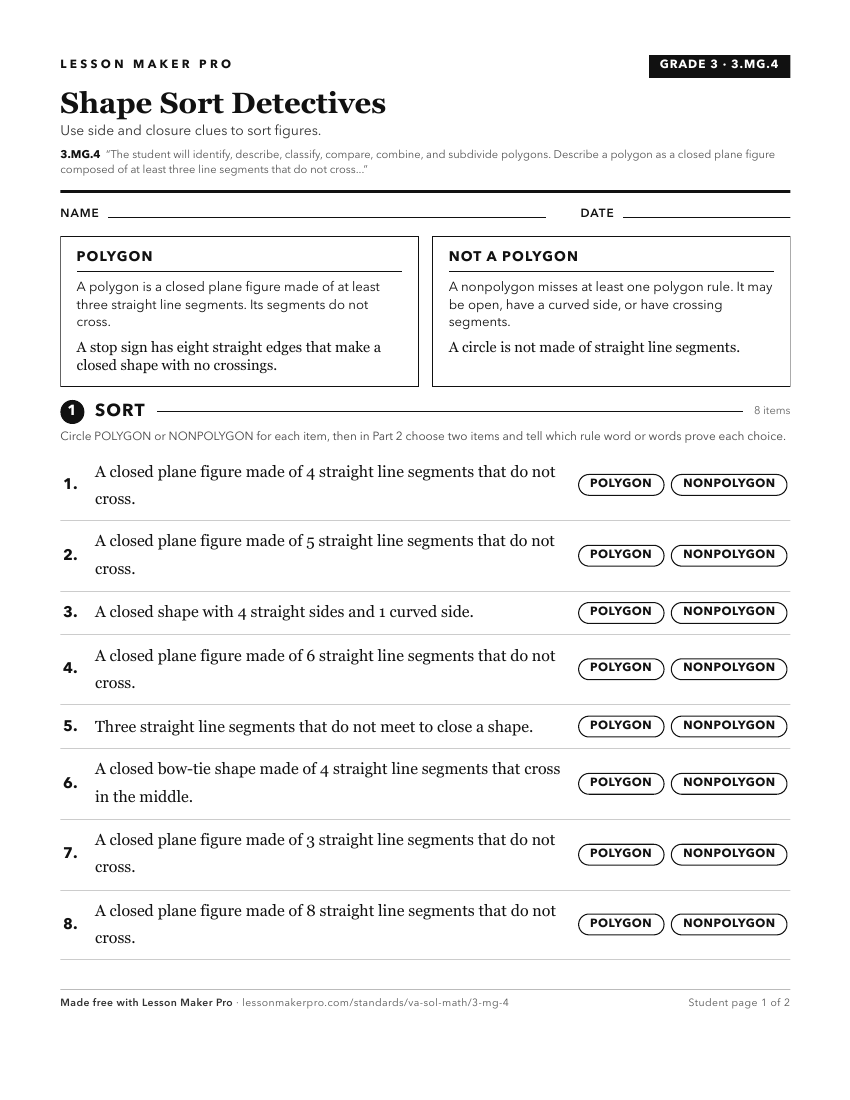
A ready-to-print activity worksheet aligned to 3.MG.4, with an answer key for the teacher on its own page. No account needed.
PDF, US Letter, prints cleanly in black and white.
Download the worksheetKeep exploring
Related Standards
- 4.MG.5
The student will classify and describe quadrilaterals (parallelograms, rectangles, squares, rhombi, and/or trapezoids) using specific properties and attributes.
- K.MG.2
The student will identify, describe, name, compare, and construct plane figures (circles, triangles, squares, and rectangles).
- 6.MG.4
The student will determine congruence of segments, angles, and polygons.
Turn this cluster into a lesson
Grade, subject, topic, and the complete cluster are prefilled. Create one free, no account needed.
Also for this cluster:Make a WorksheetMake a QuizMake a Sub Lesson