Virginia SOL 3.MG.4.c
The Standard
Identify and describe triangles, quadrilaterals, pentagons, hexagons, and octagons in various orientations, with and without contexts.
Virginia Standards of Learning for Mathematics · The student will identify, describe, classify, compare, combine, and subdivide polygons.
Teacher's field guide
What This Standard Means
What Students Need to Do
- Students name polygons by counting their straight sides and vertices. They recognize the same polygon when it is rotated, irregular, or shown in a real object.
What Mastery Looks Like
- Students correctly name familiar and unfamiliar polygons, even when shapes are turned, stretched, or shown inside pictures. They justify each name by counting straight sides and vertices.
Common Misconceptions
- Students may think a rotated shape has a different name, such as calling a tilted square a diamond. They may count corners incorrectly or classify open shapes and shapes with curved sides as polygons.
How to Assess It
- Give students six mixed shapes, including rotated and irregular examples. Ask them to name each polygon and write its number of sides and vertices.
Lesson moves
Ways to Teach It
Give pairs craft sticks to build each polygon, then label every model with its name, number of sides, and number of vertices.
Display a rotated polygon and ask, “How can you prove its name without turning the paper?”
Play polygon bingo using cards with regular, irregular, and rotated shapes while calling clues based on sides and vertices.
Take a school photo walk, then mark and name polygons found in windows, signs, floor tiles, and playground equipment.
Free download
Printable 3.MG.4.c Worksheet
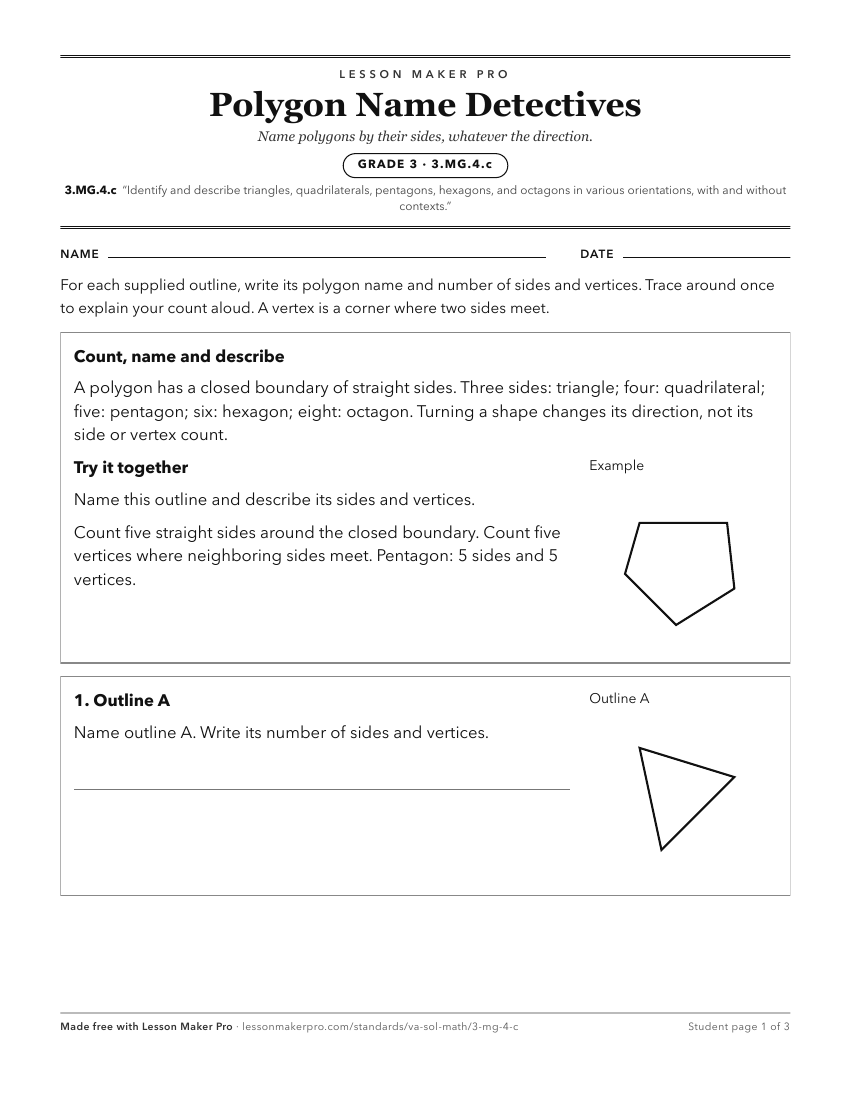
A ready-to-print activity worksheet aligned to 3.MG.4.c, with an answer key for the teacher on its own page. No account needed.
PDF, US Letter, prints cleanly in black and white.
Download the worksheetKeep exploring
Related Standards
- K.MG.2.a
Identify and name concrete and pictorial representations of circles, triangles, squares, and rectangles regardless of their orientation in space.
- 3.MG.4.e
Classify and compare polygons (triangles, quadrilaterals, pentagons, hexagons, octagons).
- 3.MG.4.d
Identify and name examples of polygons (triangles, quadrilaterals, pentagons, hexagons, octagons) in the environment.
- 1.MG.2.d
Identify, name, and describe representations of circles, squares, rectangles, and triangles, regardless of orientation, in different environments and explain re...
Turn this exact standard into a lesson
Grade, subject, topic, and the complete standard are prefilled. Create one free, no account needed.
Also for this standard:Make a WorksheetMake a QuizMake a Sub Lesson