Virginia SOL 2.NS.3.d
The Standard
Using same-size fraction pieces, from a region/area model, count by unit fractions up to two wholes (e.g., zero one-fourths, one one-fourth, two one-fourths, three one-fourths, four onefourths, five one-fourths; or zero-fourths, one-fourth, two-fourths, three-fourths, four-fourths, five-fourths).
Virginia Standards of Learning for Mathematics · The student will use mathematical reasoning and justification to solve contextual problems that involve partitioning models into equal-sized parts (halves, fourths, eighths, thirds, and sixths).
Teacher's field guide
What This Standard Means
What Students Need to Do
- Students arrange equal-sized fraction pieces and count each piece in sequence from zero through two complete shapes. They name amounts such as one-fourth, four-fourths, and five-fourths without changing the piece size.
What Mastery Looks Like
- Students count equal-sized fraction pieces in order, including amounts greater than one whole. They keep the denominator the same and identify when the pieces make one whole or two wholes.
Common Misconceptions
- Students may call the fifth fourth-sized piece five-fifths instead of five-fourths. They may restart at one after reaching a whole or think the count must stop there. Some students count pieces of different sizes together.
How to Assess It
- Show two rectangles divided into fourths, with seven parts shaded. Ask students to write the fraction count from zero-fourths through seven-fourths and circle the point that equals one whole.
Lesson moves
Ways to Teach It
Give pairs two paper circles cut into fourths; students add one piece at a time and say each fraction through eight-fourths.
Show six one-third pieces covering two rectangles and ask students to explain why the last count is six-thirds rather than six-sixths.
Play Fraction Path: students draw a denominator card, move by matching unit pieces, and name every stop up to two wholes.
Model two pans of brownies cut into eighths, then count the servings sold from zero-eighths through sixteen-eighths.
Free download
Printable 2.NS.3.d Worksheet
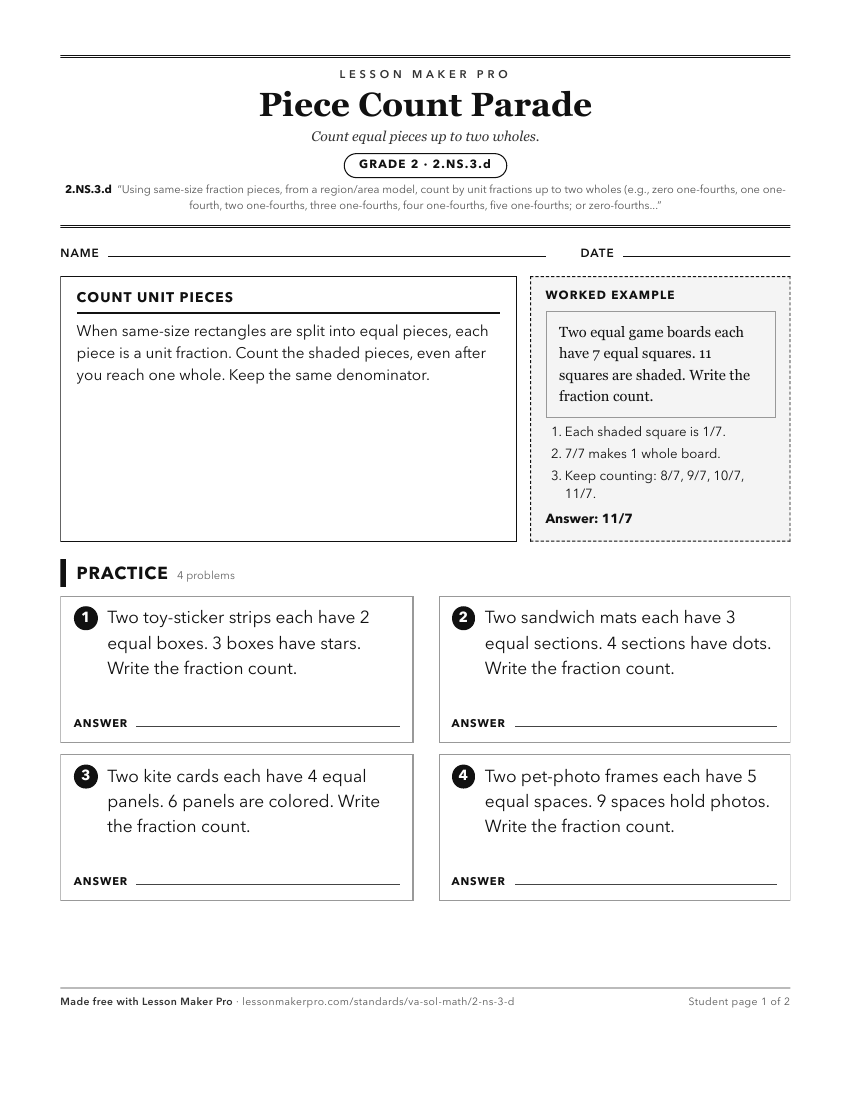
A ready-to-print activity worksheet aligned to 2.NS.3.d, with an answer key for the teacher on its own page. No account needed.
PDF, US Letter, prints cleanly in black and white.
Download the worksheetKeep exploring
Related Standards
- 2.NS.3.f
Compare unit fractions for halves, fourths, eighths, thirds, and sixths using words (greater than, less than or equal to) and symbols (>, <, =), with region/are...
- 1.NS.3.b
Represent and name halves and fourths of a whole, using a region/area model (e.g., pie pieces, pattern blocks, paper folding, drawings) and a set model (e.g., e...
- 3.NS.3.c
Use a model of a fraction greater than one to count the fractional parts to name and write it as an improper fraction and as a mixed number (e.g., 1 4 , 2 4 , 3...
- 3.NS.3.h
Represent equivalent fractions with denominators of 2, 3, 4, 5, 6, 8, or 10, using region/area models and length models.
Turn this exact standard into a lesson
Grade, subject, topic, and the complete standard are prefilled. Create one free, no account needed.
Also for this standard:Make a WorksheetMake a QuizMake a Sub Lesson