Virginia SOL 2.NS.3.a
The Standard
Model and describe fractions as representing equal-size parts of a whole.
Virginia Standards of Learning for Mathematics · The student will use mathematical reasoning and justification to solve contextual problems that involve partitioning models into equal-sized parts (halves, fourths, eighths, thirds, and sixths).
Teacher's field guide
What This Standard Means
What Students Need to Do
- Students divide one whole into a given number of equal shares and name the fraction shown by one or more shares. They use drawings, folded paper, or objects to justify that the shares are equal.
What Mastery Looks Like
- Students can divide circles, rectangles, or other whole models into halves, thirds, fourths, sixths, or eighths. They label a selected share and explain that every part must be the same size.
Common Misconceptions
- Students may count pieces without checking that they are the same size. They may think eighths are larger than fourths because eight is greater than four. They may also compare fractions made from different-sized wholes as if the wholes were equal.
How to Assess It
- Give this exit ticket: “A sandwich is shared equally among six children. Draw the shares, label one child’s share, and explain why it is fair.”
Lesson moves
Ways to Teach It
Give students paper circles to fold into halves, fourths, and eighths, then have them label one part of each circle.
Show a rectangle split into unequal pieces and ask, “Can these pieces represent fourths? Explain your answer in two sentences.”
Play Fraction Match with cards showing fraction words, symbols, and shaded models for halves, thirds, fourths, sixths, and eighths.
Have students plan how to share a pan of brownies equally among two, three, four, six, or eight people using grid paper.
Free download
Printable 2.NS.3.a Worksheet
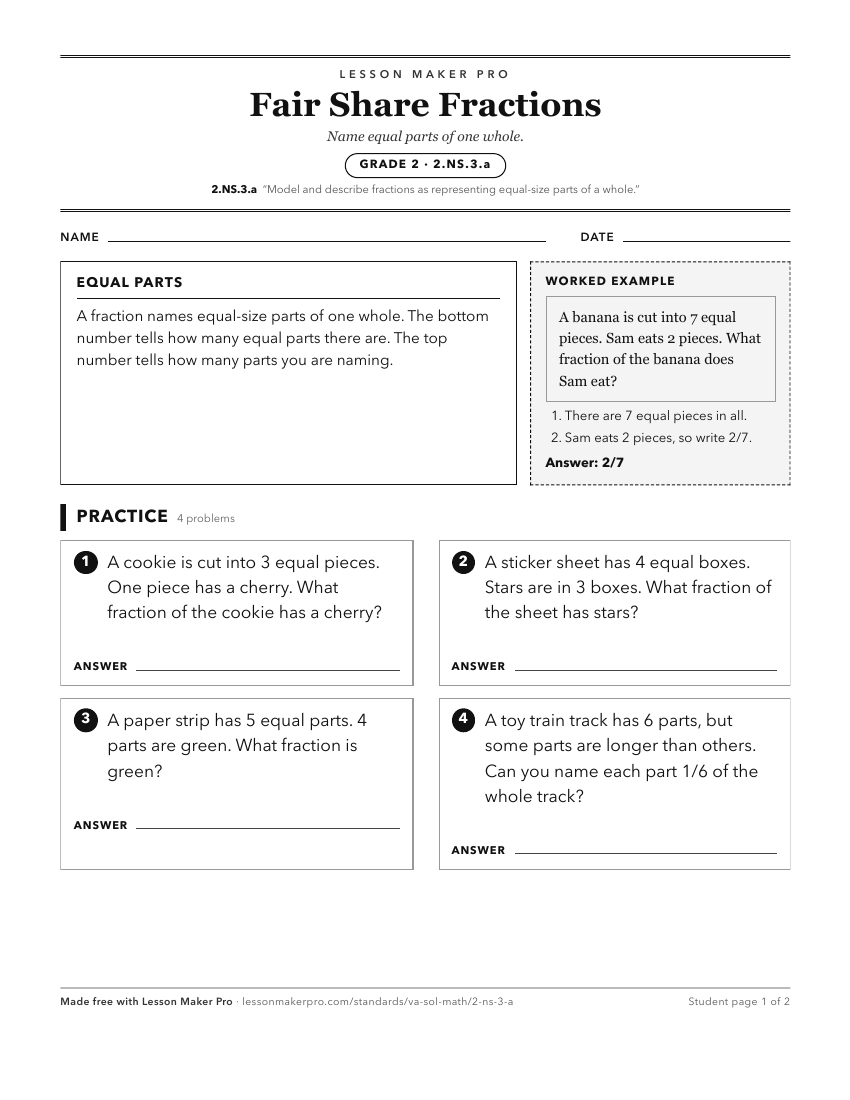
A ready-to-print activity worksheet aligned to 2.NS.3.a, with an answer key for the teacher on its own page. No account needed.
PDF, US Letter, prints cleanly in black and white.
Download the worksheetKeep exploring
Related Standards
- 2.NS.3.d
Using same-size fraction pieces, from a region/area model, count by unit fractions up to two wholes (e.g., zero one-fourths, one one-fourth, two one-fourths, th...
- 4.NS.5.b
Identify and model equivalent relationships between fractions (proper or improper) and/or mixed numbers and decimals, using halves, fourths, fifths, tenths, and...
- 5.NS.1.a
Use concrete and pictorial models to represent fractions with denominators that are thirds, eighths, and factors of 100 in their equivalent decimal form.*
- 3.NS.3.b
Identify a fraction represented by a model as the sum of unit fractions.
Turn this exact standard into a lesson
Grade, subject, topic, and the complete standard are prefilled. Create one free, no account needed.
Also for this standard:Make a WorksheetMake a QuizMake a Sub Lesson