Virginia SOL 2.MG.3.c
The Standard
Describe the two resulting figures formed by a line of symmetry as being congruent (having the same shape and size).
Virginia Standards of Learning for Mathematics · The student will identify, describe, and create plane figures (including circles, triangles, squares, and rectangles) that have at least one line of symmetry and explain its relationship with congruency.
Teacher's field guide
What This Standard Means
What Students Need to Do
- Students examine a shape divided by a symmetry line and compare the two parts. They describe the parts as congruent because they match in shape and size.
What Mastery Looks Like
- Students can fold or trace one part onto the other and show that they match exactly. They explain that the parts may face different directions but have the same shape and size.
Common Misconceptions
- Students may think any line through the middle is a line of symmetry. They may also think turned or flipped pieces are not congruent, or that matching shape without matching size is enough.
How to Assess It
- Give students a paper shape with a symmetry line. Ask them to explain how folding proves the two parts are congruent.
Lesson moves
Ways to Teach It
Fold paper circles, squares, rectangles, and triangles along drawn lines, then check whether the two parts match exactly.
Show a symmetrical shape and ask, “How can you prove the two parts have the same shape and size?”
Play Symmetry Sort by placing shape cards under “congruent parts” or “not congruent parts” and explaining each choice.
Examine butterflies, leaves, road signs, and logos, then mark lines that divide each image into matching parts.
Free download
Printable 2.MG.3.c Worksheet
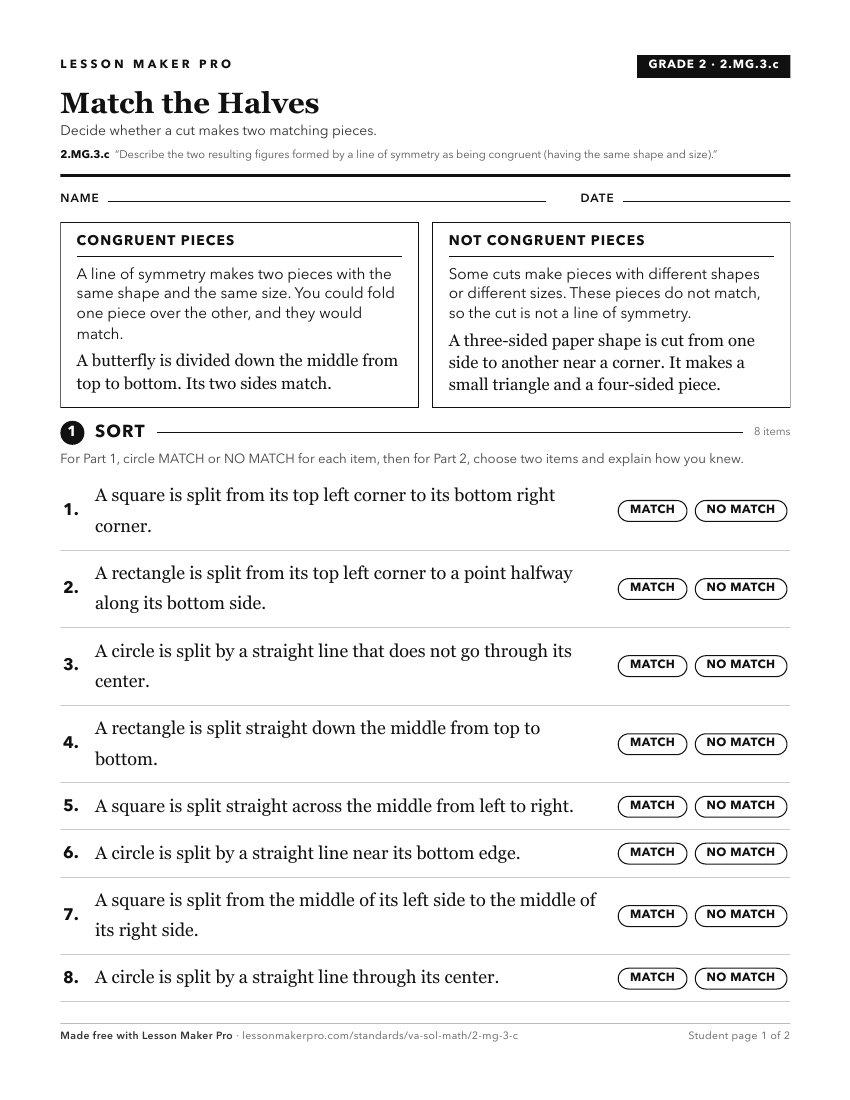
A ready-to-print activity worksheet aligned to 2.MG.3.c, with an answer key for the teacher on its own page. No account needed.
PDF, US Letter, prints cleanly in black and white.
Download the worksheetKeep exploring
Related Standards
- 2.MG.3
The student will identify, describe, and create plane figures (including circles, triangles, squares, and rectangles) that have at least one line of symmetry an...
- 6.MG.4.b
Draw lines of symmetry to divide regular polygons into two congruent parts.
- 2.MG.3.a
Explore a figure using a variety of tools (e.g., paper folding, geoboards, drawings) to show and justify a line of symmetry, if one exists.
- 2.MG.3.b
Create figures with at least one line of symmetry using various concrete and pictorial representations.
Turn this exact standard into a lesson
Grade, subject, topic, and the complete standard are prefilled. Create one free, no account needed.
Also for this standard:Make a WorksheetMake a QuizMake a Sub Lesson