Virginia SOL 6.MG.4.b
The Standard
Draw lines of symmetry to divide regular polygons into two congruent parts.
Virginia Standards of Learning for Mathematics · The student will determine congruence of segments, angles, and polygons.
Teacher's field guide
What This Standard Means
What Students Need to Do
- Students draw a line through a regular polygon so the two halves are mirror images and match exactly. They check each line by folding, tracing, or pairing corresponding points. They identify all possible symmetry lines, including slanted ones.
What Mastery Looks Like
- A student accurately draws every symmetry line on common regular polygons, regardless of their orientation. They place each line through the center and verify that corresponding points on the two halves match.
Common Misconceptions
- Some students call every diagonal a symmetry line. Others accept two regions with equal area even when their shapes do not match after folding. They may miss slanted lines or mishandle odd-sided polygons, where a line joins a vertex to the opposite side's midpoint.
How to Assess It
- Give students a regular pentagon and regular hexagon. Ask them to draw every symmetry line and mark one pair of matching vertices or sides.
Lesson moves
Ways to Teach It
Give students paper regular polygons to fold, crease, reopen, and trace each crease that makes both halves overlap exactly.
Ask, "Why is every diagonal of a square a symmetry line, but every diagonal of a regular hexagon is not?"
Play Symmetry Sort: students place drawn lines under "works" or "does not work," then verify each choice with tracing paper.
Photograph a floor tile or road sign, outline its regular polygon, and mark every line where reflected halves would match.
Free download
Printable 6.MG.4.b Worksheet
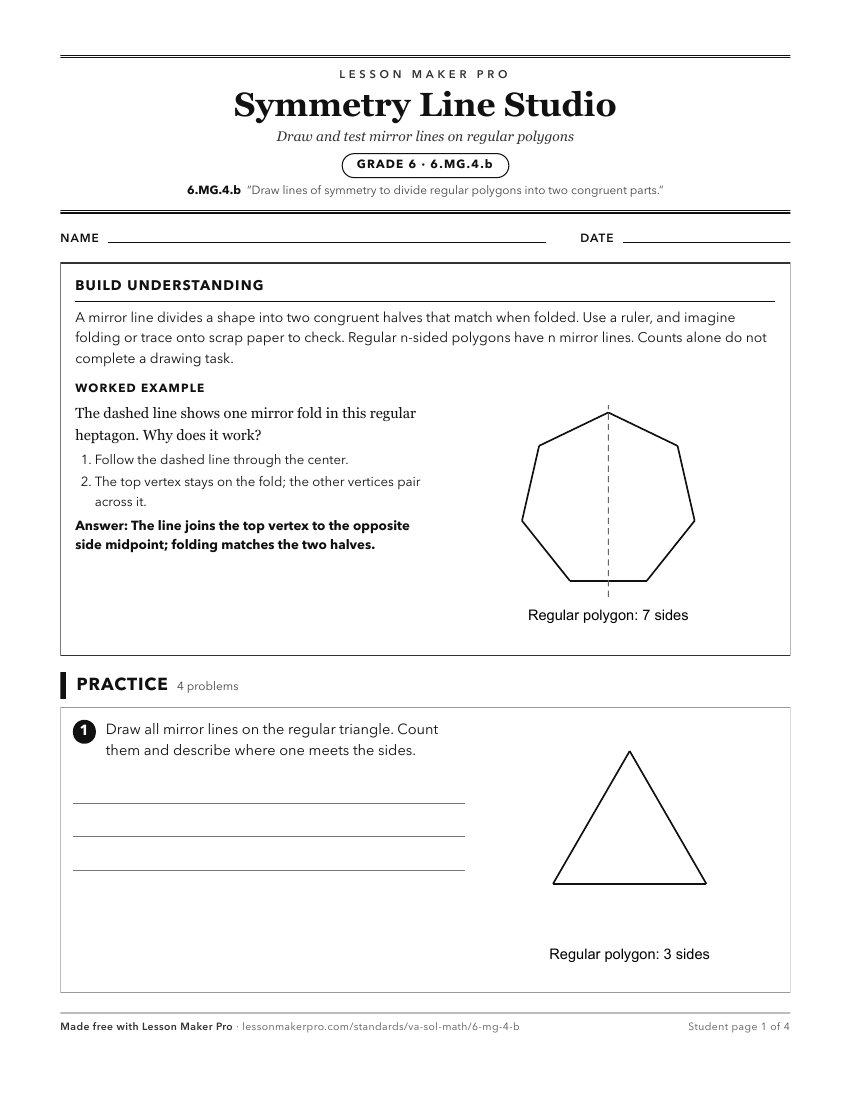
A ready-to-print activity worksheet aligned to 6.MG.4.b, with an answer key for the teacher on its own page. No account needed.
PDF, US Letter, prints cleanly in black and white.
Download the worksheetKeep exploring
Related Standards
- 6.MG.4.d
Determine whether polygons are congruent or noncongruent according to the measures of their sides and angles.
- 6.MG.4.a
Identify regular polygons.
- 2.MG.3.c
Describe the two resulting figures formed by a line of symmetry as being congruent (having the same shape and size).
- 3.MG.4.g
Subdivide a three-sided or four-sided polygon into no more than three parts and name the resulting polygons.
Turn this exact standard into a lesson
Grade, subject, topic, and the complete standard are prefilled. Create one free, no account needed.
Also for this standard:Make a WorksheetMake a QuizMake a Sub Lesson