Virginia SOL 6.MG.4.a
The Standard
Identify regular polygons.
Virginia Standards of Learning for Mathematics · The student will determine congruence of segments, angles, and polygons.
Teacher's field guide
What This Standard Means
What Students Need to Do
- Students examine a polygon's side lengths and angle measures. They decide whether both are equal throughout the figure and use that evidence to classify the polygon.
What Mastery Looks Like
- Students correctly classify polygons by checking that all sides and all interior angles are congruent. They explain why a square is regular but a non-square rhombus is not.
Common Misconceptions
- Students may check only side lengths and ignore angle measures. They may think every symmetric polygon is regular, or that a rotated polygon changes its classification.
How to Assess It
- Exit ticket: A pentagon has five equal sides, but one angle is larger than the others. Is it regular? Explain using both requirements.
Lesson moves
Ways to Teach It
Build polygons with equal-length craft sticks, then measure the angles to decide which models are regular.
Compare a square and a non-square rhombus, then write why only one is regular.
Sort polygon cards into regular and not regular piles, earning a point only when the reason names sides and angles.
Photograph signs, tiles, or logos, then measure their sides and angles to test whether the shapes are regular.
Free download
Printable 6.MG.4.a Worksheet
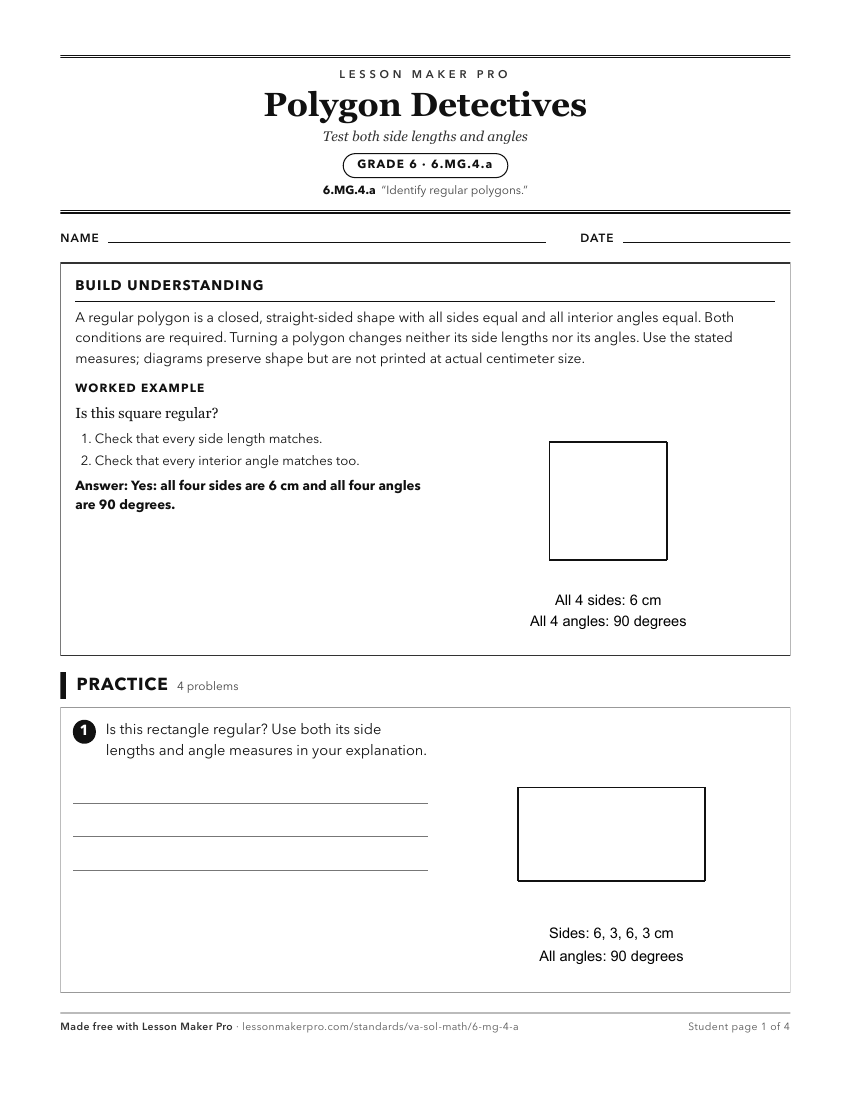
A ready-to-print activity worksheet aligned to 6.MG.4.a, with an answer key for the teacher on its own page. No account needed.
PDF, US Letter, prints cleanly in black and white.
Download the worksheetKeep exploring
Related Standards
- 3.MG.4.b
Classify figures as polygons or not polygons and justify reasoning.
- 6.MG.4.b
Draw lines of symmetry to divide regular polygons into two congruent parts.
- 3.MG.4.e
Classify and compare polygons (triangles, quadrilaterals, pentagons, hexagons, octagons).
- 3.MG.4.d
Identify and name examples of polygons (triangles, quadrilaterals, pentagons, hexagons, octagons) in the environment.
Turn this exact standard into a lesson
Grade, subject, topic, and the complete standard are prefilled. Create one free, no account needed.
Also for this standard:Make a WorksheetMake a QuizMake a Sub Lesson