Virginia SOL 2.MG.3.a
The Standard
Explore a figure using a variety of tools (e.g., paper folding, geoboards, drawings) to show and justify a line of symmetry, if one exists.
Virginia Standards of Learning for Mathematics · The student will identify, describe, and create plane figures (including circles, triangles, squares, and rectangles) that have at least one line of symmetry and explain its relationship with congruency.
Teacher's field guide
What This Standard Means
What Students Need to Do
- Students test plane figures to find lines that split them into matching halves. They use folding, geoboards, or drawings to justify whether the halves are congruent.
What Mastery Looks Like
- Students find all symmetry lines in familiar shapes and recognize when no line exists. They use a fold, geoboard, or drawing to show that matching halves are congruent.
Common Misconceptions
- Students may think any line through the center creates symmetry. They may also count a non-square rectangle's diagonal or accept halves with equal area but different shapes.
How to Assess It
- Exit ticket: Draw every line of symmetry on a square and a non-square rectangle. Explain how folding proves one pair of halves is congruent.
Lesson moves
Ways to Teach It
Give students paper circles, triangles, squares, and rectangles to fold, then trace each fold that makes the two halves match exactly.
Discuss whether a diagonal of a non-square rectangle is a symmetry line, using the phrase congruent halves in each explanation.
Play a card sort where partners group shapes by number of symmetry lines, then check disputed cards with a small mirror.
Have students sketch classroom objects or logos with symmetry, mark a symmetry line, and explain how the two sides match.
Free download
Printable 2.MG.3.a Worksheet
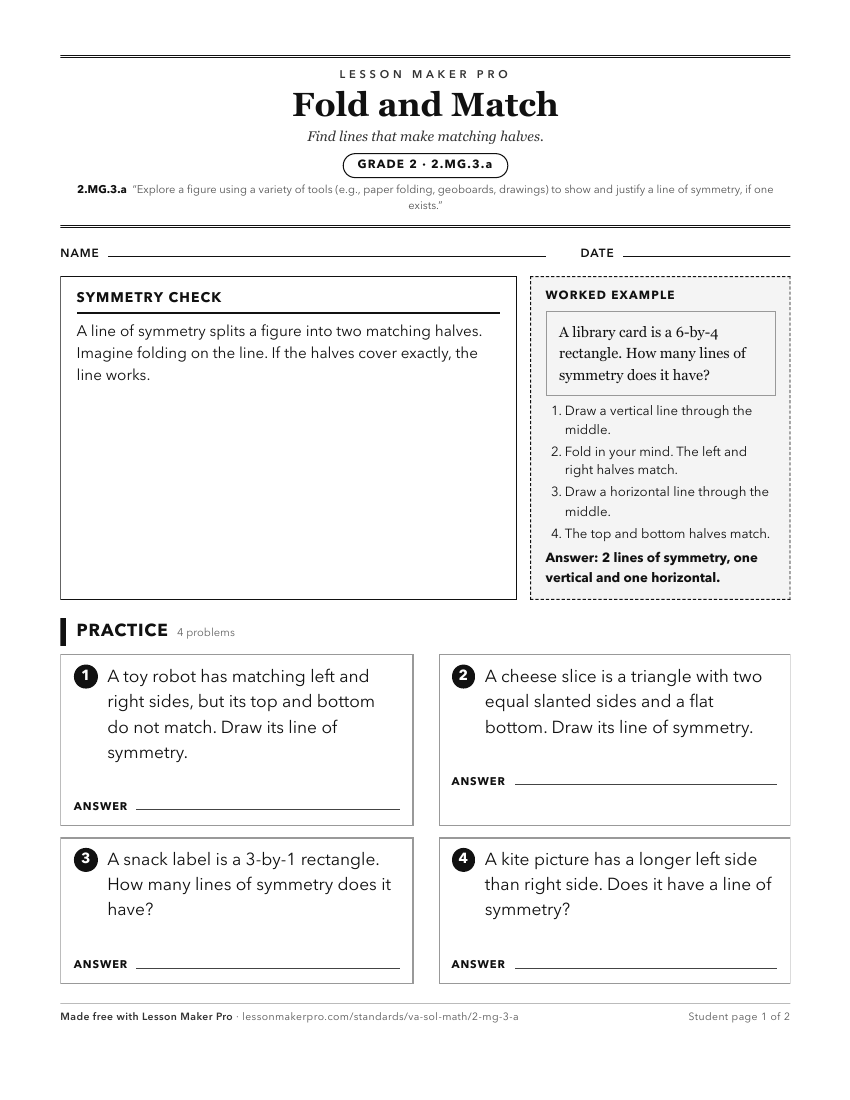
A ready-to-print activity worksheet aligned to 2.MG.3.a, with an answer key for the teacher on its own page. No account needed.
PDF, US Letter, prints cleanly in black and white.
Download the worksheetKeep exploring
Related Standards
- 2.MG.3.c
Describe the two resulting figures formed by a line of symmetry as being congruent (having the same shape and size).
- 2.MG.3
The student will identify, describe, and create plane figures (including circles, triangles, squares, and rectangles) that have at least one line of symmetry an...
- 1.MG.2.d
Identify, name, and describe representations of circles, squares, rectangles, and triangles, regardless of orientation, in different environments and explain re...
- 2.MG.3.b
Create figures with at least one line of symmetry using various concrete and pictorial representations.
Turn this exact standard into a lesson
Grade, subject, topic, and the complete standard are prefilled. Create one free, no account needed.
Also for this standard:Make a WorksheetMake a QuizMake a Sub Lesson