Virginia SOL 2.CE.1.i
The Standard
Describe the not equal symbol (≠) as representing a relationship where expressions on either side of the not equal symbol represent different values and justify reasoning.
Virginia Standards of Learning for Mathematics · The student will recall with automaticity addition and subtraction facts within 20 and estimate, represent, solve, and justify solutions to single-step and multistep problems, including those in context, using addition and subtraction with whole numbers where addends or minuends do not exceed 100.
Teacher's field guide
What This Standard Means
What Students Need to Do
- Students find the value of two expressions and decide whether the values are different. They place ≠ between unequal expressions and explain their reasoning by solving, modeling, or comparing.
What Mastery Looks Like
- Students correctly find the value of each side before comparing them. They use ≠ only when the values differ and justify the choice with equations, drawings, objects, or words.
Common Misconceptions
- Students may think expressions are unequal whenever they look different, such as 8 + 2 and 6 + 4. They may confuse ≠ with < or >, or compare numbers without finding each expression’s value.
How to Assess It
- Give this exit ticket: “Is 9 + 6 ≠ 17 - 3 true? Find both values and explain your answer with words or a drawing.”
Lesson moves
Ways to Teach It
Build 8 + 5 and 7 + 4 with linking cubes, compare the trains, then place an = or ≠ card between them.
Discuss: “Mia says 6 + 7 ≠ 8 + 5 because the expressions look different.” Ask students to agree or disagree and explain.
Play a card game where students solve two expression cards, choose = or ≠, and earn a point for a correct explanation.
Compare two classroom supply orders, such as 8 + 6 pencils and 9 + 7 pencils, then write and explain the relationship.
Free download
Printable 2.CE.1.i Worksheet
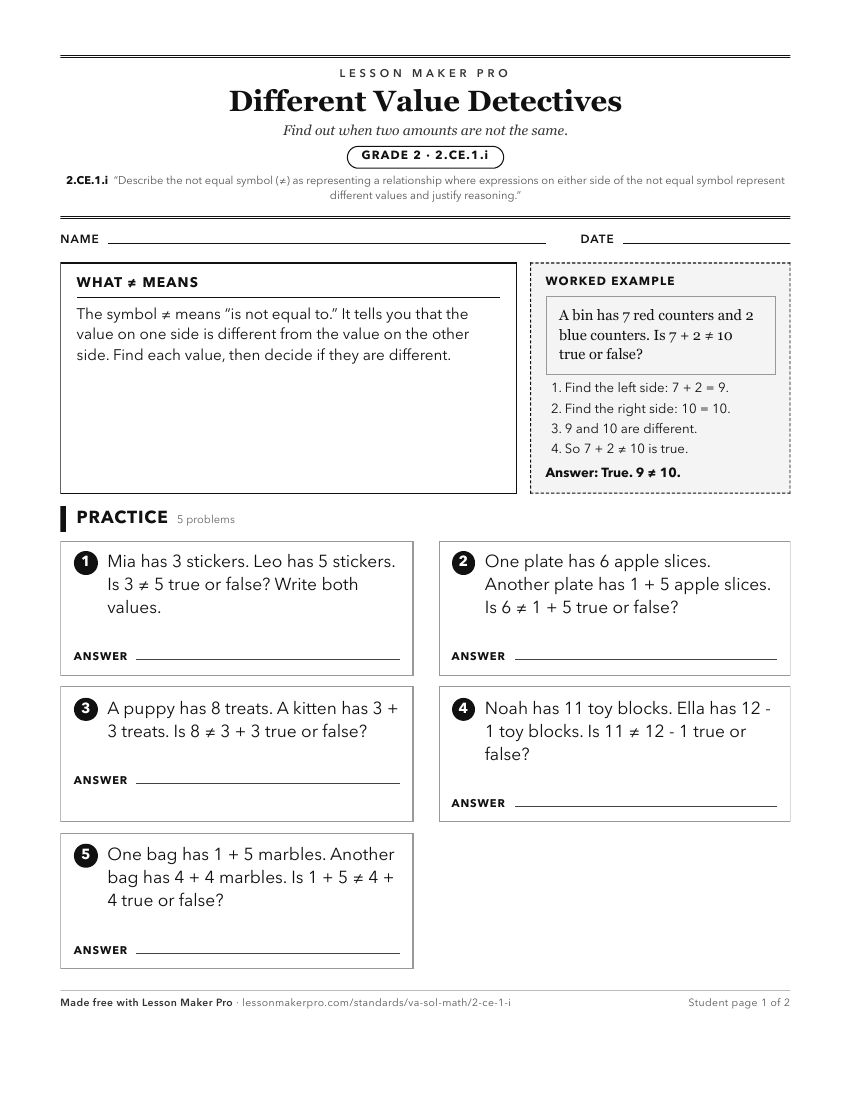
A ready-to-print activity worksheet aligned to 2.CE.1.i, with an answer key for the teacher on its own page. No account needed.
PDF, US Letter, prints cleanly in black and white.
Download the worksheetKeep exploring
Related Standards
- 3.CE.1.d
Identify and use the appropriate symbol to distinguish between expressions that are equal and expressions that are not equal (e.g., 256 - 13 = 220 + 23; 457 + 1...
- 2.CE.1.j
Represent and justify the relationship between values and expressions as equal or not equal using appropriate models and/or symbols (e.g., 9 + 24 = 10 + 23; 45 ...
- 1.CE.1.i
Describe the equal symbol (=) as a balance representing an equivalent relationship between expressions on either side of the equal symbol (e.g., 6 and 1 is the ...
- 4.CE.2.d
Identify and use the appropriate symbol to distinguish between expressions that are equal and expressions that are not equal, using addition, subtraction, multi...
Turn this exact standard into a lesson
Grade, subject, topic, and the complete standard are prefilled. Create one free, no account needed.
Also for this standard:Make a WorksheetMake a QuizMake a Sub Lesson