Virginia SOL 4.CE.2.d
The Standard
Identify and use the appropriate symbol to distinguish between expressions that are equal and expressions that are not equal, using addition, subtraction, multiplication, and division (e.g., 4 × 12 = 8 × 6 and 64 ÷ 8 ≠ 8 × 8).
Virginia Standards of Learning for Mathematics · The student will estimate, represent, solve, and justify solutions to single-step and multistep problems, including those in context, using multiplication with whole numbers, and single-step problems, including those in context, using division with whole numbers; and recall with automaticity the multiplication facts through 12 × 12 and the corresponding division facts.
Teacher's field guide
What This Standard Means
What Students Need to Do
- Students find the value of an expression on each side of a comparison. They use = when the values match and ≠ when the values differ.
What Mastery Looks Like
- A student evaluates both expressions accurately before comparing them. They choose = when the values match and ≠ when they differ, then support the choice with calculations.
Common Misconceptions
- Students may treat the equal sign as a signal that an answer comes next. They may compare operation signs instead of values or make fact errors when evaluating each side.
How to Assess It
- Give this exit ticket: Place = or ≠ in each blank and show both calculations: 7 × 8 ___ 112 ÷ 2 and 9 × 6 ___ 81 ÷ 3.
Lesson moves
Ways to Teach It
Give pairs of expression cards and symbol tiles; students solve each side with counters, then place the correct tile between the cards.
Have students write whether 6 × 8 and 96 ÷ 2 are equal, then justify the chosen symbol with calculations.
Play Expression Match, where students find classmates whose expression cards have equal values and verify each match on paper.
Compare the cost of four $6 notebooks with eight $3 notebooks, then write an equation using the correct comparison symbol.
Free download
Printable 4.CE.2.d Worksheet
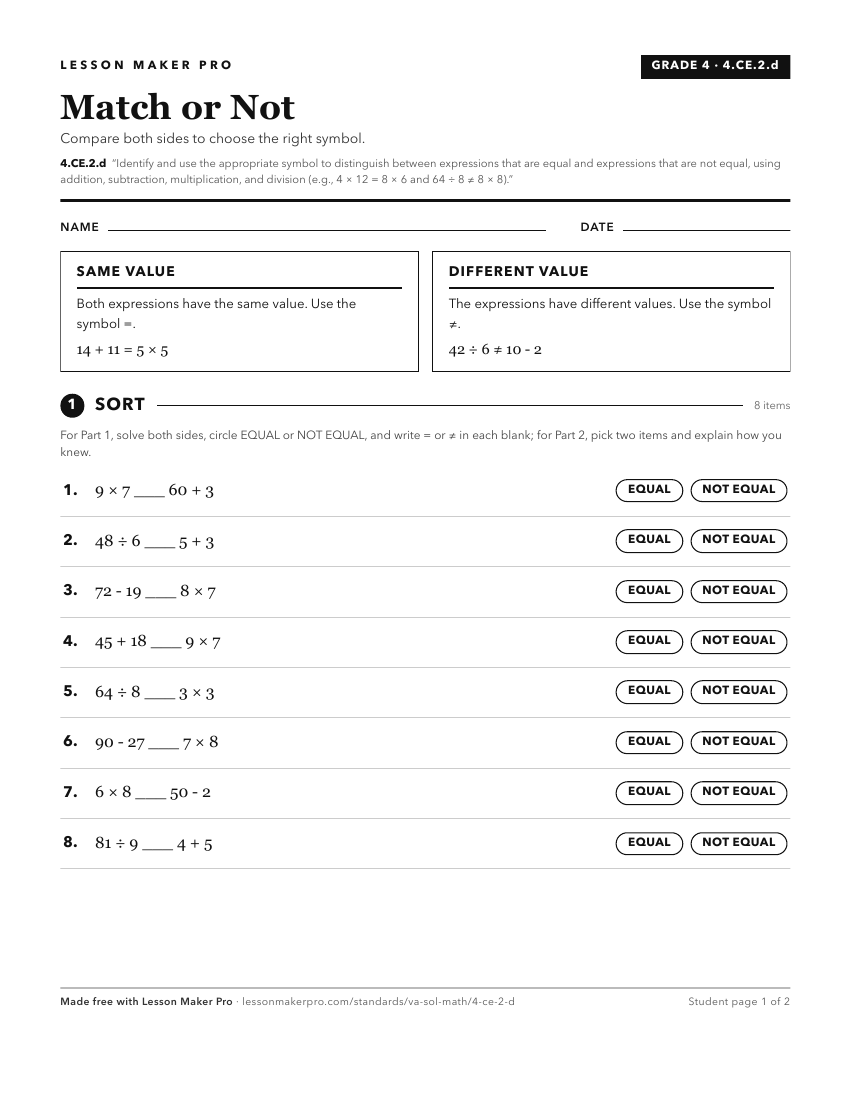
A ready-to-print activity worksheet aligned to 4.CE.2.d, with an answer key for the teacher on its own page. No account needed.
PDF, US Letter, prints cleanly in black and white.
Download the worksheetKeep exploring
Related Standards
- 3.CE.1.d
Identify and use the appropriate symbol to distinguish between expressions that are equal and expressions that are not equal (e.g., 256 - 13 = 220 + 23; 457 + 1...
- 2.CE.1.j
Represent and justify the relationship between values and expressions as equal or not equal using appropriate models and/or symbols (e.g., 9 + 24 = 10 + 23; 45 ...
- 4.CE.2.c
Create an equation using addition, subtraction, multiplication, and division to represent the relationship between equivalent mathematical expressions (e.g., 4 ...
- 1.CE.1.j
Use concrete materials to model, identify, and justify when two expressions are not equal (e.g., 10 - 3 is not equal to 3 + 5).
Turn this exact standard into a lesson
Grade, subject, topic, and the complete standard are prefilled. Create one free, no account needed.
Also for this standard:Make a WorksheetMake a QuizMake a Sub Lesson