Virginia SOL 2.CE.1.j
The Standard
Represent and justify the relationship between values and expressions as equal or not equal using appropriate models and/or symbols (e.g., 9 + 24 = 10 + 23; 45 - 9 = 46 - 10; 15 +16 ≠ 31 +15).
Virginia Standards of Learning for Mathematics · The student will recall with automaticity addition and subtraction facts within 20 and estimate, represent, solve, and justify solutions to single-step and multistep problems, including those in context, using addition and subtraction with whole numbers where addends or minuends do not exceed 100.
Teacher's field guide
What This Standard Means
What Students Need to Do
- Students find the value of each side of a number sentence and decide whether the values match. They use = or ≠, then justify the choice with objects, drawings, calculations, or words.
What Mastery Looks Like
- A student correctly compares two expressions, even when an operation appears on both sides. The student chooses = or ≠ and supports the choice with computation, a model, or compensation.
Common Misconceptions
- Students may think the equal sign means “write the answer” rather than “has the same value as.” They may judge expressions by the numbers shown instead of finding each value. Compensation errors are common, such as adding 1 to one addend without subtracting 1 from the other.
How to Assess It
- Give an exit ticket: Circle = or ≠ for 27 + 8 __ 28 + 7. Show one drawing or equation that proves your choice.
Lesson moves
Ways to Teach It
Use connecting cubes to build 9 + 24 and 10 + 23, then line up the models to check whether the totals match.
Write whether 45 - 9 and 46 - 10 are equal, then explain with numbers, words, or a drawing.
Play Equality Sort by placing equation cards under equal or not equal, then checking each card with a partner.
Compare two supply orders, such as 18 pencils plus 12 pencils and 20 pencils plus 10 pencils, to see whether totals match.
Free download
Printable 2.CE.1.j Worksheet
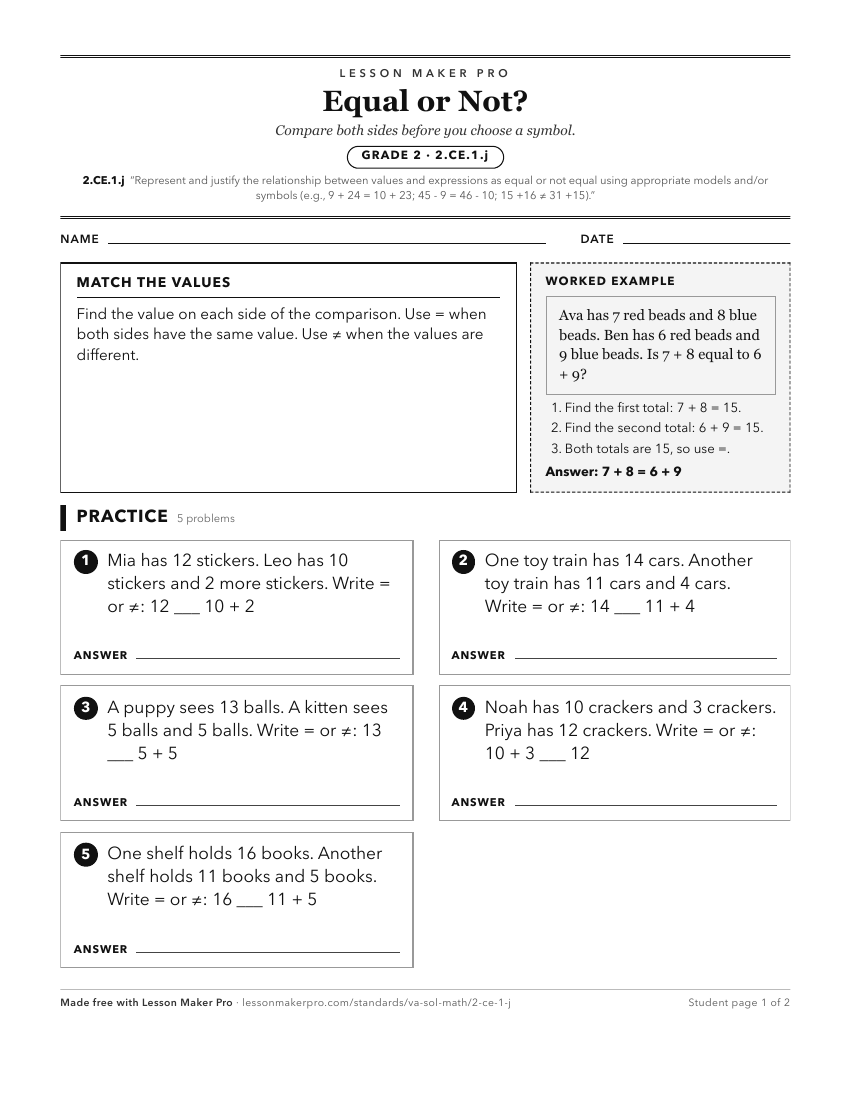
A ready-to-print activity worksheet aligned to 2.CE.1.j, with an answer key for the teacher on its own page. No account needed.
PDF, US Letter, prints cleanly in black and white.
Download the worksheetKeep exploring
Related Standards
- 3.CE.1.d
Identify and use the appropriate symbol to distinguish between expressions that are equal and expressions that are not equal (e.g., 256 - 13 = 220 + 23; 457 + 1...
- 4.CE.2.d
Identify and use the appropriate symbol to distinguish between expressions that are equal and expressions that are not equal, using addition, subtraction, multi...
- 1.CE.1.j
Use concrete materials to model, identify, and justify when two expressions are not equal (e.g., 10 - 3 is not equal to 3 + 5).
- 2.CE.1.i
Describe the not equal symbol (≠) as representing a relationship where expressions on either side of the not equal symbol represent different values and justify...
Turn this exact standard into a lesson
Grade, subject, topic, and the complete standard are prefilled. Create one free, no account needed.
Also for this standard:Make a WorksheetMake a QuizMake a Sub Lesson