Virginia SOL VS.8.d
The Standard
- VS.8
- The student will apply history and social science skills to explain the reconstruction of Virginia following the Civil War by
discussing the election of African American leader John Mercer Langston to Congress in 1890
Virginia Standards of Learning for History and Social Science
Teacher's field guide
What This Standard Means
What Students Need to Do
- Students explain who John Mercer Langston was and why his service in Congress was historically significant. They connect his success to growing African American political participation after the Civil War.
What Mastery Looks Like
- Students identify Langston as the first African American from Virginia to serve in Congress. They explain that his success showed political progress but did not end racism or unequal treatment.
Common Misconceptions
- Students may call Langston the first African American in Congress, rather than the first from Virginia. They may assume his success meant African Americans had gained full equality. Some confuse serving in Congress with becoming governor or president.
How to Assess It
- Exit ticket: Write three sentences explaining who Langston was, what made his service historic, and why it did not mean racial equality had been achieved.
Lesson moves
Ways to Teach It
Give pairs event cards for emancipation, voting rights, and Langston's election, then have them build and explain a chronological timeline.
Write: Why could Langston's election be seen as progress even though African Americans still faced discrimination?
Play a clue sort: students match Langston, Congress, Virginia, and 1890 with accurate descriptions, then correct one false match.
Use Virginia's current congressional map to compare Langston's role representing a district with the job of a representative today.
Free download
Printable VS.8.d Worksheet
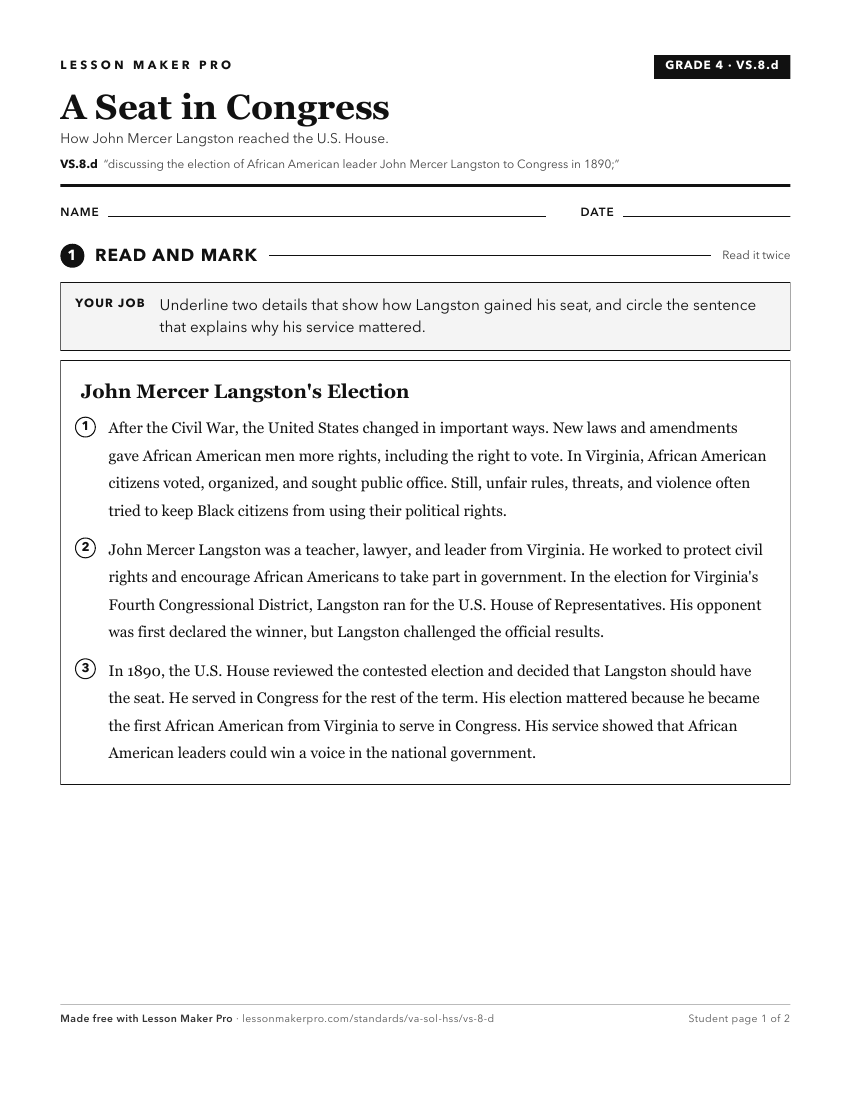
A ready-to-print activity worksheet aligned to VS.8.d, with an answer key for the teacher on its own page. No account needed.
PDF, US Letter, prints cleanly in black and white.
Download the worksheetKeep exploring
Related Standards
- USII.5.h
describing racial segregation, housing discrimination via redlining, the rise of “Jim Crow” laws, Black Codes, and threats of violence including, but not limite...
- USII.2.c
describing the legacies of Abraham Lincoln and the Gettysburg Address, Ulysses S. Grant, Robert E. Lee, Hiram Revels, and Frederick Douglass
- USII.5.i
analyzing events and impacts of African American leaders in response to “Jim Crow” including, but not limited to the formation of the National Association for t...
- 1.5.d
Barrier Breakers: John Mercer Langston, Booker T. Washington, Maggie L. Walker, Barbara Johns, Arthur R. Ashe, Jr., and L. Douglas Wilder
Turn this exact standard into a lesson
Grade, subject, topic, and the complete standard are prefilled. Create one free, no account needed.
Also for this standard:Make a WorksheetMake a QuizMake a Sub Lesson