Virginia SOL USI.5.a
The Standard
- USI.5
- The student will apply history and social science skills to explain the social, political, religious, economic, and geographic factors that shaped colonial America by
describing the characteristics and differences among the New England, the Mid-Atlantic, and the Southern colonies
Virginia Standards of Learning for History and Social Science
Teacher's field guide
What This Standard Means
What Students Need to Do
- Students compare the geography, climate, economy, settlement patterns, and daily life of the three colonial regions. They explain how land and climate shaped jobs, crops, trade, and communities.
What Mastery Looks Like
- Students correctly sort colonies and regional traits into New England, Mid-Atlantic, and Southern groups. They support comparisons with details, such as rocky soil encouraging trade in New England or long growing seasons supporting plantation crops in the South.
Common Misconceptions
- Students often treat all thirteen colonies as alike or confuse the Mid-Atlantic colonies with New England. They may assume everyone in the South lived on a plantation or that each region had only one religion, job, or crop.
How to Assess It
- Give students three short colony profiles and ask them to identify each region. For each choice, they must underline one geographic clue and one economic clue.
Lesson moves
Ways to Teach It
Give groups colony, crop, job, climate, and land cards to sort onto a three-region map, then defend two placements.
Ask students to write which colonial region they would choose to live in, using two regional details to support their choice.
Play Region Riddle, reading clues about climate, geography, economy, or settlement while teams hold up the matching region card.
Compare regional climate maps with crop needs, then have students recommend where a colonial farmer should grow wheat, tobacco, or corn.
Free download
Printable USI.5.a Worksheet
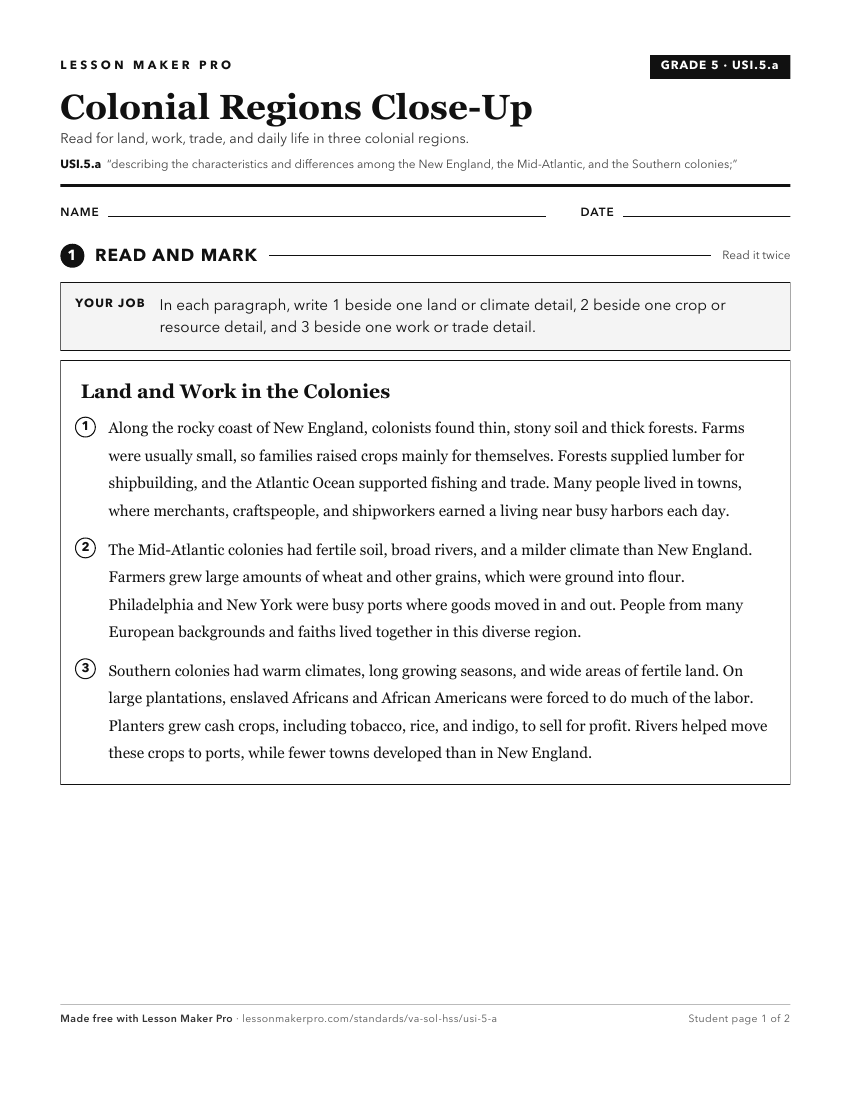
A ready-to-print activity worksheet aligned to USI.5.a, with an answer key for the teacher on its own page. No account needed.
PDF, US Letter, prints cleanly in black and white.
Download the worksheetKeep exploring
Related Standards
- 1.4.a
identifying and describing important events and locations throughout the early history of the Commonwealth including, but not limited to Werowocomoco and the fi...
- 2.8.a
identifying reasons for the settlement of the thirteen colonies
- 2.8.b
explaining the relationships between the colonies and Great Britain
- USI.9.b
describing the differences in the economies of the North and the South, growth of agriculture and industry, and how those economies impacted the outcome of the ...
Turn this exact standard into a lesson
Grade, subject, topic, and the complete standard are prefilled. Create one free, no account needed.
Also for this standard:Make a WorksheetMake a QuizMake a Sub Lesson