Virginia SOL USI.2.b
The Standard
- USI.2
- The student will apply history and social science skills to describe how early cultures developed throughout North America by
locating and explaining where Indigenous people lived prior to the arrival of Europeans, with an emphasis on how the various geographic regions they inhabited influenced their daily lives.
Virginia Standards of Learning for History and Social Science
Teacher's field guide
What This Standard Means
What Students Need to Do
- Students locate the Arctic, Northwest Coast, Great Plains, Southwest, and Eastern Woodlands on a map. They explain how climate, land, plants, and animals shaped food, shelter, clothing, and travel.
What Mastery Looks Like
- Students correctly place Indigenous groups in their geographic regions and describe the available resources. They support each daily life example with a clear geographic reason, such as bison supporting food and shelter on the Plains.
Common Misconceptions
- Students may treat Indigenous peoples as one culture or assume they no longer exist. They may also confuse regional locations or claim geography forced every group to live in exactly the same way.
How to Assess It
- Give students a blank North America map and ask them to label three regions. For each region, they must write one geography-to-daily-life connection.
Lesson moves
Ways to Teach It
Give pairs a blank map and climate, animal, plant, and shelter cards to place in five regions, then defend two placements.
Ask students to write: How would daily life change if a Plains community moved to the Arctic? Use two geographic details.
Play region match: students draw a geography card and a daily life card, keeping the pair only after explaining the connection.
Compare a current rainfall and vegetation map with a tribal nations map, then predict which local resources communities could use.
Free download
Printable USI.2.b Worksheet
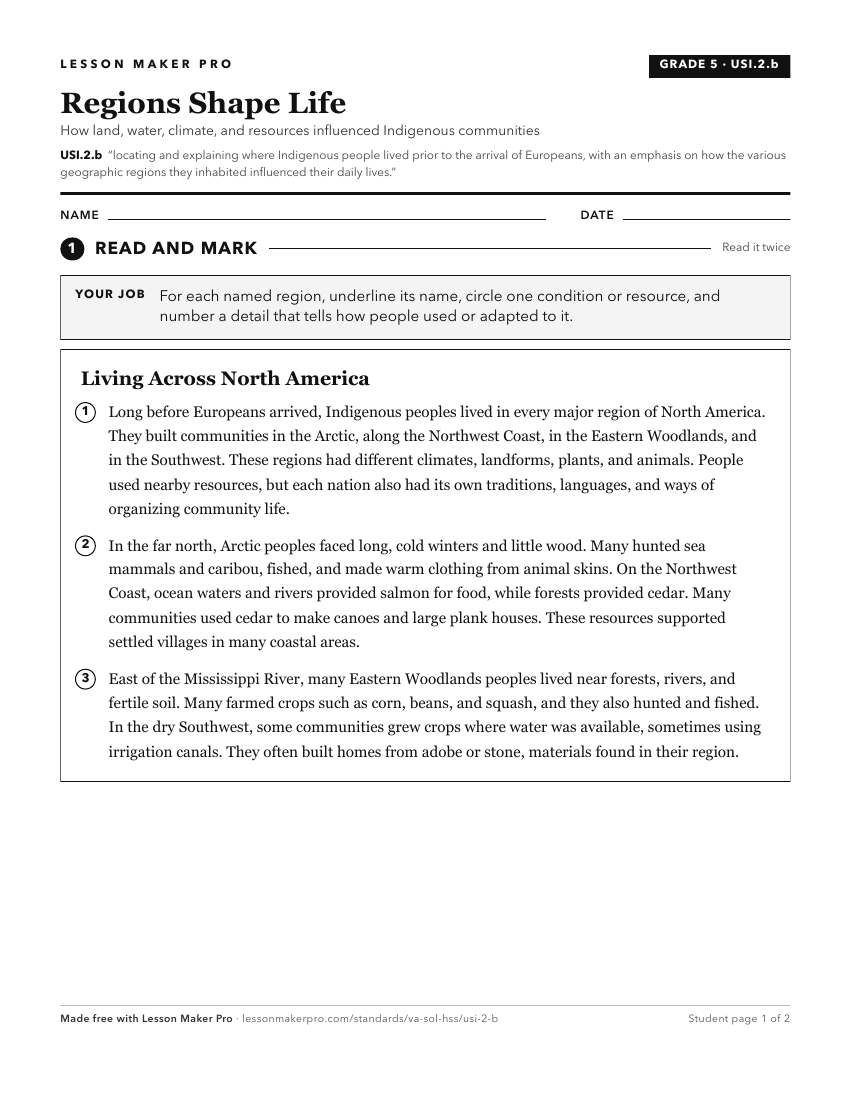
A ready-to-print activity worksheet aligned to USI.2.b, with an answer key for the teacher on its own page. No account needed.
PDF, US Letter, prints cleanly in black and white.
Download the worksheetKeep exploring
Related Standards
- USI.1.b
locating and describing major geographic regions and bodies of water of North America and their impact on the early history of the United States
- 2.5
The student will use history and social science skills to identify the geographic location, use of resources, and contributions of Indigenous people past and pr...
- VS.2.e
describing the lives and cultures of Virginia’s Indigenous People leading to the present day.
- 3.3.c
describing how geographic features have impacted the lives of individuals
Turn this exact standard into a lesson
Grade, subject, topic, and the complete standard are prefilled. Create one free, no account needed.
Also for this standard:Make a WorksheetMake a QuizMake a Sub Lesson