Virginia SOL S.WG.j
The Standard
- S.WG
- The student will demonstrate skills for historical thinking, geographical analysis, economic decision making, and responsible citizenship by
contextualizing, corroborating, and evaluating sources for credibility, propaganda, and bias to determine patterns and trends to understand the world.
Virginia Standards of Learning for History and Social Science
Teacher's field guide
What This Standard Means
What Students Need to Do
- Students identify who created a source, when it was made, its audience, and its purpose. They compare it with other evidence, spot bias or persuasion, and use credible sources to identify patterns over time or place.
What Mastery Looks Like
- A student can explain why a source is trustworthy, limited, or misleading using specific evidence. The student can confirm claims across sources and describe a supported geographic or historical trend.
Common Misconceptions
- Students may treat bias as proof that a source is useless or assume a polished source is reliable. They may confuse opinion with propaganda, ignore missing perspectives, or claim a trend from one example.
How to Assess It
- Give students two short sources about the same event. Ask: Which is more credible, what evidence supports your choice, and what claim can both sources confirm?
Lesson moves
Ways to Teach It
Give groups source cards, author cards, dates, and maps, then have them match each source to its likely context and defend each match.
Ask students to write: How can a biased source still provide useful evidence, and what limits should a reader name?
Run a credibility ranking game where teams order four sources from strongest to weakest and earn points for evidence-based explanations.
Compare a news report, government post, and social media post about one current event, then chart shared claims and unsupported claims.
Free download
Printable S.WG.j Worksheet
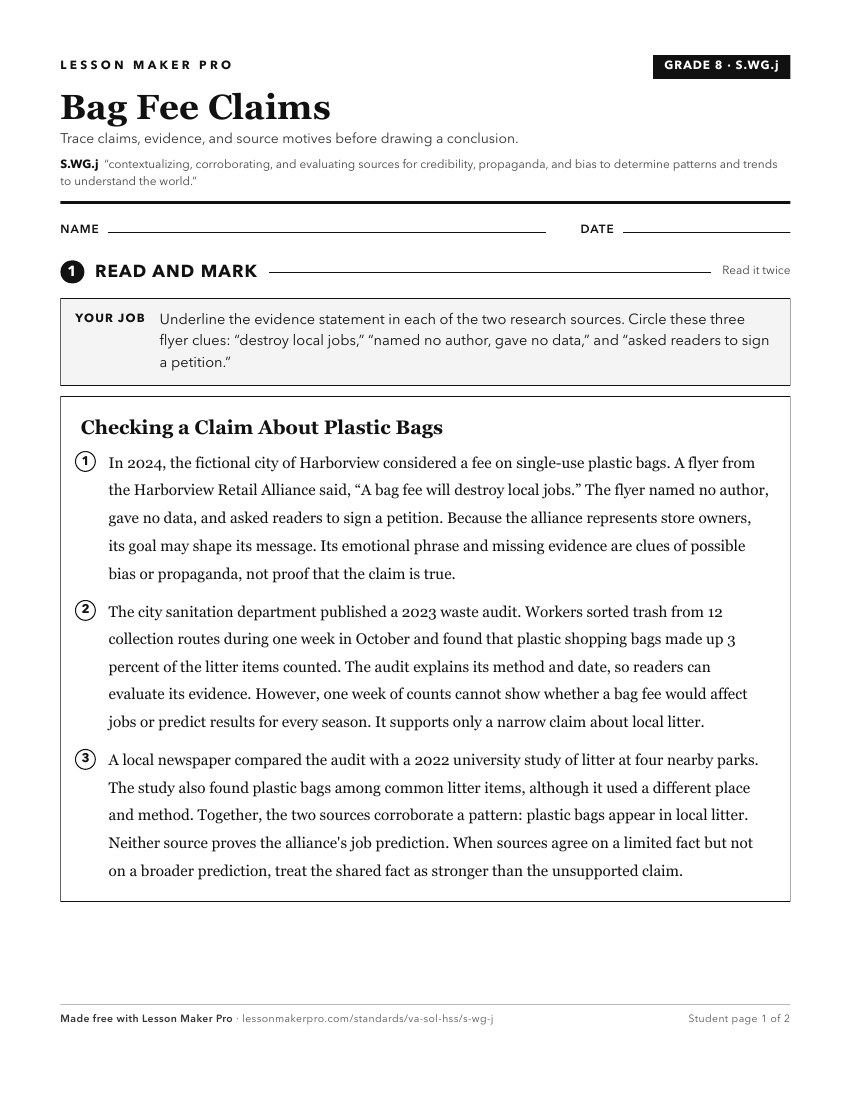
A ready-to-print activity worksheet aligned to S.WG.j, with an answer key for the teacher on its own page. No account needed.
PDF, US Letter, prints cleanly in black and white.
Download the worksheetKeep exploring
Related Standards
- S.VS.a
analyzing and interpreting information sources including, but not limited to artifacts, primary and secondary sources, charts, graphs, and diagrams
- S.3.a
analyzing and interpreting information sources including, but not limited to artifacts, primary and secondary sources, charts, graphs, and diagrams
- CE.9.e
identifying the source of information and considering possible motivations or biases of its creator
- CE.9.f
evaluating multiple sources describing the same event or idea and reflecting on the reasons for any discrepancies.
Turn this exact standard into a lesson
Grade, subject, topic, and the complete standard are prefilled. Create one free, no account needed.
Also for this standard:Make a WorksheetMake a QuizMake a Sub Lesson