Virginia SOL CE.5.d
The Standard
- CE.5
- The student will apply history and social science skills to explain the judicial systems established by the Constitution of Virginia and the Constitution of the United States by
explaining the effects of Supreme Court cases affecting the judiciary including, but not limited to Marbury v. Madison.
Virginia Standards of Learning for History and Social Science · The student will apply history and social science skills to explain the judicial systems established by the Constitution of Virginia and the Constitution of the United States by
Teacher's field guide
What This Standard Means
What Students Need to Do
- Students explain how Supreme Court rulings can change the power and work of the judicial branch. They use Marbury v. Madison to show how judicial review developed.
What Mastery Looks Like
- Students can summarize the dispute, ruling, and effect of Marbury v. Madison. They can explain that judicial review allows courts to declare government actions unconstitutional.
Common Misconceptions
- Students may think judicial review is directly stated in the Constitution or lets judges reject laws they simply dislike. They may also think Marbury received his commission.
How to Assess It
- Give an exit ticket asking: How did Marbury v. Madison change the power of the Supreme Court? Require the term judicial review and one supporting detail.
Lesson moves
Ways to Teach It
Give groups fact, issue, ruling, and effect cards for Marbury v. Madison, then have them arrange and explain the sequence.
Ask students to write whether unelected judges should be able to overturn laws, using Marbury v. Madison as evidence.
Play a matching game where students pair court case summaries with rulings and effects on judicial power.
Read a recent article about a court reviewing government action, then identify the challenged action, constitutional question, and possible effect.
Free download
Printable CE.5.d Worksheet
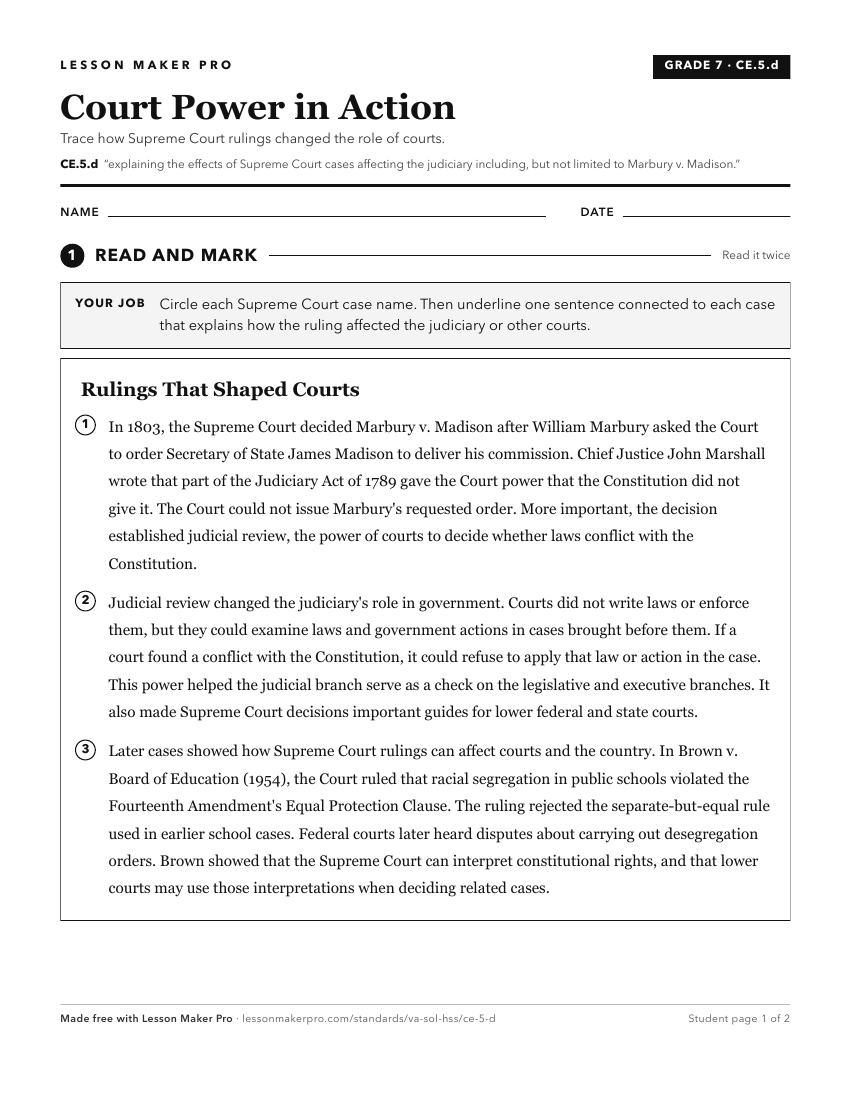
A ready-to-print activity worksheet aligned to CE.5.d, with an answer key for the teacher on its own page. No account needed.
PDF, US Letter, prints cleanly in black and white.
Download the worksheetKeep exploring
Related Standards
- CE.5.a
describing the system of state and federal courts including, but not limited to jurisdiction and judicial review
- VS.8.e
describing the effect of the Supreme Court’s decision in Plessy v. Ferguson
- CE.1.e
explaining the fundamental concepts of the U.S. government including, but not limited to due process, equal justice under the law, equal protection, elections a...
- CE.2.d
explaining the particular role and powers of the judicial branch as explained in Article III of the Constitution of the United States
Turn this exact standard into a lesson
Grade, subject, topic, and the complete standard are prefilled. Create one free, no account needed.
Also for this standard:Make a WorksheetMake a QuizMake a Sub Lesson