Virginia SOL 9.RV.1
SOL Standard (Knowledge and Skills Cluster)
Vocabulary Development and Word Analysis
Virginia Standards of Learning for English
Cluster contents
Knowledge and Skills in This Standard
9.RV.1 is a Standards of Learning standard. These are the knowledge and skills expectations under it.
- 9.RV.1.A
Develop and accurately use general academic and content-specific vocabulary through reading, discussing, and writing about grade-level texts and topics.
- 9.RV.1.B
Use context and sentence structure to clarify the literal and figurative meanings of words and phrases.
- 9.RV.1.C
Use structural analysis of roots, affixes, and etymology to explain the meanings of unfamiliar and complex words.
- 9.RV.1.D
Discriminate between the connotative and denotative meanings and interpret the connotation(s).
- 9.RV.1.E
Identify and explain idiomatic language in context.
- 9.RV.1.F
Explain the meaning of literary and classical allusions and figurative language in context and analyze their roles in texts.
- 9.RV.1.G
Use newly learned words and phrases in multiple contexts, including students’ discussions and speaking and writing activities.
Teacher's field guide
What This Cluster Means
What Students Need to Do
- Students work out unfamiliar words and phrases using context, sentence structure, roots, affixes, and word histories. They separate dictionary meanings from emotional associations and interpret idioms, allusions, and figurative language. They use new terms accurately in class talk and writing.
What Mastery Looks Like
- Given a grade-level passage, a student can infer a meaning and point to context, grammar, or word parts that support it. The student can explain how connotation or a figurative reference shapes tone and meaning. New vocabulary appears correctly in more than one spoken or written context.
Common Misconceptions
- Students may grab the first familiar definition and ignore context or sentence structure. They often treat close synonyms as interchangeable, missing differences in connotation. They may read idioms and allusions literally or identify figurative language without explaining its effect.
How to Assess It
- Give students this sentence: "Although Maya usually gave vague answers, her final statement was unequivocal: 'I will not join the plan.' Her decision opened a Pandora's box of arguments." Ask students to define unequivocal using context and word parts, explain the allusion's effect, and use unequivocal in a new sentence.
Lesson moves
Ways to Teach It
Give pairs cards labeled bene, mal, pre, dict, and ion; students combine them into words, predict meanings, and check a dictionary.
Ask students to write how replacing “slender” with “skinny” changes a character description, then cite the associations each word carries.
Play a context-clue relay where teams annotate one sentence for syntax, nearby clues, and word parts before defending their inferred meaning.
Compare headlines from two reports on the same event; students circle loaded words, discuss their effects, and rewrite each headline neutrally.
Free download
Printable 9.RV.1 Worksheet
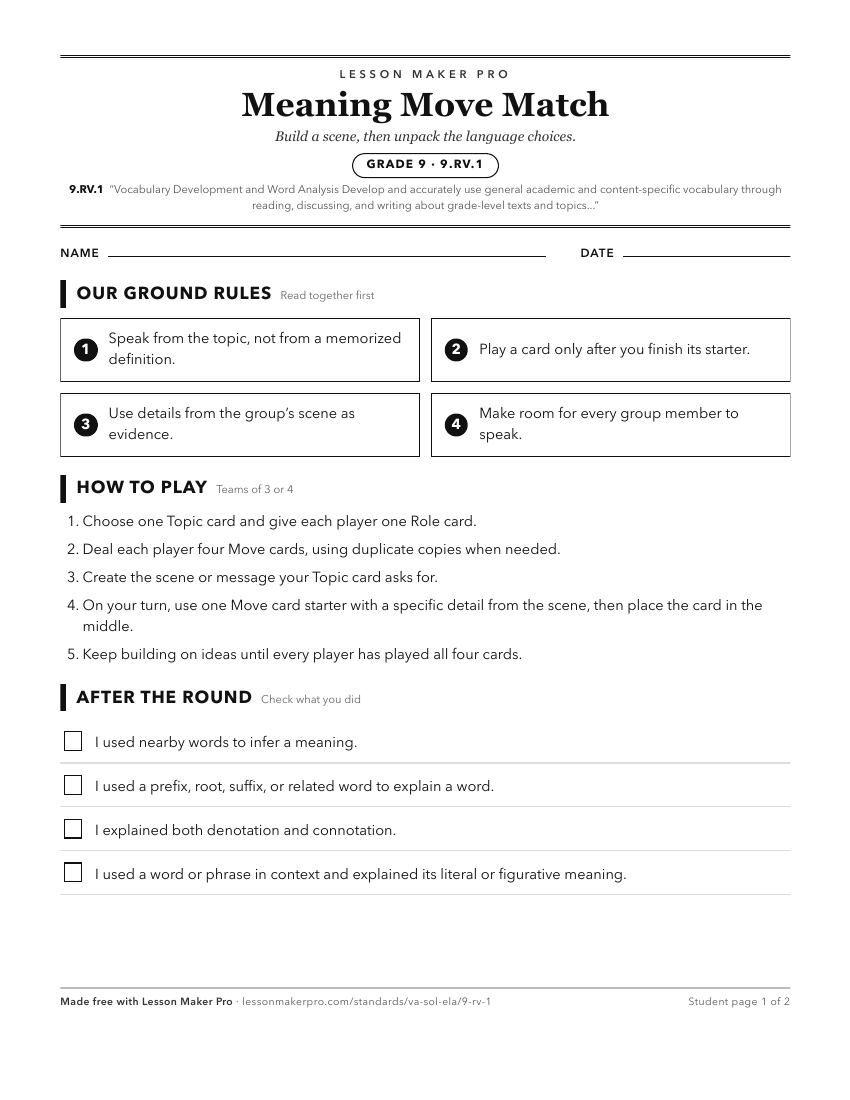
A ready-to-print activity worksheet aligned to 9.RV.1, with an answer key for the teacher on its own page. No account needed.
PDF, US Letter, prints cleanly in black and white.
Download the worksheetKeep exploring
Related Standards
Turn this cluster into a lesson
Grade, subject, and topic are prefilled; the lesson picks the standards under this heading. Create one free, no account needed.
Also for this cluster:Make a WorksheetMake a QuizMake a Sub Lesson