Virginia SOL 9.RV.1.E
The Standard
Identify and explain idiomatic language in context.
Virginia Standards of Learning for English · Vocabulary Development and Word Analysis
Teacher's field guide
What This Standard Means
What Students Need to Do
- Students recognize when a familiar phrase has a meaning different from the literal words. They use details around the phrase to explain its intended meaning in that passage.
What Mastery Looks Like
- Students spot an idiom within a sentence or passage. They explain its intended meaning and point to context clues that support their interpretation.
Common Misconceptions
- Students may interpret every phrase literally or assume any figurative phrase is an idiom. They may know the intended meaning but fail to cite the nearby words that support it. They may also confuse idioms with metaphors, similes, or slang.
How to Assess It
- Give this exit ticket: “Lena waited too long to apply, so she missed the boat.” Underline the idiom, explain its meaning, and name one context clue.
Lesson moves
Ways to Teach It
Match idiom cards to context cards, then use sticky notes to underline clues that reveal each phrase’s nonliteral meaning.
Discuss how “break the ice” changes a scene’s tone, then write a literal replacement and compare its effect.
Play Idiom Charades: students act out an intended meaning while teams name the phrase and suggest a fitting context.
Bring in three headlines, ads, or sports comments containing idioms, and have students explain what each means for its audience.
Free download
Printable 9.RV.1.E Worksheet
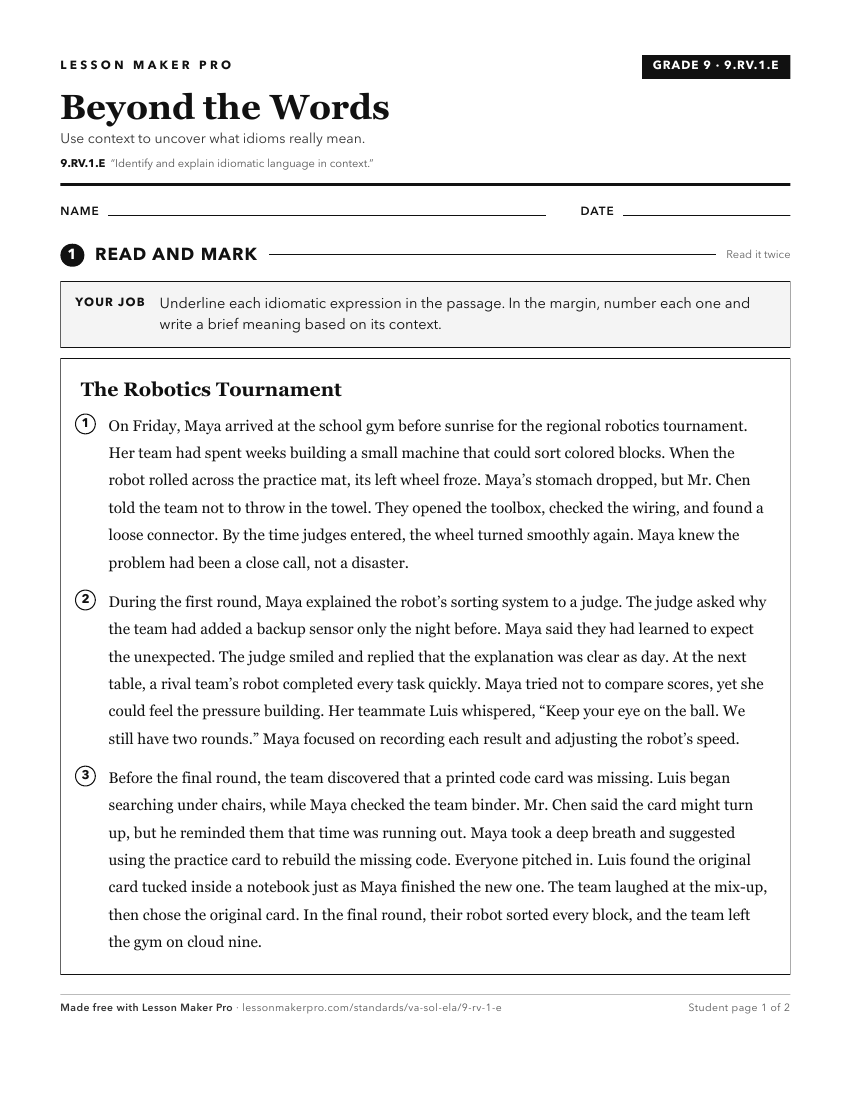
A ready-to-print activity worksheet aligned to 9.RV.1.E, with an answer key for the teacher on its own page. No account needed.
PDF, US Letter, prints cleanly in black and white.
Download the worksheetKeep exploring
Related Standards
Turn this exact standard into a lesson
Grade, subject, topic, and the complete standard are prefilled. Create one free, no account needed.
Also for this standard:Make a WorksheetMake a QuizMake a Sub Lesson