Virginia SOL 7.RL.2.C
The Standard
Explain how an author develops the points of view of different characters in a text (e.g., first-person, third person limited, third-person omniscient) and how they affect the reader’s interpretation of a text.
Virginia Standards of Learning for English · Craft and Style
Teacher's field guide
What This Standard Means
What Students Need to Do
- Students track how an author reveals each character’s perspective through thoughts, dialogue, actions, and access to information. They explain how narration and contrasting viewpoints shape the reader’s understanding and response.
What Mastery Looks Like
- Students correctly identify who tells the story and what each character knows, believes, or misunderstands. They use specific details to explain how contrasting perspectives influence sympathy, suspense, or judgment.
Common Misconceptions
- Students may confuse the narrator with the author or assume every first-person narrator is reliable. They may identify the narration type but not explain how withheld information, bias, or contrasting perspectives shape interpretation.
How to Assess It
- Give students a short passage with two character perspectives. Ask them to name the narration type, cite one detail developing each perspective, and explain how those views shape the reader’s judgment.
Lesson moves
Ways to Teach It
Give pairs a passage and colored sticky notes to mark each character’s thoughts, words, actions, and limits in knowledge.
Ask students to write: Which character do you trust most, and what two details shaped your judgment?
Play Perspective Detective by having teams identify narration type and character bias from short passage cards, earning points for cited evidence.
Have students retell a school disagreement from a student, teacher, and observer perspective, then compare how each version changes blame.
Free download
Printable 7.RL.2.C Worksheet
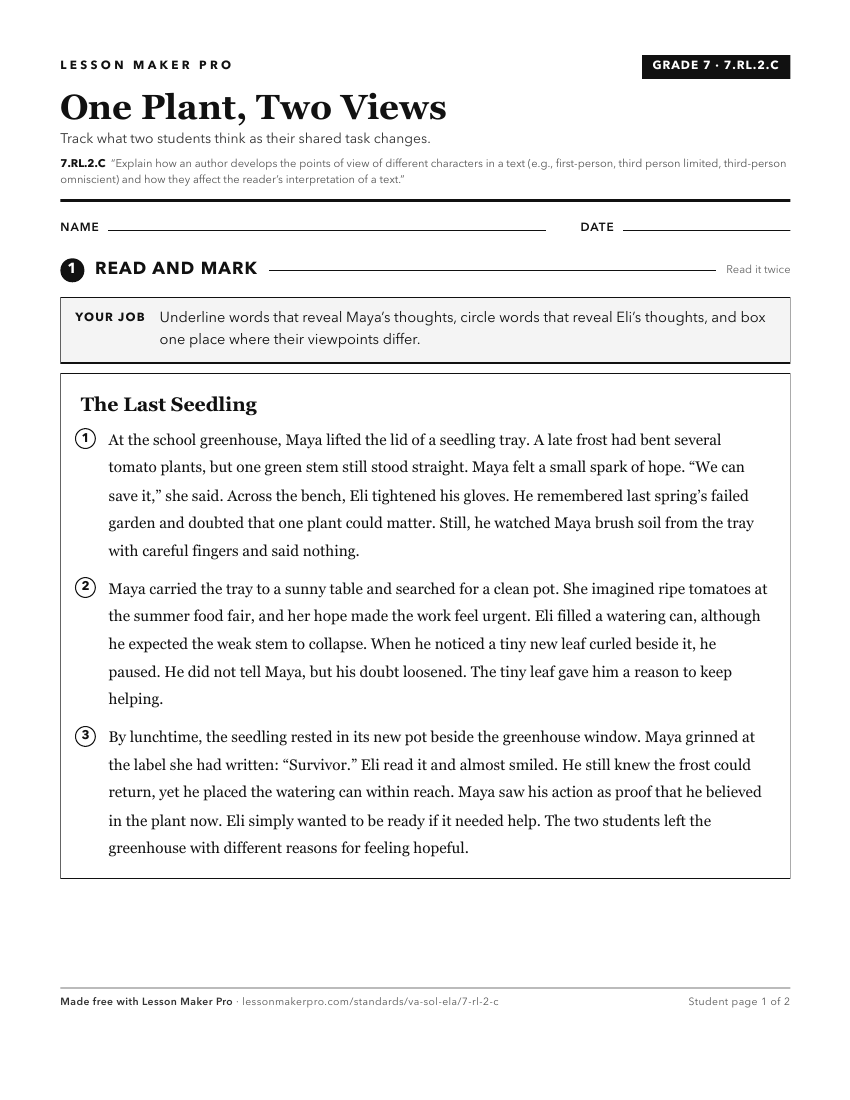
A ready-to-print activity worksheet aligned to 7.RL.2.C, with an answer key for the teacher on its own page. No account needed.
PDF, US Letter, prints cleanly in black and white.
Download the worksheetKeep exploring
Related Standards
- 5.RI.2.C
Determine the author’s purpose(s) and describe how the author’s perspective (e.g., beliefs, assumptions, biases) influences the meaning of the text.
- 5.RL.3.B
Compare and contrast the point of view from which different stories are narrated, including the difference between first-and third-person narratives.
- 6.RL.2.C
Explain how an author develops the point of view (e.g., first-person, third person limited, third-person omniscient) of the narrator or speaker in a text and in...
- 8.RL.2.C
Analyze how an author develops and contrasts the points of view of different characters or narrators in a text.
Turn this exact standard into a lesson
Grade, subject, topic, and the complete standard are prefilled. Create one free, no account needed.
Also for this standard:Make a WorksheetMake a QuizMake a Sub Lesson