Virginia SOL 10.LU.2.A
The Standard
Know and apply the rules for the use of a colon (e.g., joining independent clauses, introducing a list, introducing a quotation) when writing.
Virginia Standards of Learning for English · Mechanics
Teacher's field guide
What This Standard Means
What Students Need to Do
- Students place colons after complete clauses to signal that a list, quotation, explanation, or closely related clause follows. They also choose when another punctuation mark fits better.
What Mastery Looks Like
- Students use a colon only after a complete clause. They can introduce a list, quotation, explanation, or closely related clause and explain why the colon fits.
Common Misconceptions
- Students often place a colon directly after a verb or words such as “including” and “such as.” They may confuse colons with semicolons or capitalize every word after a colon.
How to Assess It
- Exit ticket: Correct the punctuation in “I packed: a flashlight, rope, and water” and “I knew what was missing a clear claim.” Explain one correction.
Lesson moves
Ways to Teach It
Give pairs sentence strips, and have them join complete clauses to lists, quotations, explanations, or related clauses using colons.
Ask students to explain when a colon works better than a comma or semicolon, using one original example.
Play Colon or No Colon by displaying sentences and having teams hold up punctuation cards, then justify each choice.
Have students find three colons in menus, news articles, or advertisements and label what each colon introduces.
Free download
Printable 10.LU.2.A Worksheet
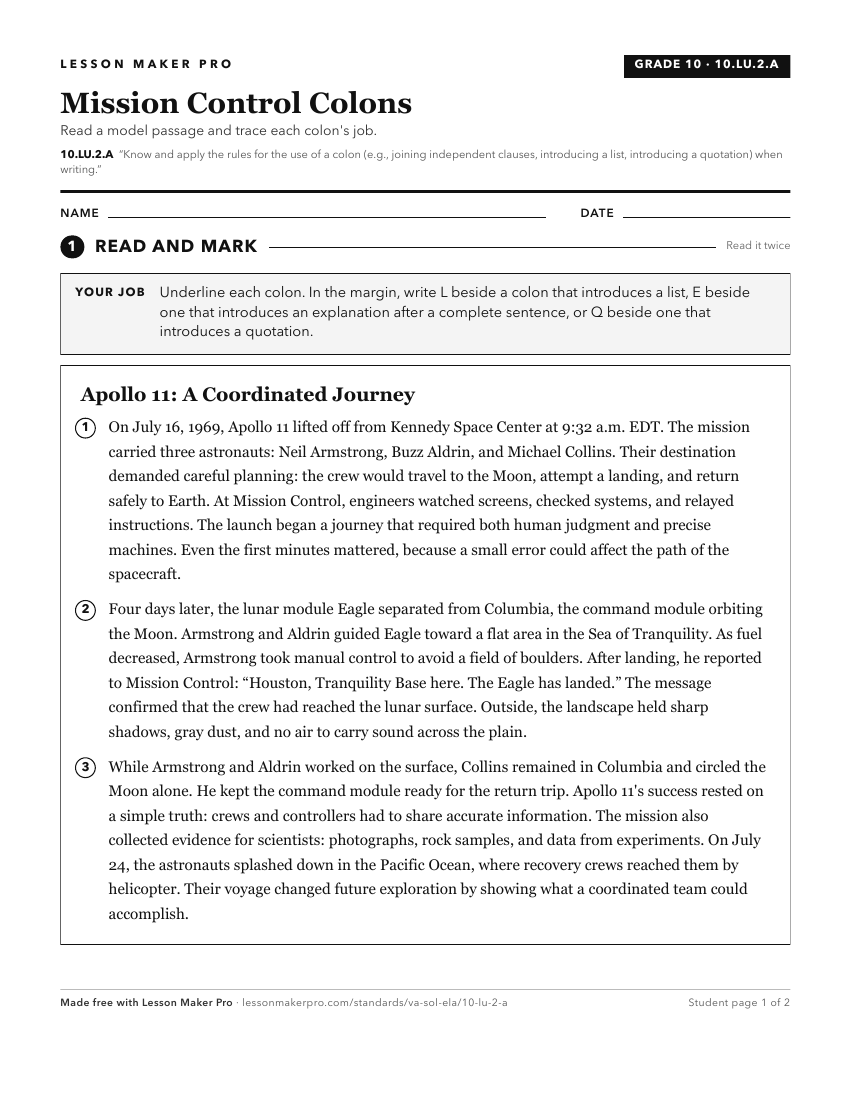
A ready-to-print activity worksheet aligned to 10.LU.2.A, with an answer key for the teacher on its own page. No account needed.
PDF, US Letter, prints cleanly in black and white.
Download the worksheetKeep exploring
Related Standards
- 9.LU.2.A
Use commas and semicolons to distinguish and divide main and subordinate clauses to link two or more closely related independent clauses when writing.
- 11.LU.2.A
Use commas, semi-colons, and colons correctly in complex sentences in writing.
- 2.LU.2.A
Identify statements, questions, and commands and use correct ending punctuation (e.g., period, question mark, and exclamation points).
- 5.LU.2.B
Use colons to separate hours and minutes and to introduce a list.
Turn this exact standard into a lesson
Grade, subject, topic, and the complete standard are prefilled. Create one free, no account needed.
Also for this standard:Make a WorksheetMake a QuizMake a Sub Lesson