Texas TEKS 8.19.A
The Standard
- 8.19
- Citizenship. The student understands the rights and responsibilities of citizens of the United States. The student is expected to:
define and give examples of unalienable rights
Texas Essential Knowledge and Skills for Social Studies
Teacher's field guide
What This Standard Means
What Students Need to Do
- Students explain that unalienable rights belong to every person and are not granted by government. They connect life, liberty, and the pursuit of happiness to concrete situations.
What Mastery Looks Like
- A student can define unalienable in their own words and name life, liberty, and the pursuit of happiness as examples. They can justify why a situation involves one of these rights.
Common Misconceptions
- Students may think government gives people unalienable rights or can remove them without cause. They may confuse rights with privileges or believe the pursuit of happiness guarantees happiness. They may also assume rights have no legal limits.
How to Assess It
- Exit ticket: In two sentences, explain what makes a right unalienable and give one real or fictional example.
Lesson moves
Ways to Teach It
Give groups scenario cards about speech, safety, and personal choice, then have them sort each under life, liberty, or pursuit of happiness.
Ask, “Does the pursuit of happiness guarantee happiness?” then require students to support their answer with one example.
Play “Right, Privilege, or Responsibility” using rapid-fire examples, with students holding up labeled cards and explaining one choice.
Have students examine one school rule and explain how it balances individual liberty with the safety or rights of others.
Free download
Printable 8.19.A Worksheet
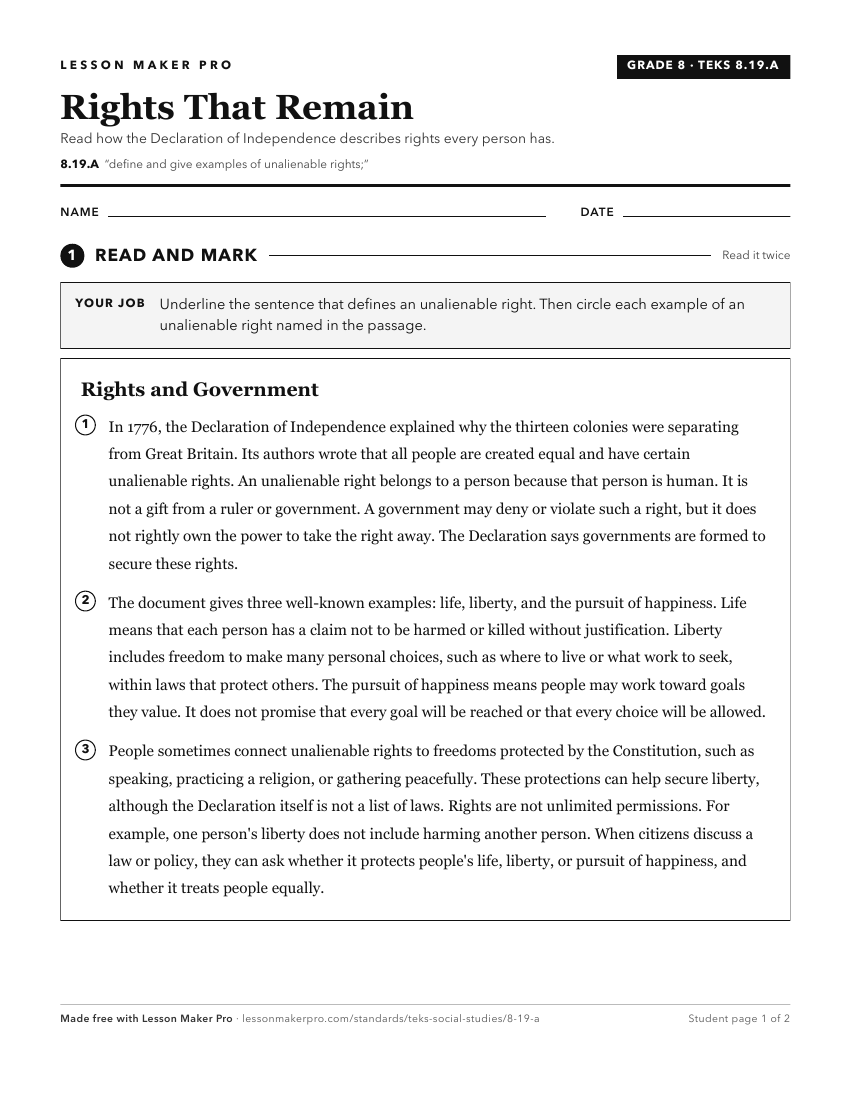
A ready-to-print activity worksheet aligned to 8.19.A, with an answer key for the teacher on its own page. No account needed.
PDF, US Letter, prints cleanly in black and white.
Download the worksheetKeep exploring
Related Standards
- 7.15.A
explain rights of Texas citizens
- 5.19
The student understands the fundamental rights of American citizens guaranteed in the Bill of Rights. The student is expected to describe the fundamental rights...
- 8.19.B
summarize rights guaranteed in the Bill of Rights
- 3.8.A
identify the purposes of the Declaration of Independence and the U.S. Constitution, including the Bill of Rights
Turn this exact standard into a lesson
Grade, subject, topic, and the complete standard are prefilled. Create one free, no account needed.
Also for this standard:Make a WorksheetMake a QuizMake a Sub Lesson