Texas TEKS 6.13.A
The Standard
- 6.13
- The student understands the similarities and differences within and among cultures in various world societies
identify and describe common traits that define cultures and culture regions
Texas Essential Knowledge and Skills for Social Studies
Teacher's field guide
What This Standard Means
What Students Need to Do
- Students examine language, religion, customs, food, arts, and social practices in different places. They use several shared traits to explain why places may be grouped together, while recognizing that boundaries can overlap.
What Mastery Looks Like
- A student can sort places into a reasonable culture region and support the choice with specific evidence. The student uses more than one trait and explains exceptions or overlap.
Common Misconceptions
- Students may treat race, nationality, and culture as the same thing. They may rely on one trait, assume everyone in a region is alike, or view regional boundaries as fixed lines.
How to Assess It
- Give students profiles of three fictional countries. Ask them to group two into one culture region and justify the choice with at least three shared traits.
Lesson moves
Ways to Teach It
Give groups cards showing food, clothing, language, religion, and music, then have them sort the cards into possible culture regions.
Write a paragraph answering: Can one place belong to more than one culture region? Use two cultural traits as evidence.
Play Culture Region Match, where teams pair place cards with trait cards and earn points for accurate explanations.
Examine local menus, store flyers, and public signs, then list cultural influences visible in the community without making assumptions about individuals.
Free download
Printable 6.13.A Worksheet
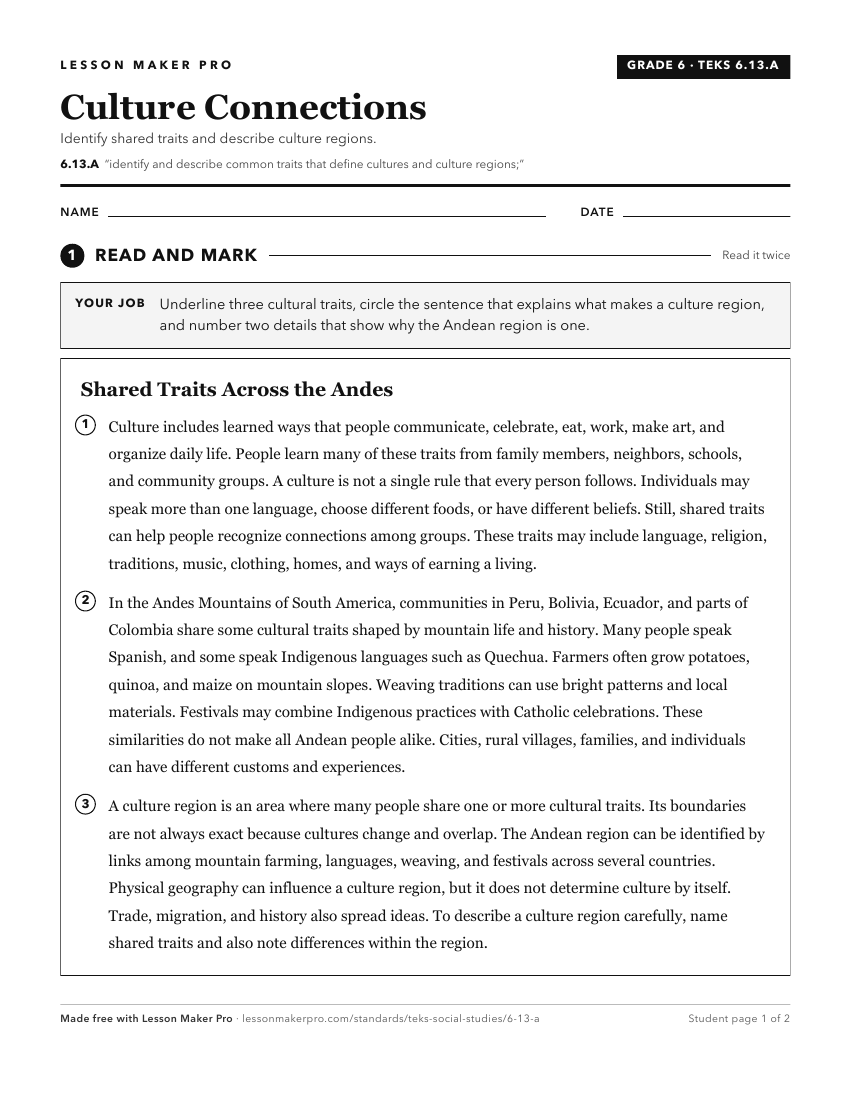
A ready-to-print activity worksheet aligned to 6.13.A, with an answer key for the teacher on its own page. No account needed.
PDF, US Letter, prints cleanly in black and white.
Download the worksheetKeep exploring
Related Standards
- 6.15.A
identify and describe means of cultural diffusion such as trade, travel, and war
- 4.1.C
describe the cultural regions in which American Indians lived such as Gulf, Plains, Puebloan, and Southeastern
- 6.15.B
identify and describe factors that influence cultural change such as improvements in communication, transportation, and economic development
- 6.13.D
identify and explain examples of conflict and cooperation between and among cultures
Turn this exact standard into a lesson
Grade, subject, topic, and the complete standard are prefilled. Create one free, no account needed.
Also for this standard:Make a WorksheetMake a QuizMake a Sub Lesson