Texas TEKS 6.10.A
The Standard
- 6.10
- The student understands various ways in which people organize governments
identify and give examples of governments with rule by one, few, or many
Texas Essential Knowledge and Skills for Social Studies
Teacher's field guide
What This Standard Means
What Students Need to Do
- Students sort governments by whether political power is concentrated in one leader, a small group, or the citizen body. They name examples and cite evidence about who makes final decisions.
What Mastery Looks Like
- A student can correctly classify an absolute monarchy, a military junta, and a representative democracy. The student explains each choice using who writes laws, selects leaders, or controls opposition.
Common Misconceptions
- Students may assume every monarchy gives one ruler total control, ignoring constitutional monarchies. They may call any country with elections a democracy, even when choices are restricted. They may also think many means every resident can vote.
How to Assess It
- Exit ticket: Classify an absolute monarchy, a military junta, and a representative democracy by where power is held. Explain one choice and name another example.
Lesson moves
Ways to Teach It
Give groups nine cards, including an absolute monarch, a military council, and an elected legislature, to sort by where decision-making power sits.
Ask: Which matters more when classifying a government, the leader's title or who makes final decisions? Defend your answer with two examples.
Play Government Detective: read one clue about lawmaking or leadership selection, and teams hold up One, Few, or Many cards.
Use a local city council webpage to trace who proposes, votes on, and can challenge a decision, then classify where power sits.
Free download
Printable 6.10.A Worksheet
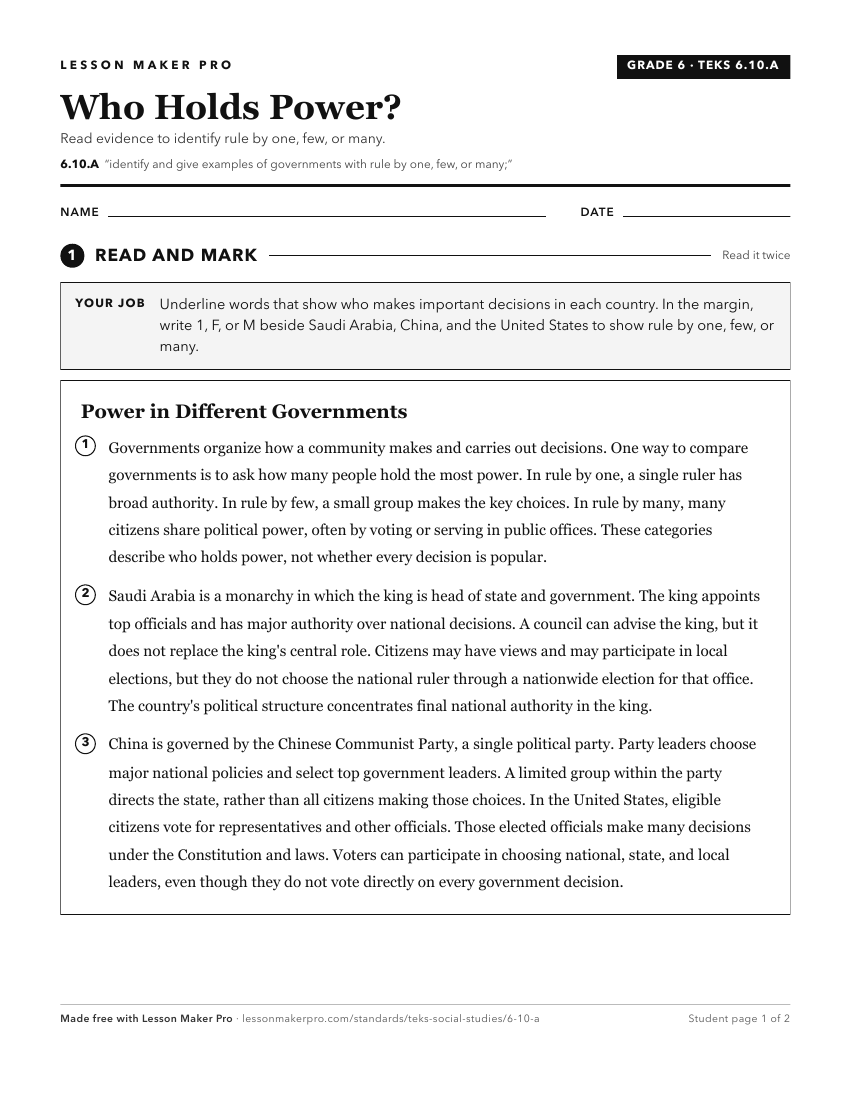
A ready-to-print activity worksheet aligned to 6.10.A, with an answer key for the teacher on its own page. No account needed.
PDF, US Letter, prints cleanly in black and white.
Download the worksheetKeep exploring
Related Standards
- 3.7.A
describe the basic structure of government in the local community, state, and nation
- 6.10
The student understands various ways in which people organize governments
- 6.10.B
compare ways in which various societies such as China, Germany, India, and Russia organize government and how they function
- 6.9.A
describe and compare examples of limited and unlimited governments such as constitutional (limited) and totalitarian (unlimited)
Turn this exact standard into a lesson
Grade, subject, topic, and the complete standard are prefilled. Create one free, no account needed.
Also for this standard:Make a WorksheetMake a QuizMake a Sub Lesson