Texas TEKS 5.9.B
The Standard
- 5.9
- Economics. The student understands the basic economic patterns of early societies in the United States. The student is expected to:
identify major industries of colonial America such as shipbuilding and growing of cash crops.
Texas Essential Knowledge and Skills for Social Studies
Teacher's field guide
What This Standard Means
What Students Need to Do
- Students match colonial regions with major industries, such as New England shipbuilding and Southern tobacco, rice, and indigo production. They explain how climate, waterways, soil, and forests shaped where industries developed.
What Mastery Looks Like
- Given a colonial map, students can place industries in the correct regions and support each choice with geographic evidence. They can distinguish crops raised for sale from crops grown mainly for household use.
Common Misconceptions
- Students may think every colony had the same industries. They may confuse a crop raised for sale with a food crop grown for a family. They may overlook the role of enslaved labor in producing Southern crops.
How to Assess It
- Give students a blank map of the colonial regions. Ask them to place shipbuilding and one crop industry, then explain each placement using a natural resource or geographic feature.
Lesson moves
Ways to Teach It
Have groups sort cards showing timber, ports, tobacco, rice, indigo, grain, and ships onto a map of the colonial regions.
Ask students to write: Why did shipbuilding grow in New England while tobacco production grew in the South?
Play a matching game in which students pair each colonial industry with its region and supporting resources.
Compare one local industry with a colonial industry, then list how geography and available resources shape both.
Free download
Printable 5.9.B Worksheet
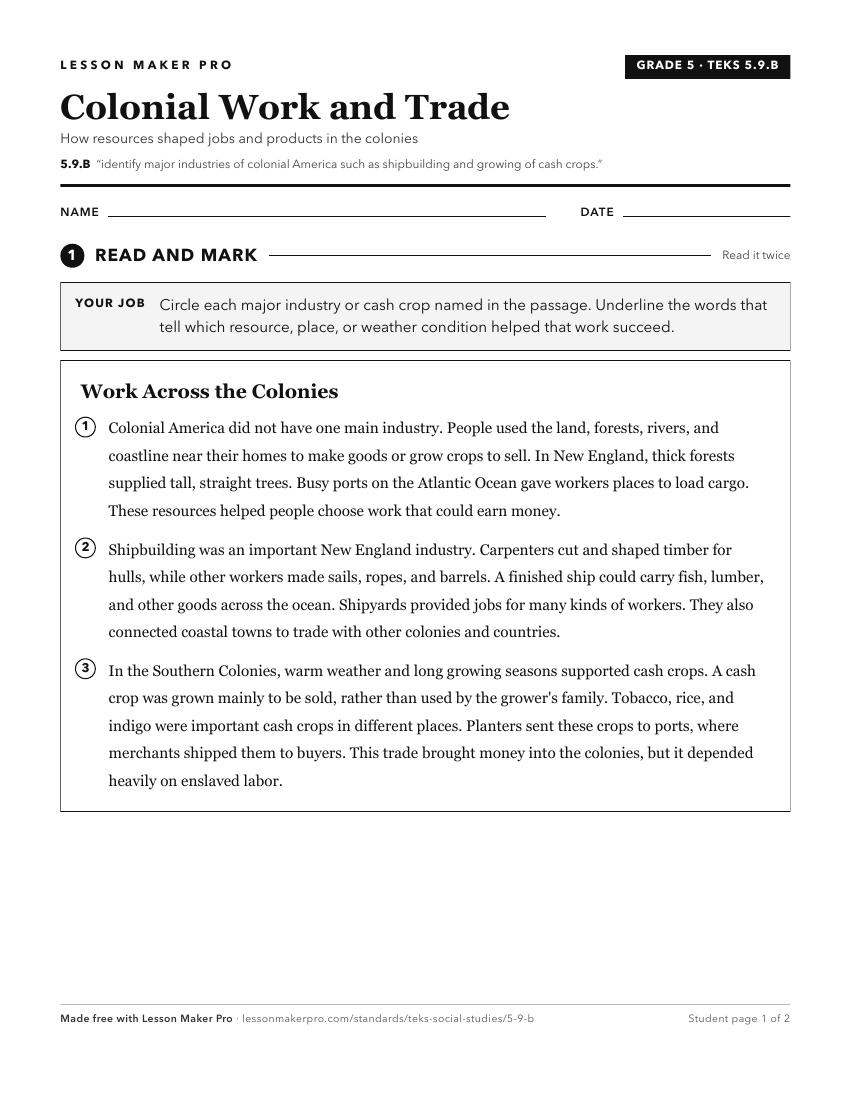
A ready-to-print activity worksheet aligned to 5.9.B, with an answer key for the teacher on its own page. No account needed.
PDF, US Letter, prints cleanly in black and white.
Download the worksheetKeep exploring
Related Standards
- 4.10.C
describe the development of the free enterprise system in Texas such as the growth of cash crops by early colonists and the railroad boom.
- 8.2.B
compare political, economic, religious, and social reasons for the establishment of the 13 English colonies.
- 5.9.A
explain the economic patterns of early European colonies
- 5.10.A
identify the development of the free enterprise system in colonial America and the United States
Turn this exact standard into a lesson
Grade, subject, topic, and the complete standard are prefilled. Create one free, no account needed.
Also for this standard:Make a WorksheetMake a QuizMake a Sub Lesson