Texas TEKS 3.2.A
The Standard
- 3.2
- History. The student understands common characteristics of communities, past and present. The student is expected to:
identify reasons people have formed communities, including a need for security and laws, religious freedom, and material well-being
Texas Essential Knowledge and Skills for Social Studies
Teacher's field guide
What This Standard Means
What Students Need to Do
- Students identify why people choose to live together in communities. They explain how safety, shared laws, freedom to practice religion, jobs, trade, and resources can shape that choice.
What Mastery Looks Like
- Students match a community example to one or more reasons it formed. They support each choice with a detail from a picture, map, short passage, or scenario.
Common Misconceptions
- Students may think every community forms for only one reason. They may think security means only soldiers, or that material well-being means being rich rather than meeting needs through work, trade, and resources.
How to Assess It
- Give students a settlement scenario and ask: “Why might people form a community here? Name two reasons and cite one detail for each.”
Lesson moves
Ways to Teach It
Build a model settlement with blocks, then add a fence, rule board, worship space, and market; explain why each feature draws people.
Write which reason would matter most when starting a new community, then support the choice with two specific examples.
Play a card-matching relay where teams pair community scenarios with security, laws, religious freedom, jobs, trade, or resources.
Study a local map and label places that support safety, laws, religious practice, jobs, trade, and access to needed resources.
Free download
Printable 3.2.A Worksheet
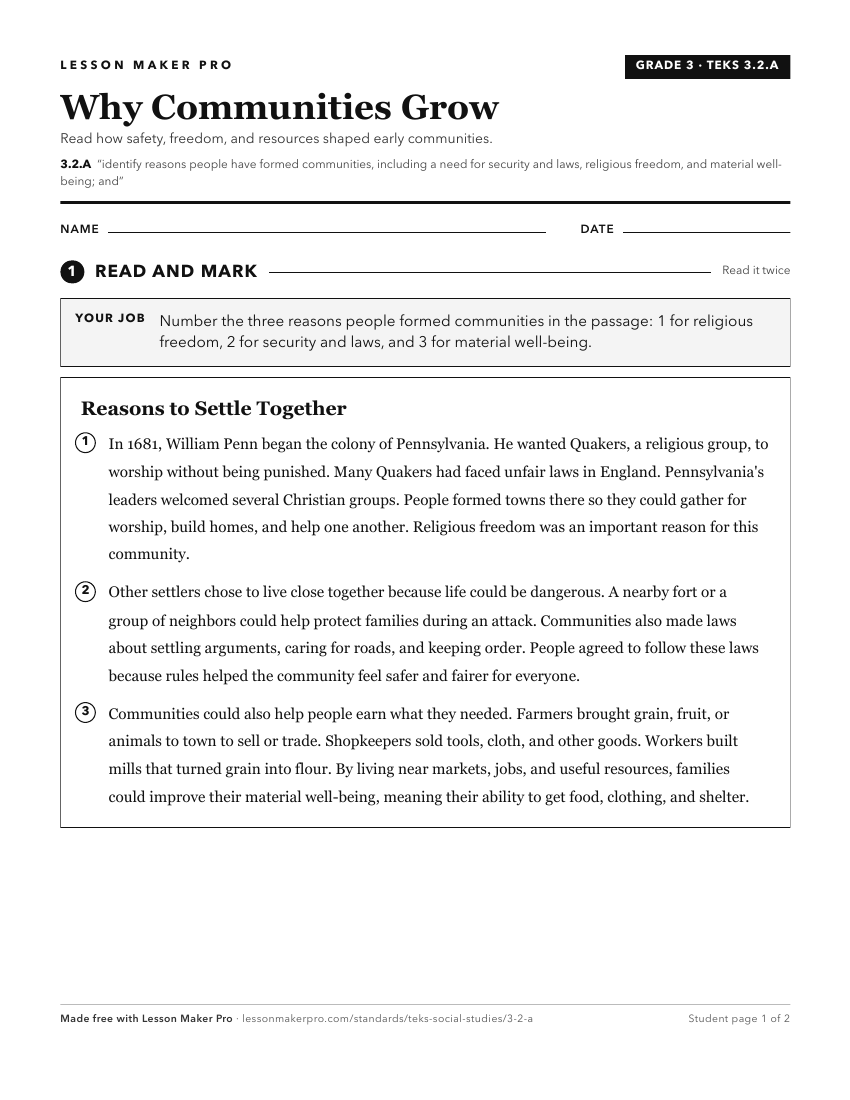
A ready-to-print activity worksheet aligned to 3.2.A, with an answer key for the teacher on its own page. No account needed.
PDF, US Letter, prints cleanly in black and white.
Download the worksheetKeep exploring
Related Standards
- 8.2.B
compare political, economic, religious, and social reasons for the establishment of the 13 English colonies.
- 3.2.B
compare ways in which people in the local community and other communities meet their needs for government, education, communication, transportation, and recreat...
- 1.14.A
describe and explain the importance of beliefs, language, and traditions of families and communities
- K.5.A
identify basic human needs of food, clothing, and shelter
Turn this exact standard into a lesson
Grade, subject, topic, and the complete standard are prefilled. Create one free, no account needed.
Also for this standard:Make a WorksheetMake a QuizMake a Sub Lesson