Texas TEKS 8.11.C
The Standard
- 8.11
- The student knows that natural events and human activity can impact global climate
describe the carbon cycle.
Texas Essential Knowledge and Skills for Science
Teacher's field guide
What This Standard Means
What Students Need to Do
- Students trace carbon as it moves among the atmosphere, organisms, oceans, soil, rocks, and fossil fuels. They connect each movement to photosynthesis, respiration, decomposition, combustion, and ocean exchange.
What Mastery Looks Like
- Students can draw and label a model showing major carbon reservoirs and processes. They can explain how carbon atoms move through both living and nonliving parts of Earth.
Common Misconceptions
- Students may think carbon exists only in carbon dioxide or that plants remove it permanently from the atmosphere. They may also confuse carbon reservoirs with the processes that move carbon.
How to Assess It
- Give students a blank diagram with the atmosphere, a plant, an animal, soil, and fossil fuels. Ask them to add arrows and label each carbon-moving process.
Lesson moves
Ways to Teach It
Give groups carbon atom cards to pass among labeled reservoir stations according to photosynthesis, respiration, decomposition, combustion, and ocean exchange.
Ask students to explain what could happen to one carbon atom released by a burning log.
Play a matching game pairing carbon movements, such as atmosphere to plant, with the process responsible for each movement.
Use local traffic, trees, and soil to map where carbon is stored and how human activity moves it.
Free download
Printable 8.11.C Worksheet
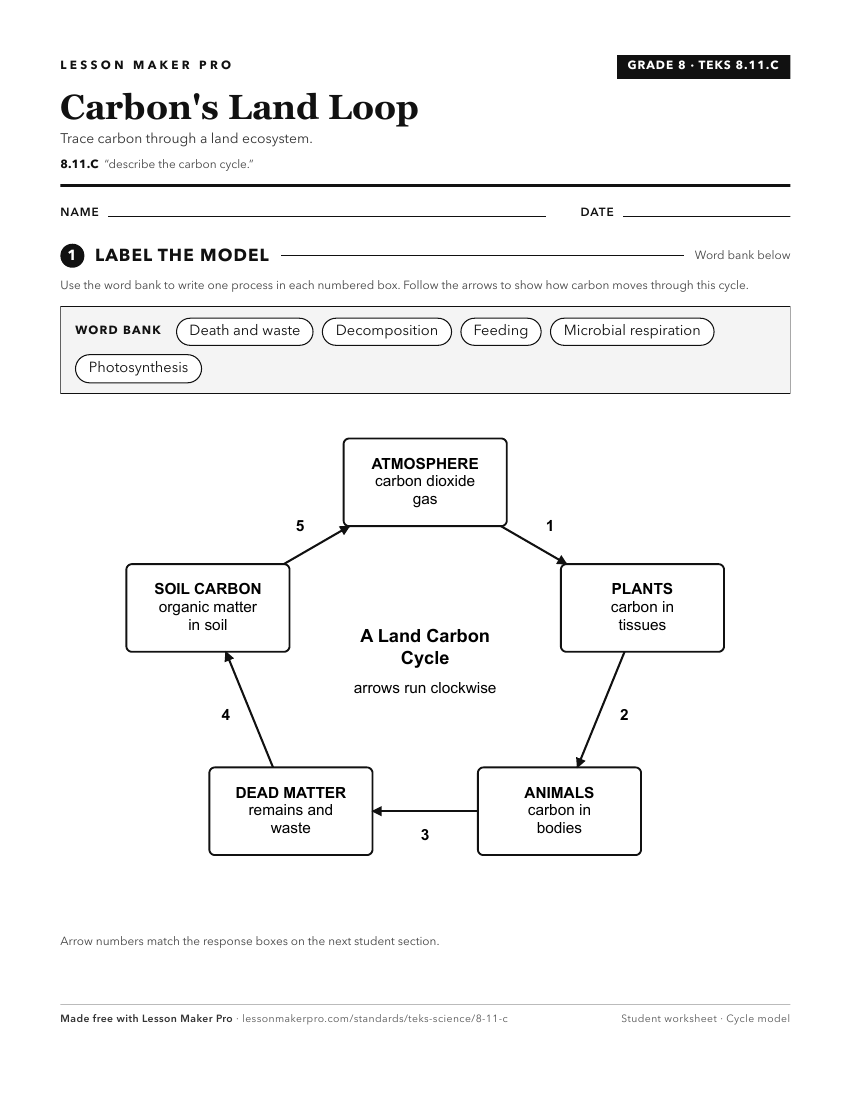
A ready-to-print activity worksheet aligned to 8.11.C, with an answer key for the teacher on its own page. No account needed.
PDF, US Letter, prints cleanly in black and white.
Download the worksheetKeep exploring
Related Standards
- 4.12.A
investigate and explain how most producers can make their own food using sunlight, water, and carbon dioxide through the cycling of matter
- 7.12.B
describe how ecosystems are sustained by the continuous flow of energy and the recycling of matter and nutrients within the biosphere.
- 4.12.B
describe the cycling of matter and flow of energy through food webs, including the roles of the Sun, producers, consumers, and decomposers
- 6.10.C
describe how metamorphic, igneous, and sedimentary rocks form and change through geologic processes in the rock cycle.
Turn this exact standard into a lesson
Grade, subject, topic, and the complete standard are prefilled. Create one free, no account needed.
Also for this standard:Make a WorksheetMake a QuizMake a Sub Lesson