Texas TEKS 7.10.B
The Standard
- 7.10
- Earth and space. The student understands the causes and effects of plate tectonics. The student is expected to:
describe how plate tectonics causes ocean basin formation, earthquakes, mountain building, and volcanic eruptions, including supervolcanoes and hot spots.
Texas Essential Knowledge and Skills for Science
Teacher's field guide
What This Standard Means
What Students Need to Do
- Students connect divergent, convergent, and transform plate motion to specific changes in Earth’s crust. They explain hot spot chains, large magma systems, and caldera-forming eruptions using cause-and-effect steps.
What Mastery Looks Like
- Given a plate boundary diagram, students can predict likely landforms and geologic events and explain why they occur. They can distinguish boundary volcanoes from hot spot volcanoes and describe how a supereruption forms a caldera.
Common Misconceptions
- Students may think ocean basins are simply low areas filled with water, rather than crust formed by seafloor spreading. They may assume all mountains are volcanoes or that all volcanoes occur at plate boundaries. Some confuse supervolcanoes with unusually tall volcanoes.
How to Assess It
- Exit ticket: Give students diagrams of divergence, subduction, a transform boundary, and a plate crossing a hot spot. Have them label each likely outcome, then explain how a large caldera can form.
Lesson moves
Ways to Teach It
Slide graham crackers over frosting to model divergence, collision, subduction, and transform motion, then record the landforms or hazards each creates.
Write: How can one moving plate create both a volcanic chain and an age pattern above a stationary hot spot?
Sort boundary, motion, evidence, and outcome cards, then race to build accurate chains such as divergence, seafloor spreading, new ocean basin.
Use current USGS earthquake and volcano maps to compare event locations with plate boundaries, Yellowstone, and the Hawaiian hot spot.
Free download
Printable 7.10.B Worksheet
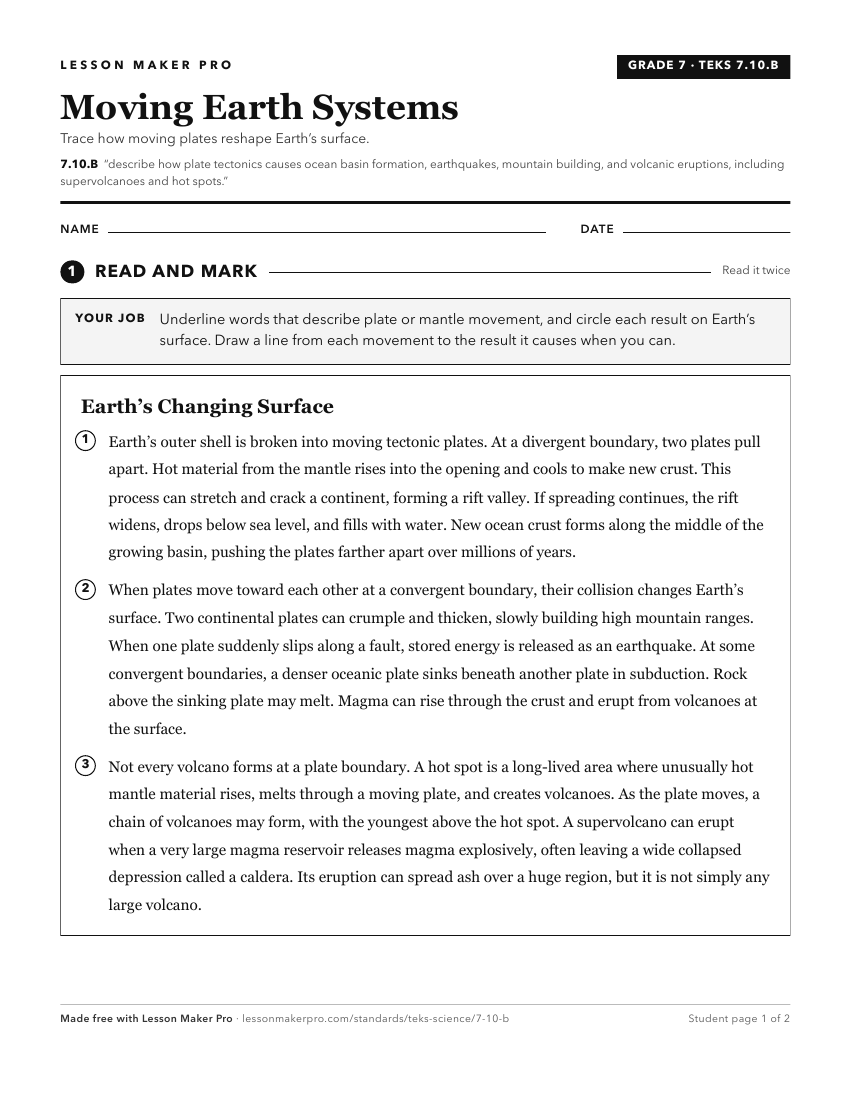
A ready-to-print activity worksheet aligned to 7.10.B, with an answer key for the teacher on its own page. No account needed.
PDF, US Letter, prints cleanly in black and white.
Download the worksheetKeep exploring
Related Standards
- 3.10.C
model and describe rapid changes in Earth's surface such as volcanic eruptions, earthquakes, and landslides.
- 7.10.A
describe the evidence that supports that Earth has changed over time, including fossil evidence, plate tectonics, and superposition
- 7.10
Earth and space. The student understands the causes and effects of plate tectonics. The student is expected to:
- 8.11.A
use scientific evidence to describe how natural events, including volcanic eruptions, meteor impacts, abrupt changes in ocean currents, and the release and abso...
Turn this exact standard into a lesson
Grade, subject, topic, and the complete standard are prefilled. Create one free, no account needed.
Also for this standard:Make a WorksheetMake a QuizMake a Sub Lesson