Texas TEKS 2.11.A
The Standard
- 2.11
- Earth and space. The student knows that earth materials and products made from these materials are important to everyday life. The student is expected to:
distinguish between natural and manmade resources
Texas Essential Knowledge and Skills for Science
Teacher's field guide
What This Standard Means
What Students Need to Do
- Students identify whether a resource comes from nature or is made by people. They sort familiar examples and explain which clues support each choice.
What Mastery Looks Like
- Students correctly group examples such as water, soil, trees, bricks, bottles, and tools. They explain that an object can use natural materials but still be made by people.
Common Misconceptions
- Students may call a wooden chair natural because wood comes from trees. They may think anything outdoors is natural, including fences and sidewalks. Some exclude air, water, soil, and rocks because they are not alive.
How to Assess It
- Exit ticket: Sort water, a tree, a brick, and a plastic bottle into natural and human-made groups. Explain why the brick belongs in its group.
Lesson moves
Ways to Teach It
Give pairs a rock, leaf, pencil, and plastic cup to sort into labeled hoops, then ask them to explain each choice.
Ask students to write: Is a wooden chair natural or human-made, and what evidence supports your answer?
Play a card relay where teams place picture cards under natural or human-made labels and correct one disputed choice together.
Walk around the schoolyard and record three resources from nature and three made by people that the school uses.
Free download
Printable 2.11.A Worksheet
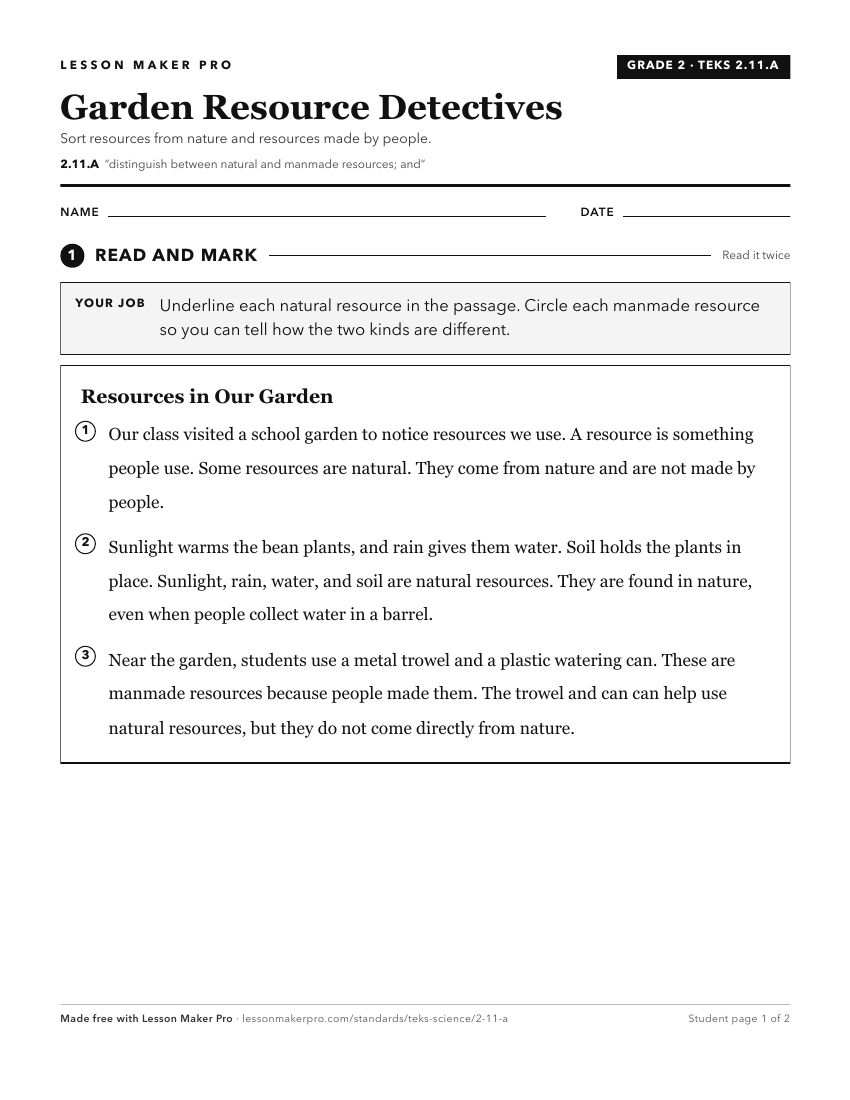
A ready-to-print activity worksheet aligned to 2.11.A, with an answer key for the teacher on its own page. No account needed.
PDF, US Letter, prints cleanly in black and white.
Download the worksheetKeep exploring
Related Standards
- 4.11.A
identify and explain advantages and disadvantages of using Earth's renewable and nonrenewable natural resources such as wind, water, sunlight, plants, animals, ...
- 4.11
Earth and space. The student understands how natural resources are important and can be managed. The student is expected to:
- 3.11.A
explore and explain how humans use natural resources such as in construction, in agriculture, in transportation, and to make products
- 3.11.B
explain why the conservation of natural resources is important
Turn this exact standard into a lesson
Grade, subject, topic, and the complete standard are prefilled. Create one free, no account needed.
Also for this standard:Make a WorksheetMake a QuizMake a Sub Lesson