TEKS Math 5.8.C
The Standard
graph in the first quadrant of the coordinate plane ordered pairs of numbers arising from mathematical and real-world problems, including those generated by number patterns or found in an input-output table
Texas Essential Knowledge and Skills for Mathematics
Teacher's field guide
What This Standard Means
What Students Need to Do
- Students turn values from tables, patterns, and word problems into points on a first-quadrant coordinate grid. They read each pair in order, moving horizontally for the first value and vertically for the second.
What Mastery Looks Like
- Students accurately plot points from a number pattern, input-output table, or short word problem. They use the origin and axis scales correctly and explain what each coordinate represents.
Common Misconceptions
- Students often reverse the coordinates and move vertically before moving horizontally. They may start counting at 1 instead of the origin or ignore the scale marked on an axis.
How to Assess It
- Give students a first-quadrant grid and the pairs (1, 3), (2, 6), (3, 9), and (4, 12). Ask them to label the axes, plot each point, and write the pattern they notice.
Lesson moves
Ways to Teach It
Make a floor coordinate grid with tape, then have students stand at ordered pairs drawn from cards.
Ask students to explain why (2, 5) and (5, 2) appear in different locations on a coordinate grid.
Run a table-to-graph relay where teams plot one row at a time and check each point before passing the marker.
Graph minutes walked and total distance from a simple fitness table, then discuss what each plotted point means.
Free download
Printable 5.8.C Worksheet
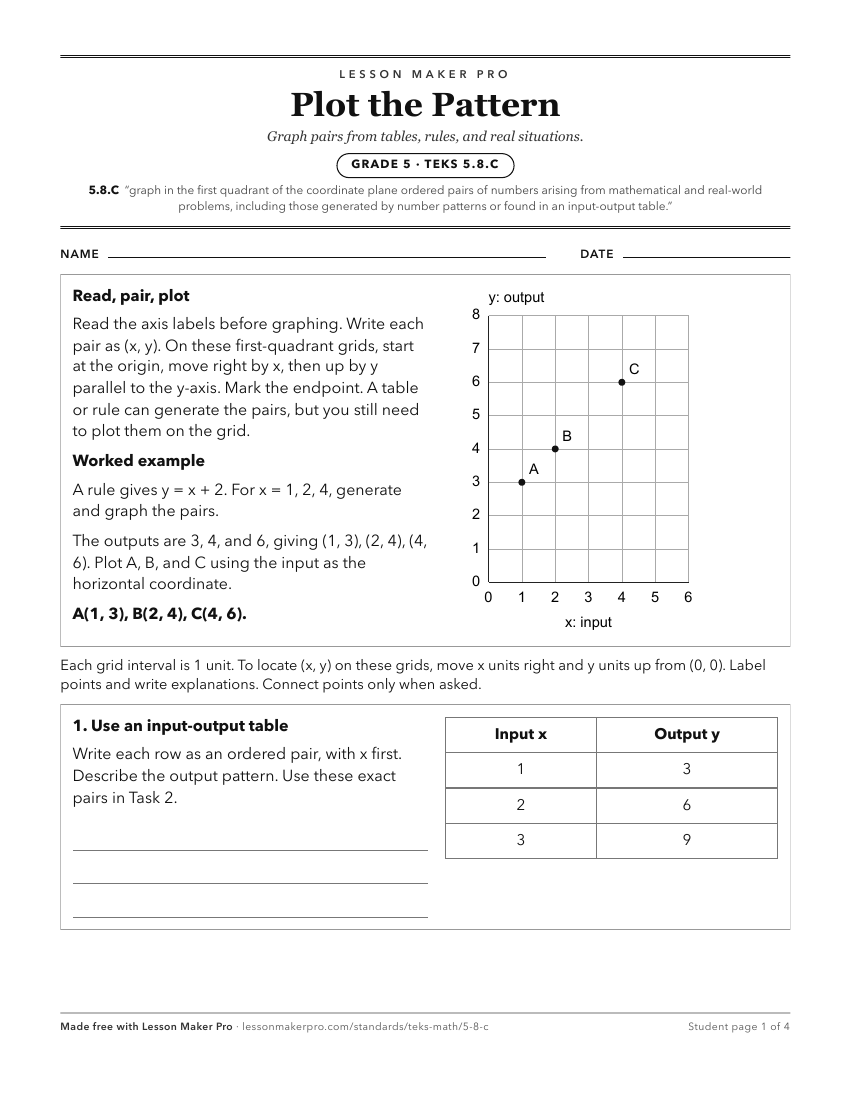
A ready-to-print activity worksheet aligned to 5.8.C, with an answer key for the teacher on its own page. No account needed.
PDF, US Letter, prints cleanly in black and white.
Download the worksheetKeep exploring
Related Standards
- 5.8.B
describe the process for graphing ordered pairs of numbers in the first quadrant of the coordinate plane
- 6.11
The student applies mathematical process standards to use coordinate geometry to identify locations on a plane. The student is expected to graph points in all f...
- 6.12.A
represent numeric data graphically, including dot plots, stem-and-leaf plots, histograms, and box plots
- 8.5.G
identify functions using sets of ordered pairs, tables, mappings, and graphs
Turn this exact standard into a lesson
Grade, subject, topic, and the complete standard are prefilled. Create one free, no account needed.
Also for this standard:Make a WorksheetMake a QuizMake a Sub Lesson