TEKS Math 3.3.B
The Standard
determine the corresponding fraction greater than zero and less than or equal to one with denominators of 2, 3, 4, 6, and 8 given a specified point on a number line
Texas Essential Knowledge and Skills for Mathematics
Teacher's field guide
What This Standard Means
What Students Need to Do
- Students identify the fraction shown by a point on a number line between 0 and 1. They use equal spaces to find denominators of 2, 3, 4, 6, or 8 and count spaces to find the numerator.
What Mastery Looks Like
- Students count the equal spaces from 0 to 1 to identify the denominator. They count spaces from 0 to the point to identify the numerator, including points at one whole.
Common Misconceptions
- Students may count tick marks instead of equal spaces, or use the point’s position as the denominator. They may also ignore the zero and label the first tick as one whole.
How to Assess It
- Give students a number line from 0 to 1 divided into eight equal spaces, with a point on the sixth tick after zero. Ask them to name the fraction and explain how they found the numerator and denominator.
Lesson moves
Ways to Teach It
Make a floor number line with tape, divide it into six equal spaces, and have students stand at fractions called aloud.
Show a point at 3/4 and ask, “What does each space represent, and how does the point show the numerator?”
Play Fraction Line Match by pairing cards showing number lines with cards labeled in halves, thirds, fourths, sixths, or eighths.
Mark fractional distances on a one-mile trail map and ask students to name each marked distance from the starting point.
Free download
Printable 3.3.B Worksheet
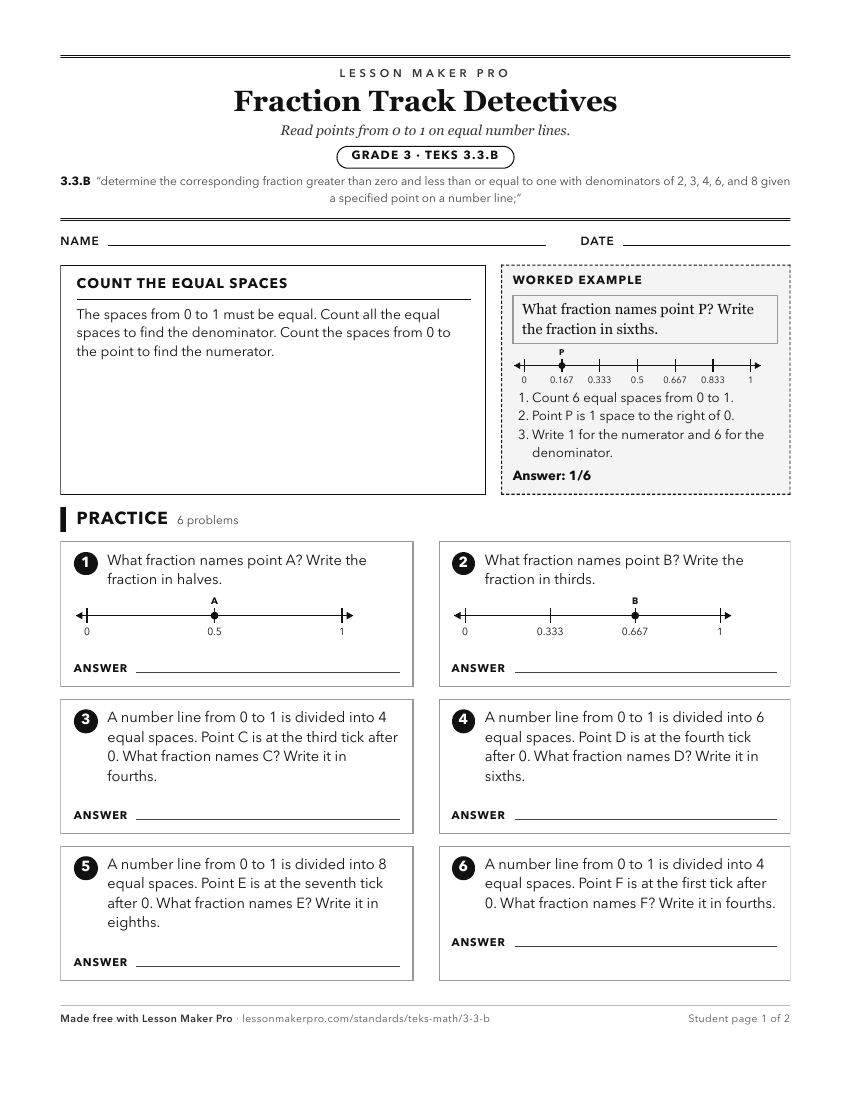
A ready-to-print activity worksheet aligned to 3.3.B, with an answer key for the teacher on its own page. No account needed.
PDF, US Letter, prints cleanly in black and white.
Download the worksheetKeep exploring
Related Standards
- 3.3.F
represent equivalent fractions with denominators of 2, 3, 4, 6, and 8 using a variety of objects and pictorial models, including number lines
- 3.7.A
represent fractions of halves, fourths, and eighths as distances from zero on a number line
- 3.3.A
represent fractions greater than zero and less than or equal to one with denominators of 2, 3, 4, 6, and 8 using concrete objects and pictorial models, includin...
- 4.2.H
determine the corresponding decimal to the tenths or hundredths place of a specified point on a number line
Turn this exact standard into a lesson
Grade, subject, topic, and the complete standard are prefilled. Create one free, no account needed.
Also for this standard:Make a WorksheetMake a QuizMake a Sub Lesson