TEKS Math 3.1.F
The Standard
analyze mathematical relationships to connect and communicate mathematical ideas
Texas Essential Knowledge and Skills for Mathematics
Teacher's field guide
What This Standard Means
What Students Need to Do
- Students look for how numbers, operations, patterns, and representations are related. They explain those links with words, equations, tables, drawings, or objects.
What Mastery Looks Like
- A student can identify a valid relationship, such as equal totals, inverse operations, or a repeated pattern. They use two representations and explain why the connection works.
Common Misconceptions
- Students may focus on surface features, such as matching numbers, without explaining the mathematical link. They may give two representations but not show why both represent the same idea.
How to Assess It
- Exit ticket: Show two different representations of 18 ÷ 3, then write one sentence explaining how they show the same relationship.
Lesson moves
Ways to Teach It
Give pairs counters and two number sentences, then have them build both, find the relationship, and label what stays the same.
Ask, “How are 6 × 4 and 4 × 6 related?” Students write a claim and support it with a model.
Play Relationship Match with cards showing equations, arrays, number lines, and explanations; students match equivalent ideas and justify each set.
Compare two ways to arrange 24 chairs for an assembly, then explain how the arrangements connect to multiplication and division.
Free download
Printable 3.1.F Worksheet
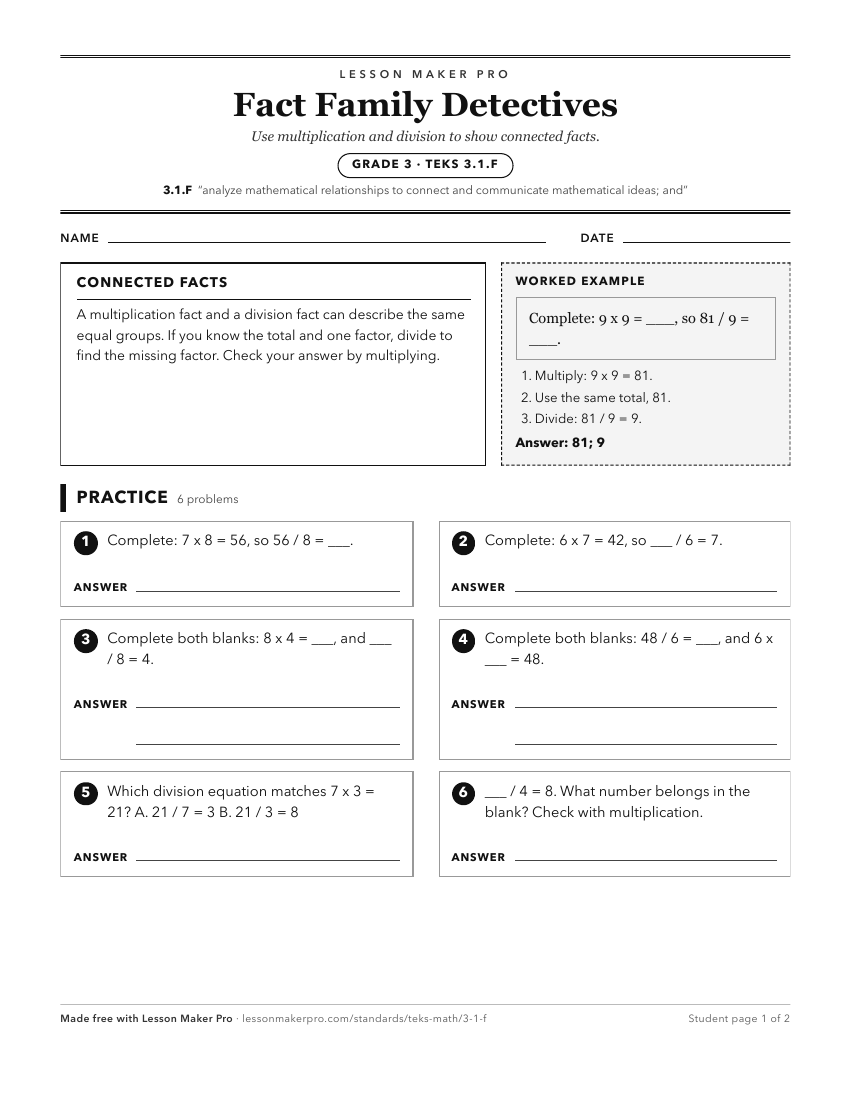
A ready-to-print activity worksheet aligned to 3.1.F, with an answer key for the teacher on its own page. No account needed.
PDF, US Letter, prints cleanly in black and white.
Download the worksheetKeep exploring
Related Standards
Turn this exact standard into a lesson
Grade, subject, topic, and the complete standard are prefilled. Create one free, no account needed.
Also for this standard:Make a WorksheetMake a QuizMake a Sub Lesson