TEKS Math 2.5.A
The Standard
determine the value of a collection of coins up to one dollar
Texas Essential Knowledge and Skills for Mathematics
Teacher's field guide
What This Standard Means
What Students Need to Do
- Students identify pennies, nickels, dimes, and quarters by name and value. They group and skip-count mixed coins to find totals no greater than 100 cents.
What Mastery Looks Like
- Given mixed coins in any order, a student counts accurately and records the total using the cent symbol. The student recognizes that 100 cents equals one dollar and can explain the counting path used.
Common Misconceptions
- Students may think a larger coin is always worth more, so they value a nickel above a dime. They may count the number of coins instead of their values or lose track when switching skip-count patterns.
How to Assess It
- Give each student 2 quarters, 3 dimes, 2 nickels, and 4 pennies. Ask them to record the total and show how they counted.
Lesson moves
Ways to Teach It
Give pairs cups of mixed play coins to sort, order from greatest value to least, and count aloud.
Ask students to write which coin they would count first in a mixed collection and explain why.
Play Coin Total Match by pairing coin collection cards with matching value cards up to 100 cents.
Set up a classroom store where students choose an item and build its exact price with play coins.
Free download
Printable 2.5.A Worksheet
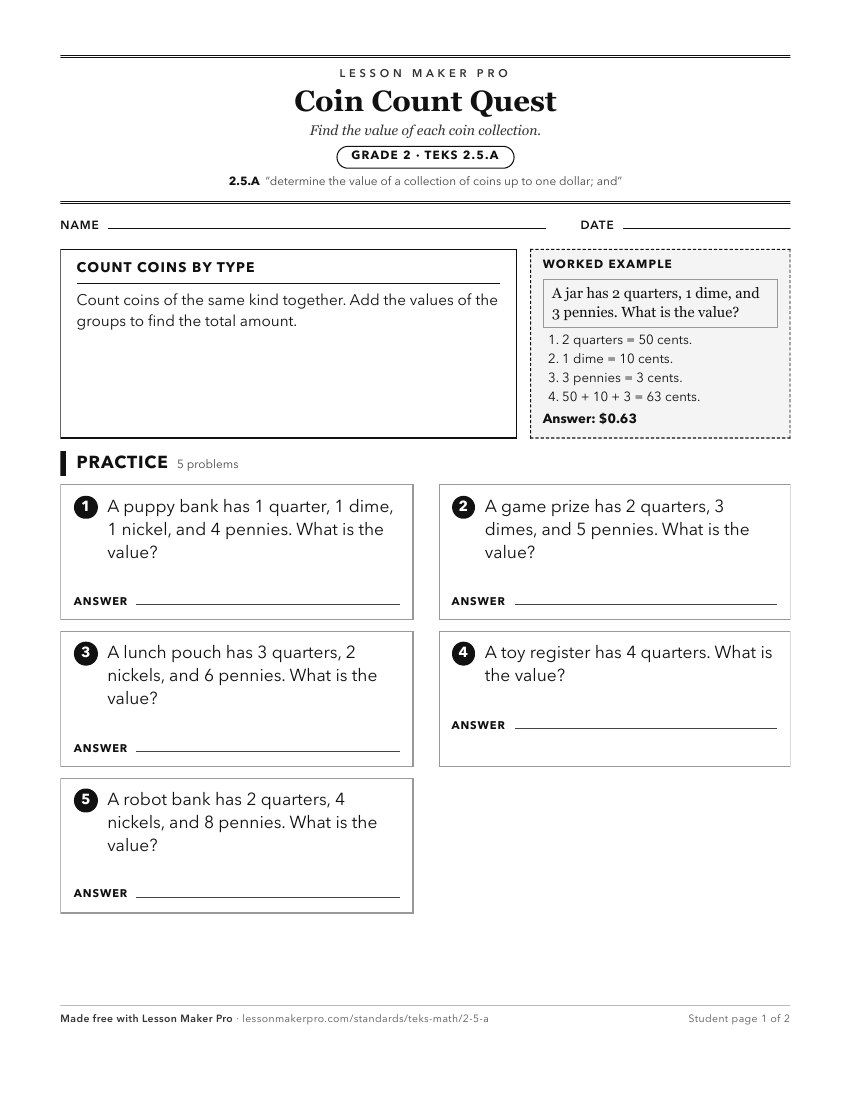
A ready-to-print activity worksheet aligned to 2.5.A, with an answer key for the teacher on its own page. No account needed.
PDF, US Letter, prints cleanly in black and white.
Download the worksheetKeep exploring
Related Standards
- 1.4.A
identify U.S. coins, including pennies, nickels, dimes, and quarters, by value and describe the relationships among them
- 2.5.B
use the cent symbol, dollar sign, and the decimal point to name the value of a collection of coins.
- 1.4.C
use relationships to count by twos, fives, and tens to determine the value of a collection of pennies, nickels, and/or dimes
- 3.4.C
determine the value of a collection of coins and bills
Turn this exact standard into a lesson
Grade, subject, topic, and the complete standard are prefilled. Create one free, no account needed.
Also for this standard:Make a WorksheetMake a QuizMake a Sub Lesson