TEKS ELAR K.9.E
The Standard
listen to and experience first- and third-person texts.
Texas Essential Knowledge and Skills for English Language Arts and Reading
Teacher's field guide
What This Standard Means
What Students Need to Do
- Students listen for who is telling a story. They decide whether the speaker is part of the story or describing other characters from outside it.
What Mastery Looks Like
- Students can tell whether the narrator is a character or an outside voice. They can point to words such as “I,” “we,” “he,” or “they” as evidence.
Common Misconceptions
- Students may think every narrator is the author. They may also assume any story using a character’s name is told by that character.
How to Assess It
- Read two short passages, one using “I” and one using “she.” Ask students to point to the passage told by a character and explain their clue.
Lesson moves
Ways to Teach It
Give pairs two puppets and picture cards, then have one puppet tell its own action and the other describe that action.
Read two versions of the same event and ask, “Who is telling each version, and which words helped you know?”
Play Narrator Sort by having students place sentence cards under “character voice” or “outside voice” headings.
Compare a child saying, “I lost my mitten,” with a teacher reporting, “Mia lost her mitten,” and name who speaks.
Free download
Printable K.9.E Worksheet
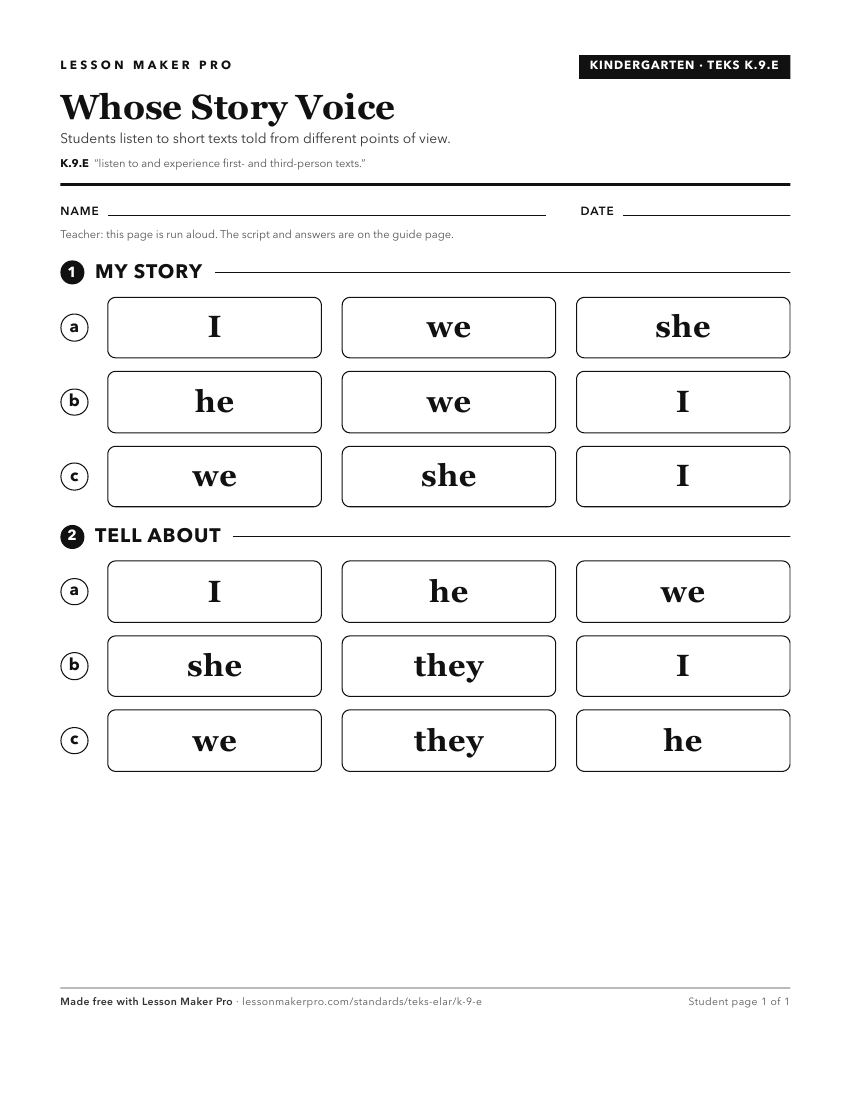
A ready-to-print activity worksheet aligned to K.9.E, with an answer key for the teacher on its own page. No account needed.
PDF, US Letter, prints cleanly in black and white.
Download the worksheetKeep exploring
Related Standards
- 5.10.E
identify and understand the use of literary devices, including first- or third-person point of view;
- 2.10.E
identify the use of first or third person in a text; and
- 1.10.E
The 1st Grade version of this standard.
- 4.10.E
identify and understand the use of literary devices, including first- or third-person point of view;
Turn this exact standard into a lesson
Grade, subject, topic, and the complete standard are prefilled. Create one free, no account needed.
Also for this standard:Make a WorksheetMake a QuizMake a Sub Lesson