TEKS ELAR 1.10.E
The Standard
listen to and experience first- and third-person texts.
Texas Essential Knowledge and Skills for English Language Arts and Reading
Teacher's field guide
What This Standard Means
What Students Need to Do
- Students listen to stories told by a character and stories told by an outside narrator. They notice who is telling each story and identify clues such as I, we, he, she, and they.
What Mastery Looks Like
- A student can tell whether a character or an outside narrator is speaking. The student points to pronouns and story details that support the answer.
Common Misconceptions
- Students may think the author and narrator are always the same person. They may mistake dialogue containing "I" for first-person narration. They may also assume the main character always tells the story.
How to Assess It
- Read aloud, "I packed my red bag," and, "Mia packed her red bag." Ask students who is telling each sentence and which word gives the clue.
Lesson moves
Ways to Teach It
Give pairs sentence cards with I, we, he, she, and they, then have them sort the cards by who tells the story.
Read a short story and ask, "Is a character telling the story, or is someone outside the story telling it?"
Play Narrator Signal, where students hold up one finger for a character narrator and three fingers for an outside narrator.
Have students describe recess using "I," then retell the same event like a school reporter using names, he, she, or they.
Free download
Printable 1.10.E Worksheet
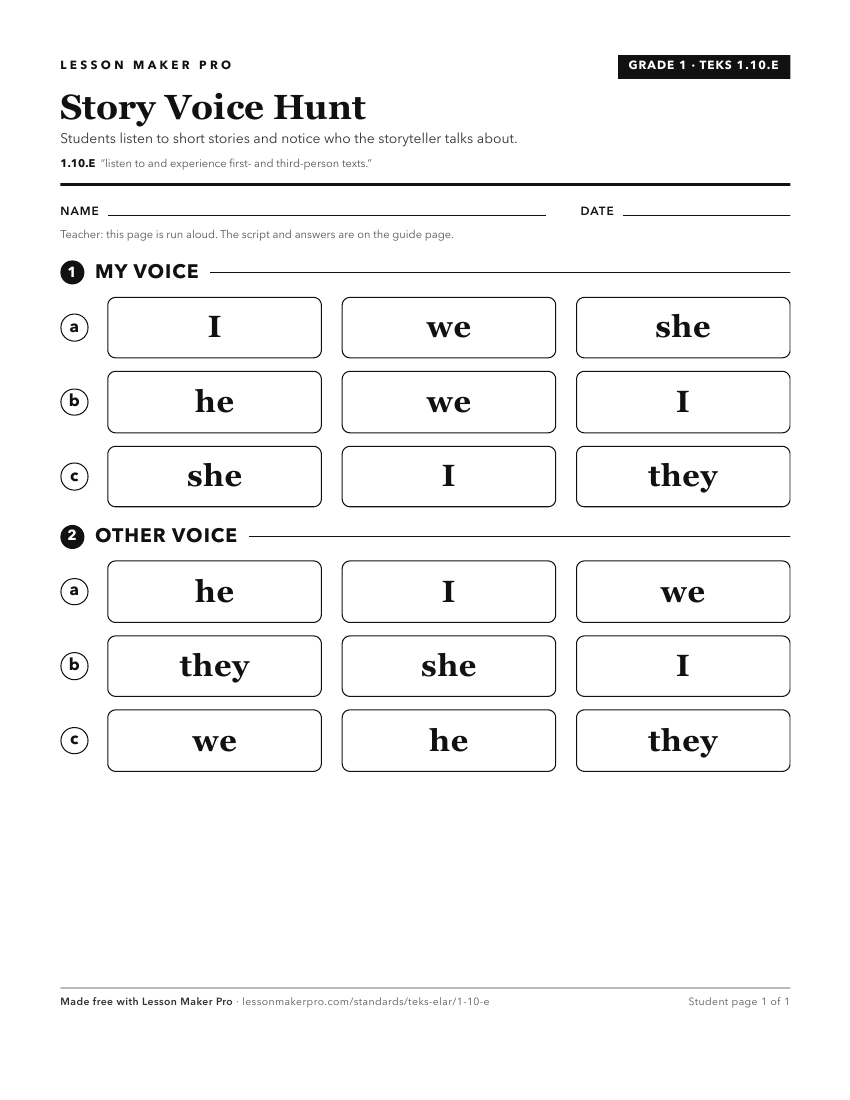
A ready-to-print activity worksheet aligned to 1.10.E, with an answer key for the teacher on its own page. No account needed.
PDF, US Letter, prints cleanly in black and white.
Download the worksheetKeep exploring
Related Standards
- 5.10.E
identify and understand the use of literary devices, including first- or third-person point of view;
- 2.10.E
identify the use of first or third person in a text; and
- K.9.E
The Kindergarten version of this standard.
- 4.10.E
identify and understand the use of literary devices, including first- or third-person point of view;
Turn this exact standard into a lesson
Grade, subject, topic, and the complete standard are prefilled. Create one free, no account needed.
Also for this standard:Make a WorksheetMake a QuizMake a Sub Lesson