TEKS ELAR K.11.B
The Standard
dictate or compose informational texts.
Texas Essential Knowledge and Skills for English Language Arts and Reading
Teacher's field guide
What This Standard Means
What Students Need to Do
- Students share facts about one topic through speech, drawings, labels, or simple sentences. They keep their ideas focused on teaching the reader about that topic.
What Mastery Looks Like
- A student names a clear topic and gives at least two accurate, related facts. The student can read the piece aloud or explain how the drawing and words teach the reader.
Common Misconceptions
- Students may tell a personal story instead of sharing facts. They may give an opinion, such as “Dogs are the best,” as if it were a fact. They may draw or label a topic without adding information about it.
How to Assess It
- Show a familiar object and say, “Tell or write what this object is and two facts about it.” Allow students to respond through dictation, labels, or sentences.
Lesson moves
Ways to Teach It
Let students inspect a classroom object with a magnifier, sketch it, add labels, and dictate two facts.
Ask, “What could we teach someone about frogs?” Record student facts, then have each child choose one to illustrate and write.
Play Fact Match by having students pair animal picture cards with simple fact cards and explain each match.
Create a classroom guide with one page per center, showing what is there and how students use the materials.
Free download
Printable K.11.B Worksheet
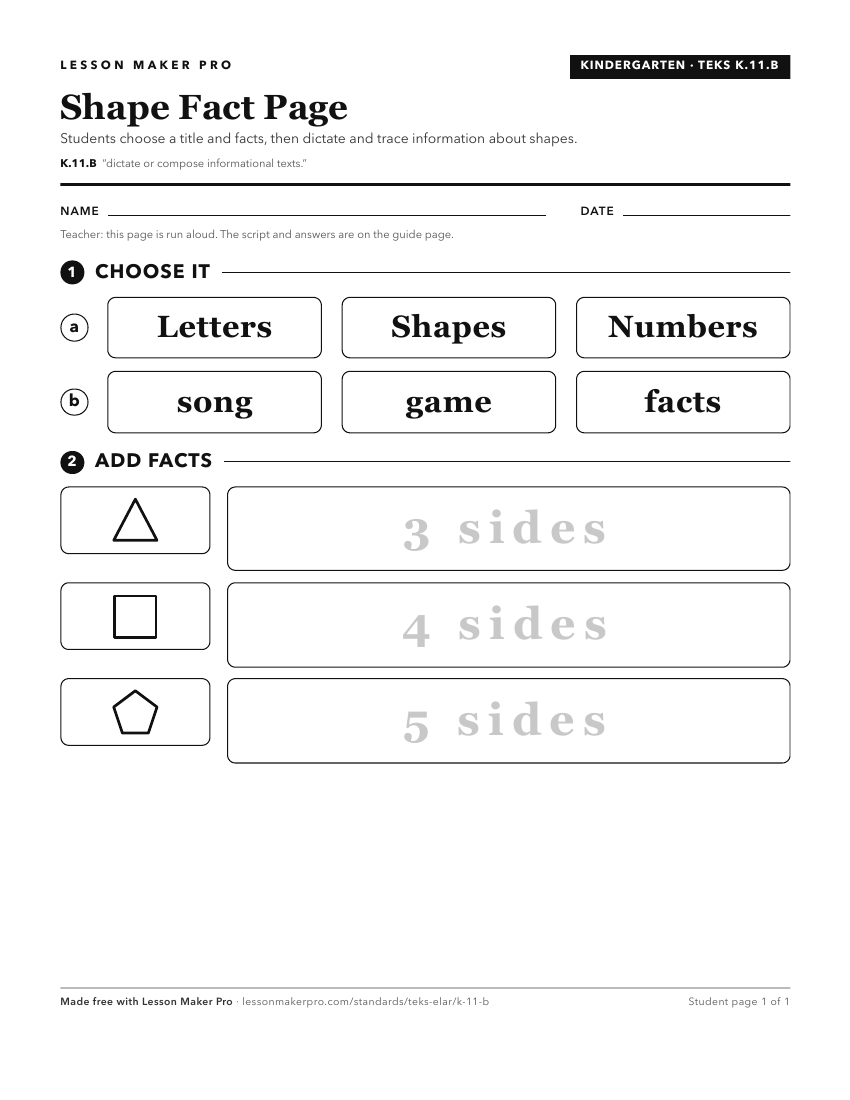
A ready-to-print activity worksheet aligned to K.11.B, with an answer key for the teacher on its own page. No account needed.
PDF, US Letter, prints cleanly in black and white.
Download the worksheetKeep exploring
Related Standards
- 1.12.C
dictate or compose correspondence such as thank you notes or letters.
- K.11.A
dictate or compose literary texts, including personal narratives; and
- 1.12.A
dictate or compose literary texts, including personal narratives and poetry;
- 1.12.B
dictate or compose informational texts, including procedural texts; and
Turn this exact standard into a lesson
Grade, subject, topic, and the complete standard are prefilled. Create one free, no account needed.
Also for this standard:Make a WorksheetMake a QuizMake a Sub Lesson