TEKS ELAR 7.7.B
The Standard
analyze how characters' qualities influence events and resolution of the conflict
Texas Essential Knowledge and Skills for English Language Arts and Reading · Multiple genres: listening, speaking, reading, writing, and thinking using multiple texts
Teacher's field guide
What This Standard Means
What Students Need to Do
- Students identify a character’s qualities through actions, thoughts, dialogue, and others’ responses. They explain how those qualities drive choices, cause later events, and affect the conflict’s outcome.
What Mastery Looks Like
- Students support a character quality with a specific action, thought, or line of dialogue. They clearly trace how that quality causes events and shapes the conflict’s outcome.
Common Misconceptions
- Students may name a trait but never connect it to a choice or consequence. They may confuse a temporary feeling with a lasting quality or simply summarize the plot.
How to Assess It
- Use an exit ticket: “Name one character quality, cite one action that shows it, and explain how it helps resolve or worsen the conflict.”
Lesson moves
Ways to Teach It
Give pairs trait, action, event, and outcome cards from a class text, then have them arrange and explain a cause-and-effect chain.
Ask students to write: “Which character quality most changes the ending, and what evidence proves your claim?”
Play a Trait-to-Plot relay where teams match character qualities to choices and consequences, earning points for accurate explanations.
Have students examine a team captain, community leader, or public figure and explain how one quality shaped a decision and its result.
Free download
Printable 7.7.B Worksheet
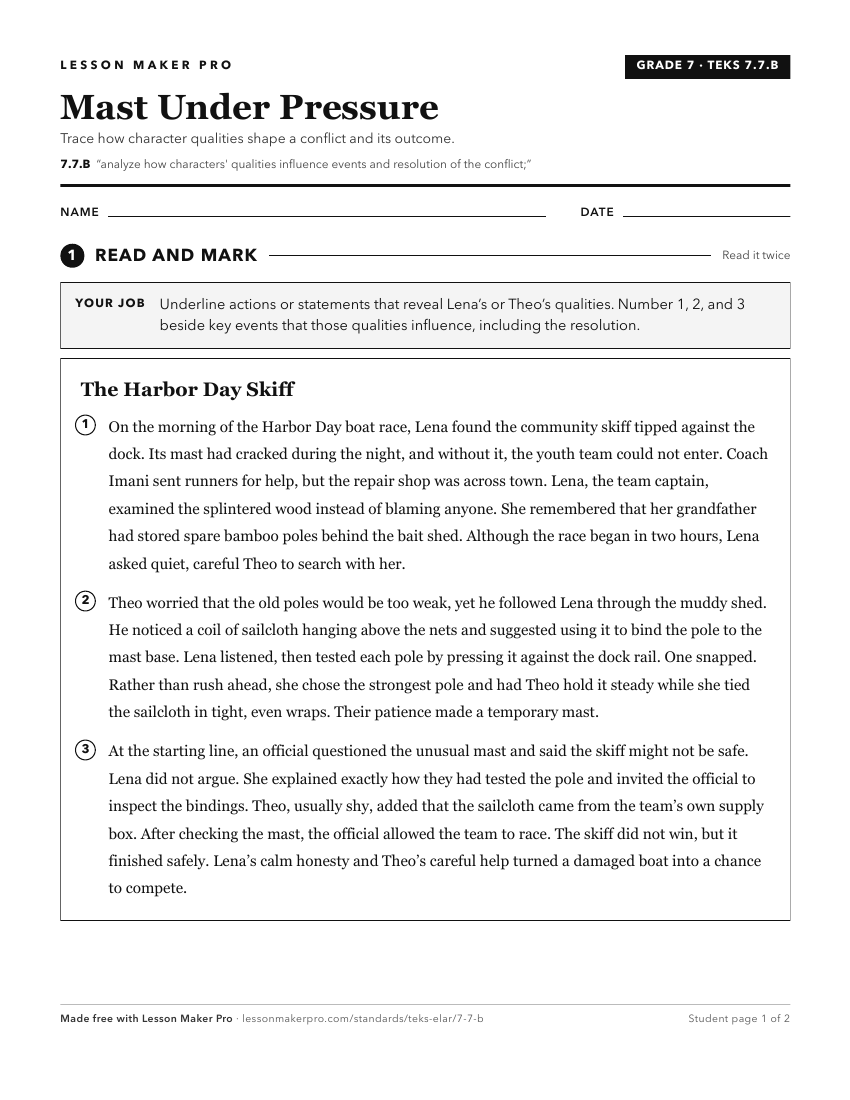
A ready-to-print activity worksheet aligned to 7.7.B, with an answer key for the teacher on its own page. No account needed.
PDF, US Letter, prints cleanly in black and white.
Download the worksheetKeep exploring
Related Standards
- 5.8.B
analyze the relationships of and conflicts among the characters;
- 8.7.B
analyze how characters' motivations and behaviors influence events and resolution of the conflict;
- 8.7.A
analyze how themes are developed through the interaction of characters and events;
- 6.7.B
analyze how the characters' internal and external responses develop the plot;
Turn this exact standard into a lesson
Grade, subject, topic, and the complete standard are prefilled. Create one free, no account needed.
Also for this standard:Make a WorksheetMake a QuizMake a Sub Lesson