TEKS ELAR 7.2.B
The Standard
use context such as contrast or cause and effect to clarify the meaning of words
Texas Essential Knowledge and Skills for English Language Arts and Reading · Developing and sustaining foundational language skills: listening, speaking, discussion, and thinking
Teacher's field guide
What This Standard Means
What Students Need to Do
- Students use surrounding ideas to work out the meaning of an unfamiliar word. They notice when a sentence shows contrast or links a cause to an effect, then explain how that clue supports the meaning.
What Mastery Looks Like
- Students infer a word’s meaning accurately and point to the exact clue that supports it. They name the relationship as contrast or cause and effect, then use the word correctly in a new sentence.
Common Misconceptions
- Students may guess from the nearest word instead of reading the whole sentence. They may confuse a contrast clue with a cause-and-effect clue or identify the relationship without determining the word's meaning.
How to Assess It
- Give this exit ticket: “Unlike her gregarious sister, Mina was reserved. Because the path was treacherous, hikers moved slowly.” Define each target word, underline the clue, and label the relationship.
Lesson moves
Ways to Teach It
Give groups sentence strips to sort into contrast and cause-and-effect piles, then have them infer each highlighted word’s meaning.
Ask students to explain in writing which clue reveals an unfamiliar word’s meaning and how the ideas are connected.
Play Context Clue Relay, where teams identify a word’s meaning, circle evidence, and label contrast or cause and effect.
Have students find unfamiliar words in news headlines or product reviews, then mark clues that reveal each word’s meaning.
Free download
Printable 7.2.B Worksheet
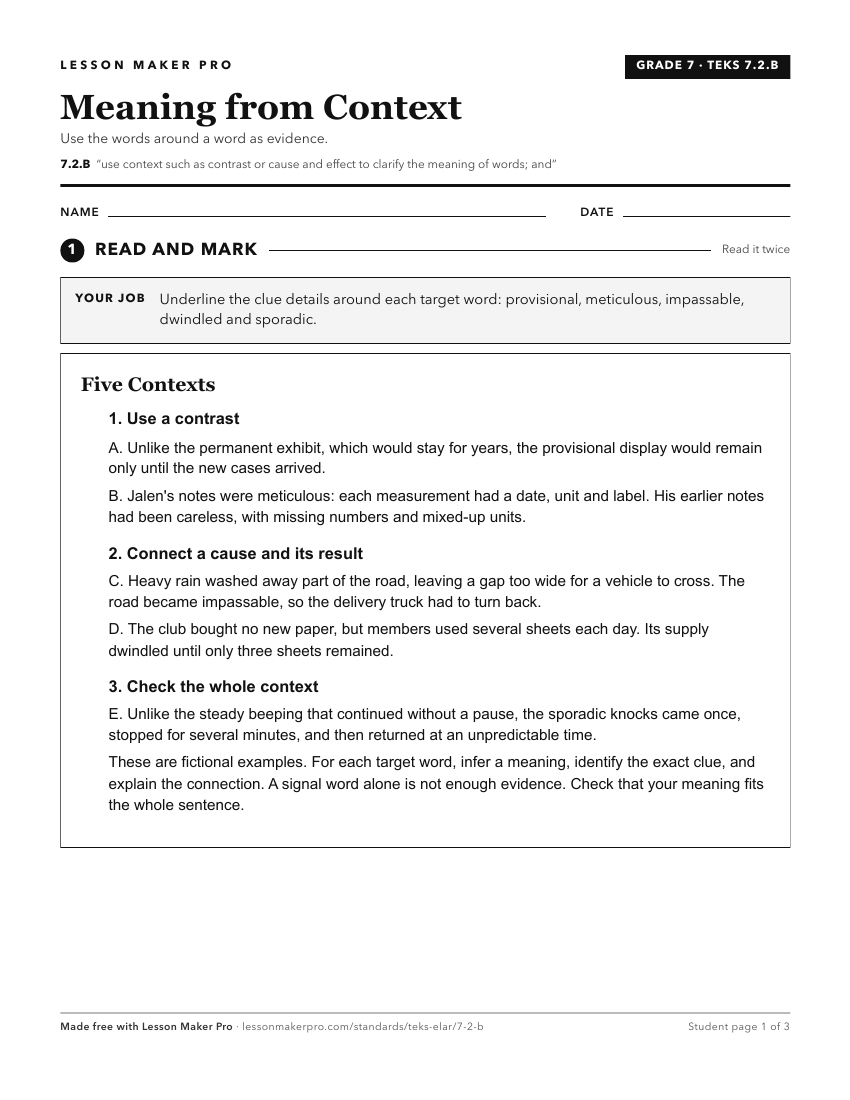
A ready-to-print activity worksheet aligned to 7.2.B, with an answer key for the teacher on its own page. No account needed.
PDF, US Letter, prints cleanly in black and white.
Download the worksheetKeep exploring
Related Standards
- 8.2.B
use context within or beyond a paragraph to clarify the meaning of unfamiliar or ambiguous words; and
- 4.3.B
use context within and beyond a sentence to determine the relevant meaning of unfamiliar words or multiple-meaning words;
- 5.3.B
use context within and beyond a sentence to determine the relevant meaning of unfamiliar words or multiple-meaning words;
- 6.2.B
use context such as definition, analogy, and examples to clarify the meaning of words; and
Turn this exact standard into a lesson
Grade, subject, topic, and the complete standard are prefilled. Create one free, no account needed.
Also for this standard:Make a WorksheetMake a QuizMake a Sub Lesson