TEKS ELAR 5.11.D.iv
The Standard
adjectives, including their comparative and superlative forms
Texas Essential Knowledge and Skills for English Language Arts and Reading · The student uses the writing process recursively to compose multiple texts that are legible and uses appropriate conventions.
Teacher's field guide
What This Standard Means
What Students Need to Do
- Students find adjectives in drafts and check whether each comparison fits the number of people, places, things, or ideas being compared. They use endings like -er and -est, words like more and most, and irregular forms such as better and best.
What Mastery Looks Like
- A student can revise incorrect phrases such as "more easier" to "easier" and "the most kindest" to "the kindest." The student can explain why comparing two differs from comparing three or more.
Common Misconceptions
- Students may use double comparisons, such as "more taller" or "most fastest." They may write forms like "gooder," or use a superlative when comparing only two things.
How to Assess It
- Give this exit ticket: Correct "Mia is more taller than Ava," "Of the two routes, Oak Street is the shortest," and "That was the goodest ending."
Lesson moves
Ways to Teach It
Give pairs adjective cards and picture cards, then have them build sentences comparing two objects and groups of three objects.
Ask students to describe two classmates' fictional pets, then explain why they chose forms such as friendlier, bigger, or most playful.
Play an adjective relay where teams draw a word card and write a correct comparison sentence about animal pictures.
Use grocery ads to compare prices, sizes, and quantities, then write two accurate product comparison claims.
Free download
Printable 5.11.D.iv Worksheet
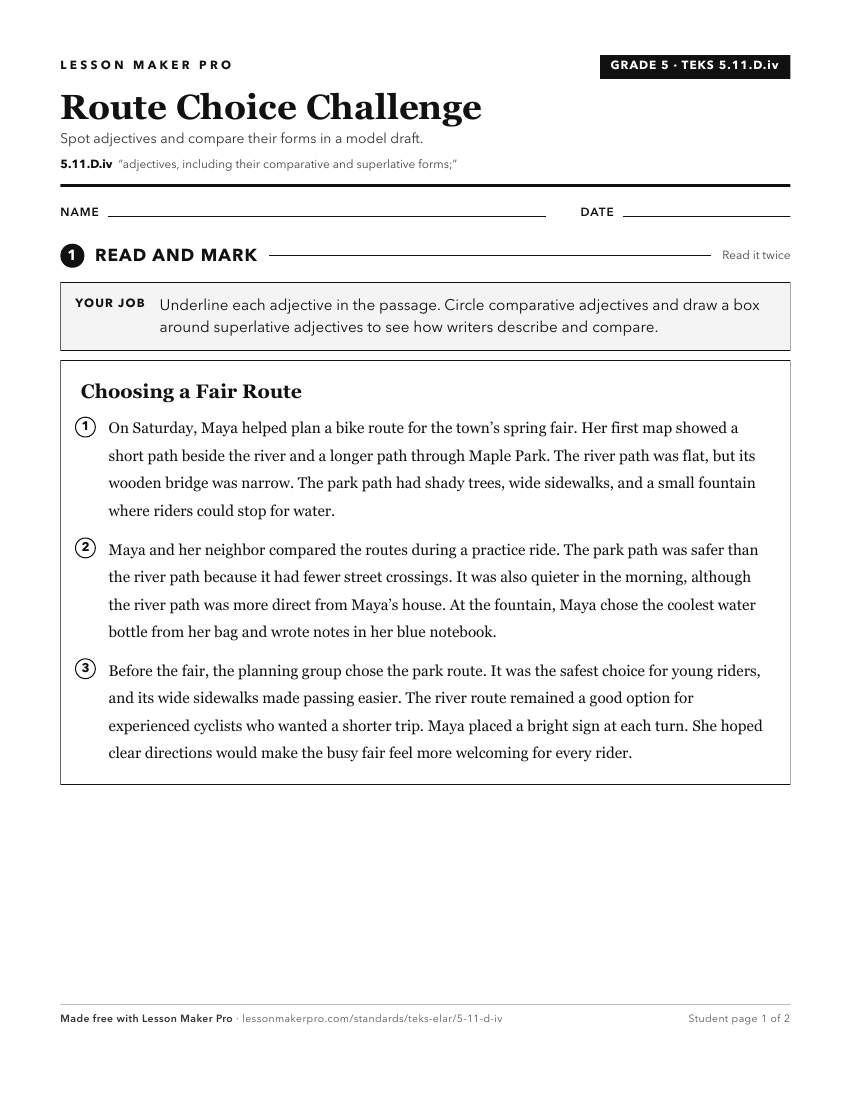
A ready-to-print activity worksheet aligned to 5.11.D.iv, with an answer key for the teacher on its own page. No account needed.
PDF, US Letter, prints cleanly in black and white.
Download the worksheetKeep exploring
Related Standards
Turn this exact standard into a lesson
Grade, subject, topic, and the complete standard are prefilled. Create one free, no account needed.
Also for this standard:Make a WorksheetMake a QuizMake a Sub Lesson