TEKS ELAR 3.11.D.iv
The Standard
adjectives, including their comparative and superlative forms
Texas Essential Knowledge and Skills for English Language Arts and Reading · The student uses the writing process recursively to compose multiple texts that are legible and uses appropriate conventions.
Teacher's field guide
What This Standard Means
What Students Need to Do
- Students choose adjective forms that compare two or three or more people, places, things, or ideas. They edit sentences to fix incorrect forms and repeated comparison words.
What Mastery Looks Like
- Students correctly use forms such as tall, taller, and tallest in their drafts. They also recognize irregular forms such as good, better, and best when editing.
Common Misconceptions
- Students may use the base adjective when comparing two or more things. They may write forms such as “more taller,” “beautifuller,” or “goodest.”
How to Assess It
- Give students: “Of the three dogs, Max is the ___ (large).” Ask them to fill in the blank and explain why.
Lesson moves
Ways to Teach It
Give pairs adjective cards and three classroom objects, then have them order the objects and write sentences using all three adjective forms.
Ask students to explain in writing when they would use taller instead of tallest, with one example of each.
Play an adjective relay where teams change a base adjective to its comparative and superlative forms, then check each answer.
Have students compare three snack packages by size, price, or weight and write sentences using words such as cheaper and heaviest.
Free download
Printable 3.11.D.iv Worksheet
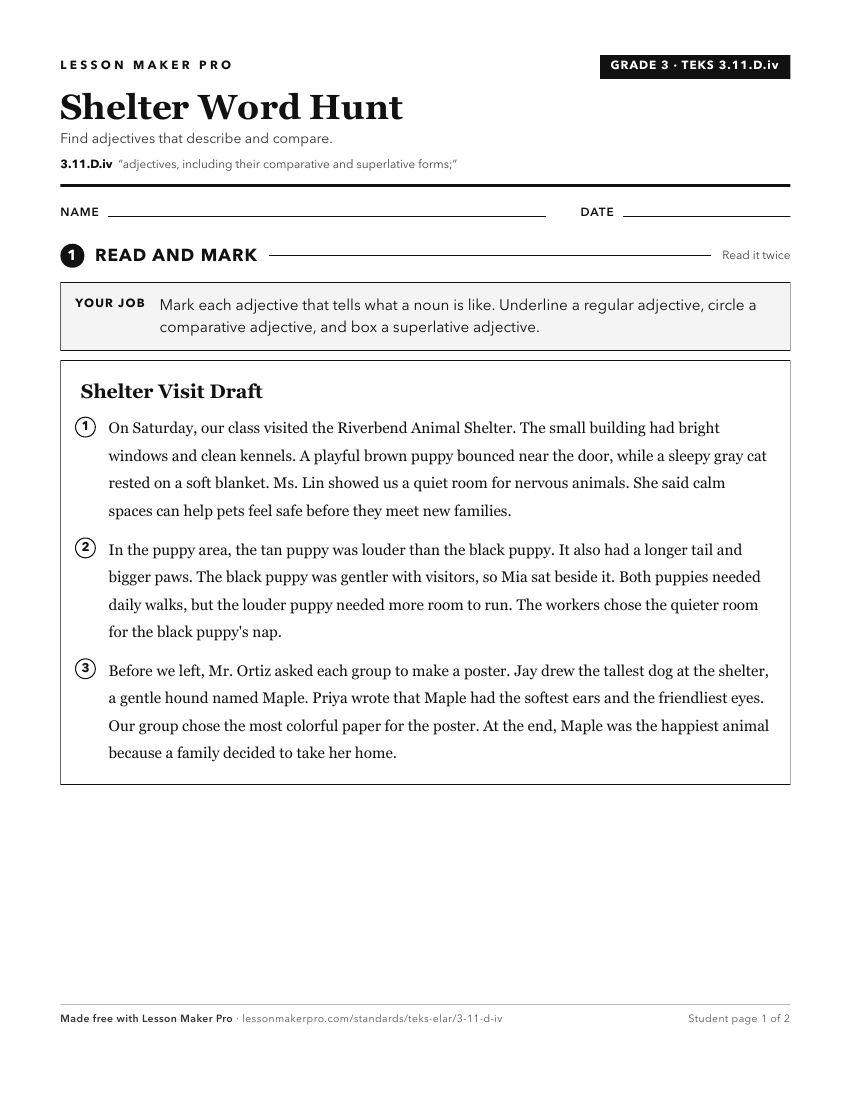
A ready-to-print activity worksheet aligned to 3.11.D.iv, with an answer key for the teacher on its own page. No account needed.
PDF, US Letter, prints cleanly in black and white.
Download the worksheetKeep exploring
Related Standards
Turn this exact standard into a lesson
Grade, subject, topic, and the complete standard are prefilled. Create one free, no account needed.
Also for this standard:Make a WorksheetMake a QuizMake a Sub Lesson