TEKS ELAR 5.11.D.ii
The Standard
past tense of irregular verbs
Texas Essential Knowledge and Skills for English Language Arts and Reading · The student uses the writing process recursively to compose multiple texts that are legible and uses appropriate conventions.
Teacher's field guide
What This Standard Means
What Students Need to Do
- Students find irregular verbs in their drafts and change them to the correct past-tense forms. They also check that past tense stays consistent when describing completed actions.
What Mastery Looks Like
- A student correctly edits forms such as went, saw, brought, taught, and caught. The student avoids forms such as goed and brang and can use each correction in context.
Common Misconceptions
- Students may add -ed to every verb, producing forms such as goed, buyed, or teached. They may also confuse simple past with past participles, writing "I seen" or "She has went."
How to Assess It
- Exit ticket: Rewrite this sentence with correct irregular past-tense verbs: "Yesterday Mia goed to the pond, seen a frog, catched it, and brang it home."
Lesson moves
Ways to Teach It
Give pairs verb cards such as go/went and bring/brought, then have them match each present-tense verb to its past-tense form.
Have students write three sentences about what happened yesterday, then underline each irregular past-tense verb and explain why it is correct.
Play Past-Tense Relay: teams draw a present-tense verb card, write its irregular past form, and earn a point for a correct sentence.
Students write a short police report about a missing backpack, using five irregular past-tense verbs to describe what witnesses did and saw.
Free download
Printable 5.11.D.ii Worksheet
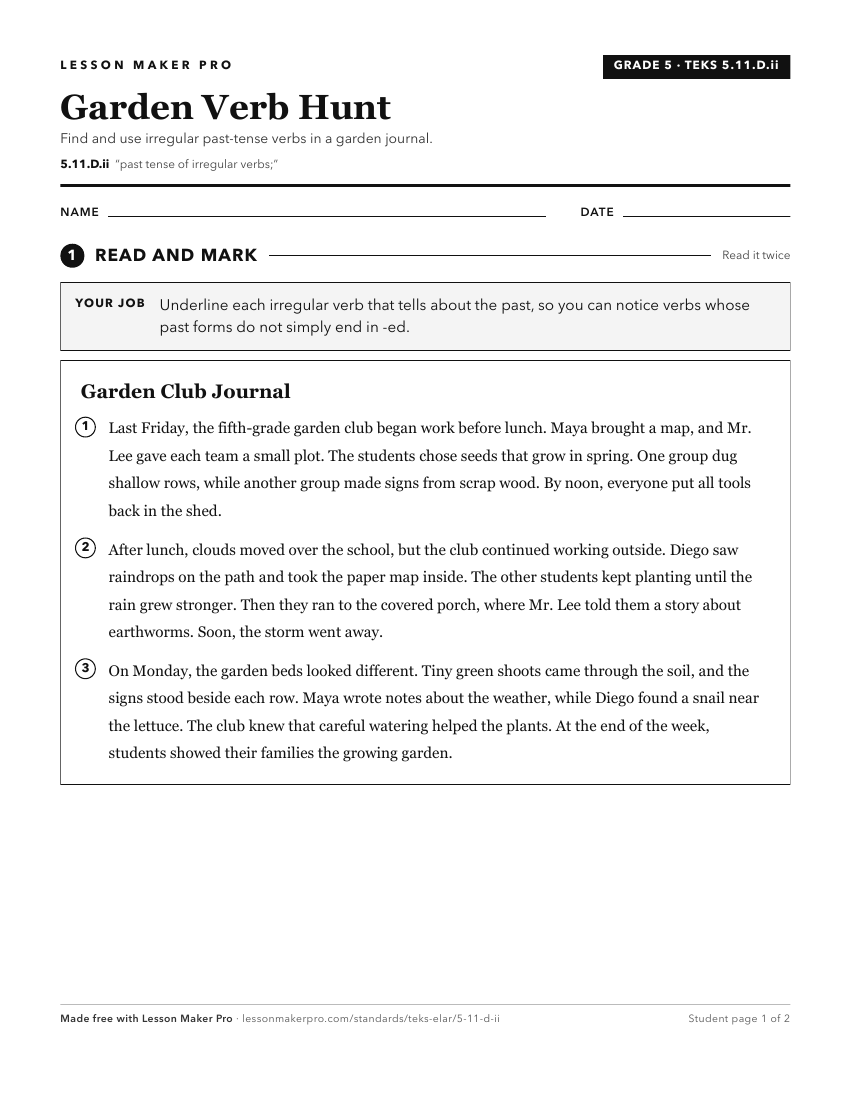
A ready-to-print activity worksheet aligned to 5.11.D.ii, with an answer key for the teacher on its own page. No account needed.
PDF, US Letter, prints cleanly in black and white.
Download the worksheetKeep exploring
Related Standards
Turn this exact standard into a lesson
Grade, subject, topic, and the complete standard are prefilled. Create one free, no account needed.
Also for this standard:Make a WorksheetMake a QuizMake a Sub Lesson