TEKS ELAR 3.11.D.ii
The Standard
past, present, and future verb tense
Texas Essential Knowledge and Skills for English Language Arts and Reading · The student uses the writing process recursively to compose multiple texts that are legible and uses appropriate conventions.
Teacher's field guide
What This Standard Means
What Students Need to Do
- Students use verb forms to show when actions happen. They edit sentences and paragraphs so the time stays clear and consistent.
What Mastery Looks Like
- Students select the correct verb form for the time of an action. They keep the time frame consistent across related sentences and fix shifts that confuse the reader.
Common Misconceptions
- Students may add “will” to every sentence about later events, even when another form sounds clearer. They may also shift time within a paragraph or use forms such as “goed” and “runned.”
How to Assess It
- Give students three sentences with time clues and incorrect verbs. Ask them to rewrite each sentence so the verb matches yesterday, today, or tomorrow.
Lesson moves
Ways to Teach It
Have students sort sentence strips under yesterday, today, and tomorrow headings, then correct any verbs that do not match.
Ask students to write three sentences about one activity: what happened yesterday, what happens today, and what will happen tomorrow.
Play Verb Tense Relay, where teams draw a time card and rewrite a sentence to match that time.
Use a weekly class schedule to write what the class did Monday, does today, and will do Friday.
Free download
Printable 3.11.D.ii Worksheet
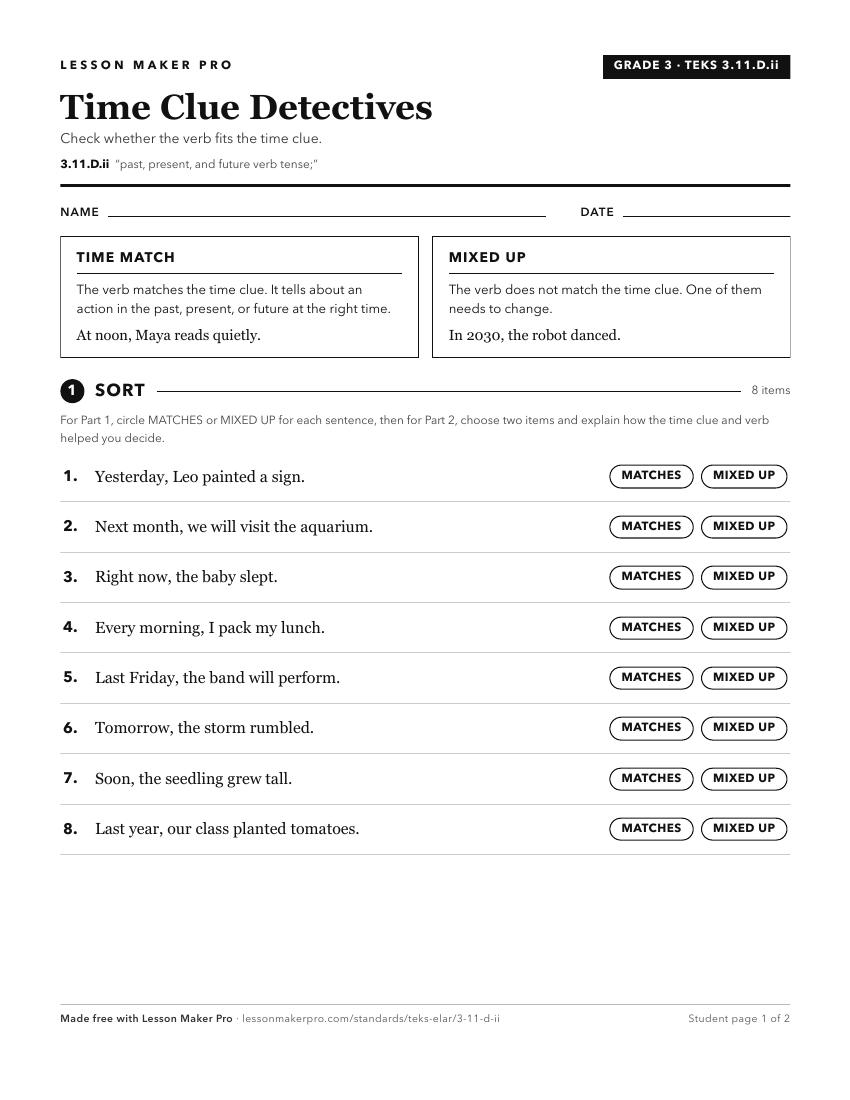
A ready-to-print activity worksheet aligned to 3.11.D.ii, with an answer key for the teacher on its own page. No account needed.
PDF, US Letter, prints cleanly in black and white.
Download the worksheetKeep exploring
Related Standards
Turn this exact standard into a lesson
Grade, subject, topic, and the complete standard are prefilled. Create one free, no account needed.
Also for this standard:Make a WorksheetMake a QuizMake a Sub Lesson