TEKS ELAR 1.7.E
The Standard
interact with sources in meaningful ways such as illustrating or writing
Texas Essential Knowledge and Skills for English Language Arts and Reading
Teacher's field guide
What This Standard Means
What Students Need to Do
- Students show what they understood from a story, poem, video, or read-aloud by drawing or writing about it. Their response connects to a specific detail or idea.
What Mastery Looks Like
- After reading, listening, or viewing, a student can draw or write a response that matches the source. The response includes an accurate character, event, fact, or idea.
Common Misconceptions
- Students may draw something loosely related to the topic instead of showing a detail from the source. They may copy a picture, title, or sentence without showing what they understood.
How to Assess It
- After a read-aloud, prompt: “Draw one important part. Write or dictate one sentence that explains your drawing using a detail from the text.”
Lesson moves
Ways to Teach It
Read a short picture book, then have pairs arrange three event cards and create a drawing with a one-sentence caption.
Ask, “Which part helped you understand the character best?” Students talk with a partner, then draw the part and add a label.
Play Response Match by having students pair short passage cards with drawings or sentences that accurately show each passage.
Show a short weather report, then have students draw and write what clothing they would choose based on the forecast.
Free download
Printable 1.7.E Worksheet
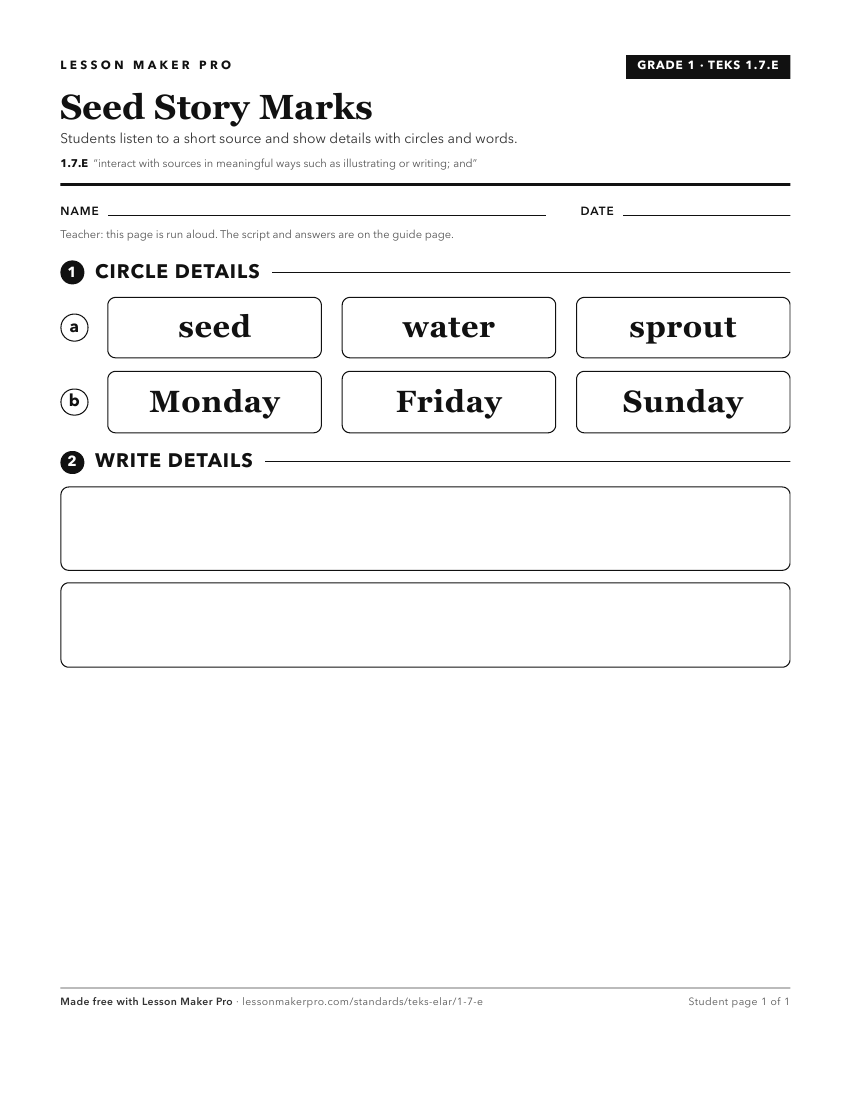
A ready-to-print activity worksheet aligned to 1.7.E, with an answer key for the teacher on its own page. No account needed.
PDF, US Letter, prints cleanly in black and white.
Download the worksheetKeep exploring
Related Standards
- 6.6.E
interact with sources in meaningful ways such as notetaking, annotating, freewriting, or illustrating;
- K.6.E
The Kindergarten version of this standard.
- 2.7.E
The 2nd Grade version of this standard.
- 4.7.E
interact with sources in meaningful ways such as notetaking, annotating, freewriting, or illustrating;
Turn this exact standard into a lesson
Grade, subject, topic, and the complete standard are prefilled. Create one free, no account needed.
Also for this standard:Make a WorksheetMake a QuizMake a Sub Lesson