South Dakota ELA 3.W.3
Standard Cluster
Write narratives (e.g. story, poetry, drama) to develop real and imagined experiences or events using descriptive details, and clear event sequences. Establish a situation and/or setting; introduce a narrator and/or characters; organize an event sequence that unfolds naturally. Use narrative techniques, such as dialogue and descriptions of actions, thoughts, and feelings to develop experiences and events or show the response of characters to situations. Use transition words and phrases to signal event order. Provide a sense of conclusion (when appropriate to the genre).
South Dakota English Language Arts Standards (2025)
Cluster contents
Standards in This Cluster
3.W.3 is a cluster heading. These are the individual standards under it.
- 3.W.3.a
Establish a situation and/or setting; introduce a narrator and/or characters; organize an event sequence that unfolds naturally.
- 3.W.3.b
Use narrative techniques, such as dialogue and descriptions of actions, thoughts, and feelings to develop experiences and events or show the response of charact...
- 3.W.3.d
Provide a sense of conclusion (when appropriate to the genre).
Teacher's field guide
What This Cluster Means
What Students Need to Do
- Students write a story, poem, or short play about a real or made-up event. They introduce the place or people and put events in a clear order. They add details about actions and feelings, use time words, and give the piece an ending when it needs one.
What Mastery Looks Like
- A reader can tell who is involved and follow what happens first, next, and last. The writer uses specific actions, thoughts, or dialogue to show how a character reacts. The piece closes in a way that fits its form.
Common Misconceptions
- Students may list events with repeated 'and then' but leave out what anyone says or feels. They may bring in a new character without introducing them, or stop at the biggest event without showing what happened next.
How to Assess It
- Exit ticket: Write five sentences about finding a lost mitten. Name the place and character, show two events in order with a time word, add a feeling or line of dialogue, and end the story.
Lesson moves
Ways to Teach It
Give pairs three event cards, 'lost dog,' 'searched park,' and 'found dog'; have them order the cards and add a feeling to each.
Have students write two lines of dialogue for a child who finds a kitten in a box, then explain what those lines reveal.
Play transition swap: replace each 'then' in 'I woke up, then ate, then walked to school, then sat down' with a different time phrase.
Ask students to write about spilling a drink at lunch, showing what happened next, how someone reacted, and how they cleaned up.
Free download
Printable 3.W.3 Worksheet
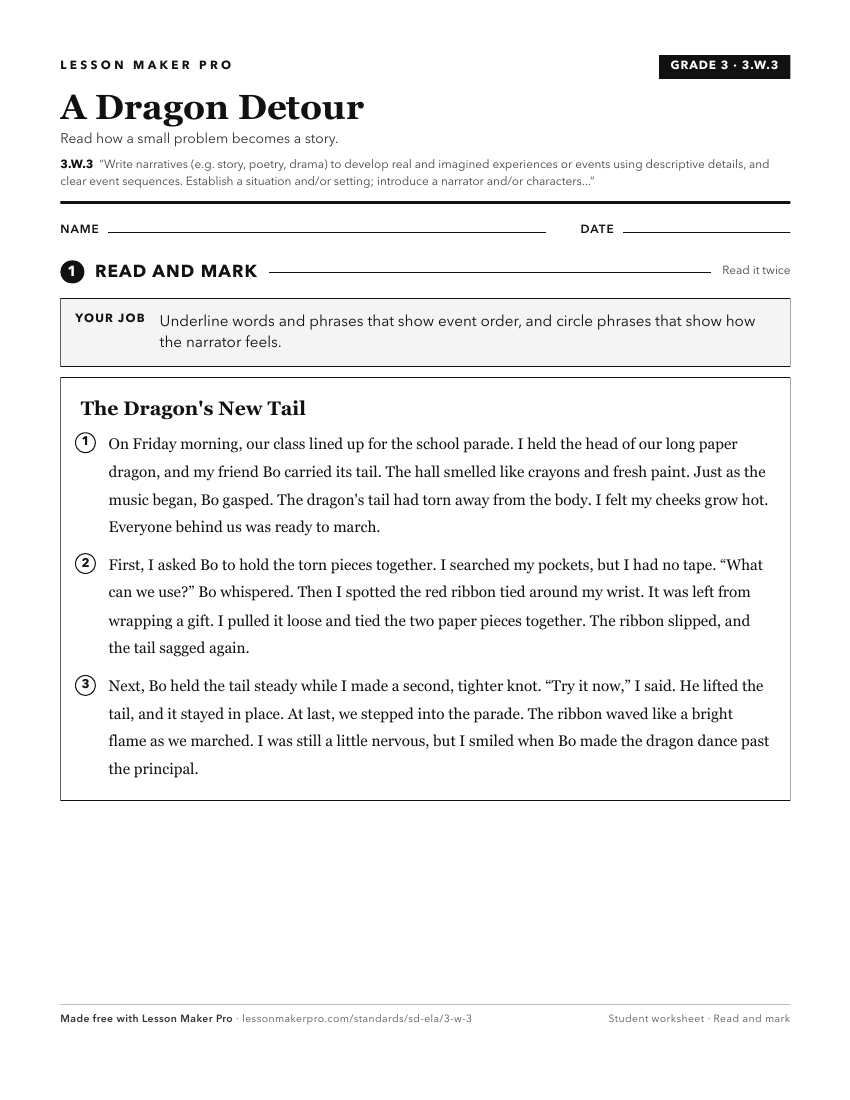
A ready-to-print activity worksheet aligned to 3.W.3, with an answer key for the teacher on its own page. No account needed.
PDF, US Letter, prints cleanly in black and white.
Download the worksheetKeep exploring
Related Standards
- 6.W.3
Write narratives and other creative texts (e.g. poetry, graphic stories, digital compositions, memoirs) to develop real or imagined experiences or events using ...
- 5.W.3
Write narratives (story, poetry, or drama) to develop real or imagined experiences or events using effective technique, relevant descriptive details, and clear ...
- 7.W.3
Write narratives and other creative texts (e.g. poetry, graphic stories, digital composition, memoirs) to develop real or imagined experiences or events using e...
Turn this cluster into a lesson
Grade, subject, topic, and the complete cluster are prefilled. Create one free, no account needed.
Also for this cluster:Make a WorksheetMake a QuizMake a Sub Lesson