South Dakota ELA 3.W.3.d
The Standard
- 3.W.3
- Write narratives (e.g. story, poetry, drama) to develop real and imagined experiences or events using descriptive details, and clear event sequences.
Provide a sense of conclusion (when appropriate to the genre).
South Dakota English Language Arts Standards (2025)
Teacher's field guide
What This Standard Means
What Students Need to Do
- Students end their writing so readers know it is finished. They choose an ending that fits what they wrote, such as a final action in a story or a closing thought in a report.
What Mastery Looks Like
- A story ends after its main problem is settled. A report ends with a thought tied to its topic, rather than stopping mid-fact.
Common Misconceptions
- Students may stop when they run out of details, leaving the reader hanging. Some add “The End” without closing the story, or introduce a new problem in the last sentence.
How to Assess It
- Give students this story: “Mia lost her library book. She searched her backpack and under her bed. At last, she found it behind the couch.” Ask them to write one sentence that ends the story without starting a new problem.
Lesson moves
Ways to Teach It
Give pairs sentence strips with a lost-dog story, a rainy-picnic story, and matching endings; have them match each ending to its story.
Read two endings for a lost-book story: “Mia put it in her bag” and “Then a dragon appeared.” Ask which fits and why.
Play Ending Fix-It: replace “The End” on a lost-dog story with one sentence showing the dog safely home.
Have students write a note asking the principal for more recess, ending with a polite sentence that repeats the request.
Free download
Printable 3.W.3.d Worksheet
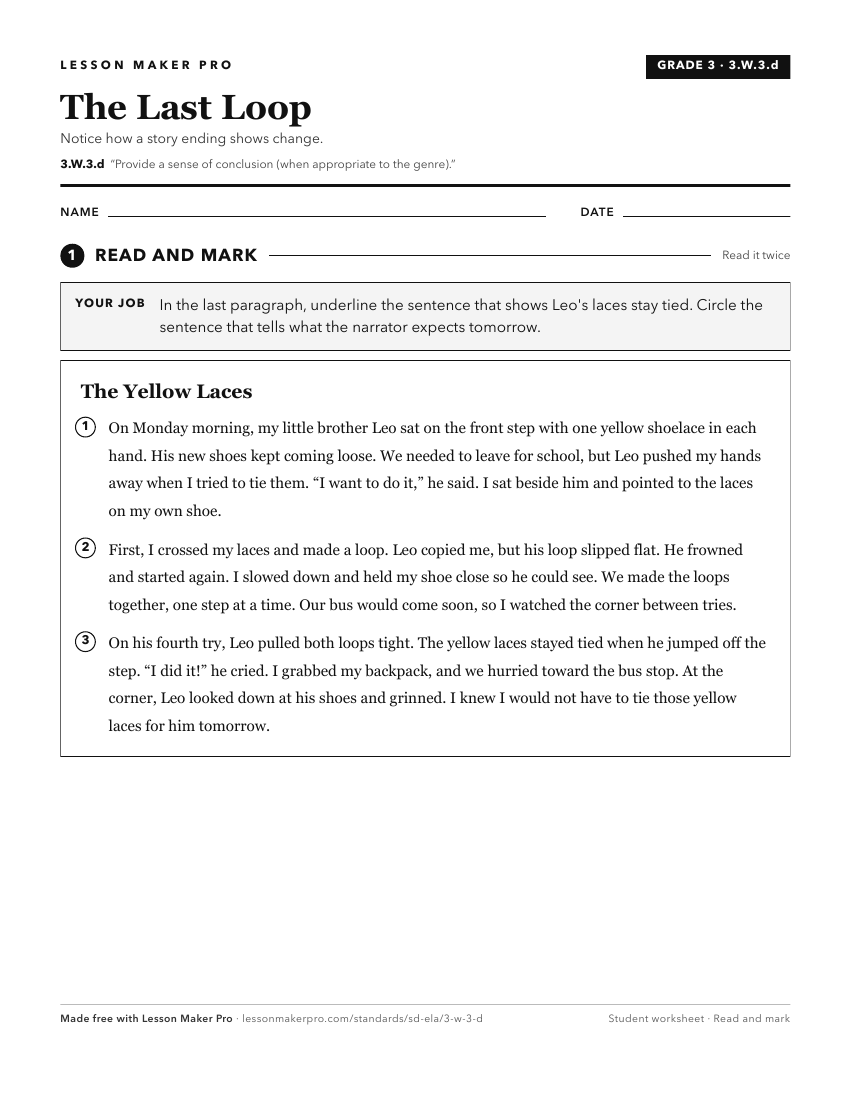
A ready-to-print activity worksheet aligned to 3.W.3.d, with an answer key for the teacher on its own page. No account needed.
PDF, US Letter, prints cleanly in black and white.
Download the worksheetKeep exploring
Related Standards
- 7.W.3.e
Provide a conclusion that follows from and/or reflects on the narrated experiences or events (when appropriate to genre).
- 6.W.3.e
Provide a conclusion that follows from and/or reflects the narrated experiences or event (when appropriate to the genre).
- 5.W.3.e
Provide a conclusion that follows the narrated experiences or events (when appropriate to the genre).
- 4.W.3.e
Provide a conclusion that follows from the narrated experiences or events (when appropriate to the genre).
Turn this exact standard into a lesson
Grade, subject, topic, and the complete standard are prefilled. Create one free, no account needed.
Also for this standard:Make a WorksheetMake a QuizMake a Sub Lesson